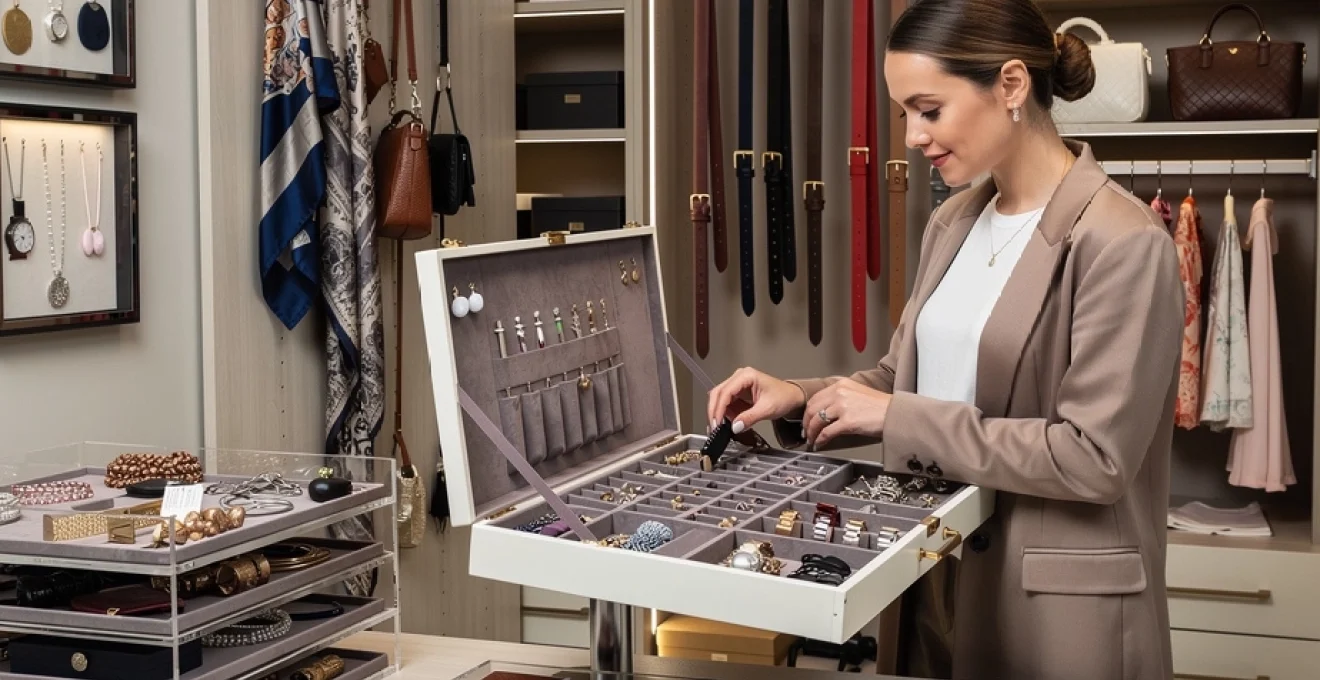
Accessories possess an extraordinary ability to transform any outfit from mundane to magnificent, yet their small size and delicate nature often make them challenging to manage effectively. Whether you own a modest collection of everyday pieces or an extensive array of statement jewellery, scarves, and bags, proper organisation extends beyond mere tidiness—it preserves the integrity of your investments whilst ensuring quick access during those rushed morning routines. The psychology of organisation reveals that systematically arranged possessions reduce decision fatigue and create a sense of calm control over your daily choices. Modern storage solutions have evolved dramatically, incorporating advanced materials and innovative designs that cater to diverse collection sizes and spatial constraints. Professional organisers consistently emphasise that effective accessory management requires understanding both the unique characteristics of different materials and the specific needs of your lifestyle.
Compartmentalised storage solutions for jewellery and small accessories
The foundation of effective accessory organisation lies in creating dedicated spaces for each type of item, preventing damage whilst maintaining visibility and accessibility. Modern compartmentalised storage systems have revolutionised how collectors approach their precious pieces, offering customisable solutions that adapt to growing collections.
Velvet-lined jewellery boxes with adjustable dividers
Premium velvet-lined storage represents the gold standard for protecting delicate jewellery pieces from scratches, tarnishing, and environmental damage. The soft texture of quality velvet creates a protective barrier that prevents metal-on-metal contact, whilst its anti-static properties naturally repel dust and lint. Adjustable dividers within these systems allow you to customise compartment sizes according to your specific collection, accommodating everything from petite stud earrings to substantial statement necklaces.
Investment-grade jewellery boxes typically feature multiple tiers with varying compartment configurations, enabling logical categorisation of pieces by type, frequency of use, or material composition. The sophisticated locking mechanisms found in higher-end models provide security for valuable pieces, whilst interior mirrors add functionality for quick styling decisions. Professional jewellers consistently recommend these storage solutions for collections valued above £500, as the protective benefits far outweigh the initial investment cost.
Acrylic drawer organisers with variable grid systems
Transparent acrylic organisers have gained tremendous popularity amongst modern accessory enthusiasts due to their versatility and visual clarity. These systems utilise modular grid configurations that can be reconfigured as your collection evolves, providing exceptional flexibility for diverse storage needs. The crystal-clear material allows instant identification of contents without disturbing surrounding pieces, significantly reducing handling and potential damage.
Variable grid systems excel in drawer applications where vertical space is limited but horizontal expansion is possible. The interlocking design of quality acrylic organisers prevents shifting during drawer movement, maintaining your carefully arranged displays. Interior designers frequently specify these solutions for clients seeking minimalist aesthetics, as the transparent nature creates an illusion of expanded space whilst maintaining impeccable organisation.
Wall-mounted display cases for rotating collections
Vertical storage solutions maximise spatial efficiency whilst transforming accessories into decorative elements that enhance your living space. Wall-mounted display cases with rotating mechanisms provide both storage and showcase functionality, allowing easy access to pieces whilst protecting them from environmental factors. These systems prove particularly valuable for frequently used items that benefit from immediate visibility and quick selection.
The rotation mechanism in premium display cases enables access to multiple storage layers without removing the entire unit from the wall. Security features such as locking fronts protect valuable pieces whilst maintaining the aesthetic appeal of an organised display. Contemporary storage specialists recommend positioning these units at eye level for optimal accessibility, typically 150-160cm from floor level for average-height users.
Stackable modular trays for expandable storage
Modular tray systems offer unparalleled scalability, allowing collectors to expand their storage capacity incrementally as their collections grow. These systems utilise precise engineering to ensure stable stacking whilst providing easy access to individual tiers. The modular approach proves especially valuable for collectors who frequently acquire new pieces or prefer seasonal rotation of their accessible inventory.
Premium stackable systems incorporate anti-slip bases and interlocking mechanisms that prevent accidental shifting or toppling. The ability to mix and match different tray configurations within a single stack creates customised storage solutions
to suit changing accessory categories, from ring grids to open sections for oversized bangles or sunglasses. This flexibility means you can align each tray with a specific function: one for fine jewellery, another for costume pieces, and a third for watches or brooches. When stacked inside drawers or on closet shelves, they create a compact, layered archive where every item has a defined “home”.
For maximum efficiency, label the underside or front edge of each modular tray so you can identify contents at a glance when the stack is tall. Many professional organisers suggest assigning the top tray to your most frequently worn accessories, with less commonly used items descending in order of importance. Over time, this hierarchy naturally guides your daily routines and prevents your collection from slipping back into chaos.
Systematic categorisation methods for fashion accessories
Once you have solid storage infrastructure in place, the next step is to develop systematic categorisation methods that make retrieval almost effortless. A structured classification system reduces decision fatigue and helps you see what you already own before purchasing something new. Interestingly, a 2023 survey by the National Association of Productivity and Organizing Professionals found that over 60% of respondents bought duplicate accessories simply because they could not locate existing items quickly enough.
Effective accessory organisation combines visual logic with lifestyle practicality. You are not just putting things away; you are building a framework that mirrors how you actually get dressed. The following categorisation strategies can be layered together or used independently, depending on the size of your wardrobe and the variety of your accessories.
Colour-coded classification systems
Colour coding remains one of the most intuitive ways to organise accessories, especially when you are a visual thinker. By grouping jewellery, belts, scarves, and handbags by colour families, you effectively create a physical mood board that simplifies outfit coordination. Imagine opening a drawer where all gold-toned jewellery gleams in one section while silver, rose gold, and coloured stones follow in clearly defined zones.
To implement a colour-coded system, start with broad categories such as neutrals, metallics, warm tones, and cool tones. Within each, you can further refine into specific shades if your collection is extensive. This approach works particularly well in open or transparent storage like acrylic jewellery organisers or glass-front cabinets, where the colour gradients become a design feature in their own right. You will notice that once items are grouped by shade, it becomes obvious which colours dominate and which tones you rarely wear—helpful insight for future purchases.
Frequency-based accessibility hierarchies
Have you ever found yourself wearing the same three accessories on repeat simply because they are the easiest to grab? Frequency-based organisation tackles this by deliberately assigning prime real estate to the items you reach for most often. In practice, that means everyday watches, simple hoops, and signature belts should live at eye level, in shallow drawers, or on open trays near your dressing area.
Less frequently used accessories—such as occasion clutches, statement necklaces, or seasonal scarves—can be stored slightly higher, deeper, or in less accessible compartments. Think of your storage like a well-planned city: the busiest “streets” need the clearest signage and easiest access, while quieter “neighbourhoods” can sit further out. By consciously ranking your accessories according to how often you wear them, you speed up your morning routine and avoid rummaging through rarely used items every time you get dressed.
Material-specific segregation techniques
From a preservation standpoint, grouping accessories by material is just as important as grouping them by style or colour. Different materials age and react in unique ways—leather can dry out, silk can snag, and certain metals can tarnish or cause chemical reactions when stored together. Material-specific segregation minimises these risks while making maintenance more straightforward.
For jewellery, separate sterling silver, gold, plated pieces, and costume jewellery into distinct compartments, preferably in fabric-lined trays. Keep pearls, opals, and other soft gemstones away from harder stones that could scratch them. Leather belts and handbags should be stored away from humid zones like bathrooms, ideally in breathable dust bags. Scarves can be divided into silk, wool, cashmere, and synthetic blends, with the most delicate fabrics placed in drawers or on padded hangers. This technique may seem meticulous, but it pays off through reduced repair costs and a noticeably longer lifespan for your favourite accessories.
Seasonal rotation methodologies
As with clothing, a seasonal rotation system for accessories can dramatically reduce visual noise and make your current choices more obvious. You would not keep heavy wool coats at the front of your wardrobe in midsummer, so why let thick scarves, fur-trimmed bags, or jewel-toned statement pieces crowd out your lighter, warm-weather options? By curating a smaller, seasonally relevant edit, you streamline daily dressing and highlight items you actually want to wear right now.
The simplest approach involves designating secondary storage—upper shelves, under-bed boxes, or the back of a wardrobe—for off-season accessories. Label containers clearly with “Spring/Summer” or “Autumn/Winter” and schedule a rotation twice a year. During each swap, take the opportunity to inspect items for damage, clean them, and decide whether they still align with your current style. Over a few cycles, you will find that this ritual keeps your accessories collection lean, intentional, and refreshingly up to date.
Climate-controlled preservation techniques for delicate items
Delicate accessories such as fine jewellery, vintage handbags, silk scarves, and heirloom pieces require more than simple organisation—they need thoughtful environmental control. Fluctuations in temperature and humidity can accelerate tarnish, cause leather to crack, and weaken delicate threads or adhesives. Conservation specialists generally recommend storing sensitive items in environments kept between 18–22°C with relative humidity around 40–50%, conditions that significantly slow deterioration.
At home, you may not have museum-grade climate control, but you can approximate stable conditions with a few practical strategies. Avoid storing accessories in attics, basements, or bathrooms where temperature and moisture levels vary dramatically. Consider using silica gel packets or rechargeable dehumidifiers in closed cabinets and jewellery drawers to combat excess humidity. For silver jewellery or cutlery, anti-tarnish strips and treated fabrics can reduce polishing frequency by up to 80%, according to data from several conservation supply companies.
Light exposure is another critical factor. Prolonged contact with direct sunlight can fade dyed leather, discolour fabrics, and dry out organic materials. Where possible, keep display pieces behind UV-filtering glass or position them away from strong windows. For particularly precious or sentimental accessories, double-layer protection—a soft fabric pouch within a sturdy box—creates a microclimate that shields against dust, pollutants, and minor knocks. Think of these protective layers like a tailored overcoat for your accessories: they do not change the item itself, but they dramatically change how well it withstands the elements.
Digital inventory management systems for accessory collections
As collections grow in size and value, keeping a mental inventory of every accessory becomes increasingly unrealistic. Digital inventory management bridges this gap by giving you a searchable, visual record of what you own and where it is stored. This approach is particularly useful if you rotate items seasonally, store some pieces off-site, or simply want to plan outfits without standing in front of your wardrobe for half an hour.
Modern tools range from simple spreadsheet templates to sophisticated wardrobe apps that integrate with your smartphone camera. Many professional stylists now rely on digital catalogues to track client wardrobes, ensuring that each new purchase complements existing pieces rather than duplicating them. For you, the benefits are similar: easier insurance documentation, faster decision-making, and the satisfying realisation that you are actually using more of what you already own.
Cataloguing applications with visual recognition technology
Wardrobe and accessory apps using visual recognition technology have advanced rapidly in recent years. These tools allow you to photograph your jewellery, bags, scarves, and belts, then automatically tag or suggest categories based on shape, colour, or type. While manual refinement is still necessary, visual recognition significantly speeds up the cataloguing process compared with building a database from scratch.
Once your accessories are uploaded, you can create virtual “collections” for workwear, travel, special occasions, or specific seasons. Some apps even offer outfit suggestions, pairing your bags and jewellery with existing clothing items to help you rediscover forgotten pieces. It is like having a digital stylist who remembers every item you have ever bought, without the bias of always reaching for the same favourites.
Barcode and QR code tracking implementation
For larger or high-value accessory collections, barcode or QR code tracking adds another layer of precision. This system mirrors what you might find in a professional archive or boutique, but scaled down for home use. Each storage box, dust bag, or shelf section is assigned a unique code, which you can scan using your phone to pull up associated information: contents, photos, purchase details, and maintenance notes.
Implementing QR codes is surprisingly simple: free online generators let you create scannable labels that link to a cloud-based document or entry in your inventory app. When you store a piece—say, a vintage leather handbag—you attach the code to its dust bag or storage container. Need to know where that bag is six months later? One quick scan, and the location appears instantly. This method is particularly helpful if you store accessories across multiple rooms, a secondary residence, or even a safe deposit box.
Cloud-based storage documentation platforms
Cloud-based platforms ensure that your accessory inventory is accessible from any device, at any time. Whether you prefer dedicated wardrobe apps, general note-taking tools, or spreadsheet software, the key is to centralise your data so updates sync automatically. This prevents the all-too-common problem of multiple, conflicting lists living on different devices or scraps of paper.
In your documentation, consider tracking more than just the basics. Alongside photos and locations, record purchase dates, approximate values, materials, repair history, and care instructions. Over time, this forms a detailed provenance record that can be invaluable for insurance claims, resale decisions, or simply understanding which brands and materials have offered the best longevity. In effect, you are turning your accessories collection into a curated archive, not just a pile of pretty things.
Space-efficient vertical storage architectures
When floor space is limited—as it increasingly is in modern homes—vertical storage becomes your most powerful ally. By thinking upwards rather than outwards, you can create high-capacity accessory storage without encroaching on living areas. Wall-mounted rails, pegboards, slimline cabinets, and over-door organisers all transform unused vertical surfaces into practical display zones.
A common strategy involves installing a shallow, floor-to-ceiling cabinet with a combination of hooks, narrow shelves, and pull-out panels designed specifically for accessories. Necklaces can hang freely to avoid tangling, belts can loop over horizontal rods, and handbags can sit on individual shelves with clear dividers to maintain their shape. Because the unit is shallow, it occupies minimal floorspace while still offering a comprehensive overview of your collection at a glance.
Interior architects often recommend aligning vertical accessory storage with your natural dressing “route”. For example, a slim rack of scarves and hats near the front door helps with last-minute styling before you leave the house, while a wall-mounted jewellery panel inside your wardrobe door streamlines outfit completion in the bedroom. By placing each vertical storage solution exactly where you need it, you reduce backtracking and create a more intuitive dressing flow—much like arranging a kitchen so your most-used tools are within easy reach of your primary workspace.
Professional-grade conservation materials and anti-tarnish solutions
The final refinement in organising and storing accessories lies in the materials you choose to line, cushion, and protect them. Professional-grade conservation products, long used by museums and archives, are increasingly accessible to home users. These include acid-free tissue paper, lignin-free storage boxes, inert plastics, and speciality fabrics that slow down tarnish and corrosion. While they may cost slightly more than everyday alternatives, they offer superior long-term protection for valuable or sentimental items.
For metal jewellery, anti-tarnish strips and cloths impregnated with corrosion inhibitors can be placed inside drawers, boxes, or display cases. Many users report that with consistent use, polishing frequency drops dramatically, preserving delicate surface details that might otherwise be worn down. When wrapping delicate pieces, choose unbuffered, acid-free tissue rather than coloured or recycled paper, which can transfer dyes or acids over time. Similarly, avoid PVC plastics, which can off-gas harmful chemicals; instead, look for polypropylene or polyester sleeves and compartments clearly marked as archival-safe.
Leather accessories benefit from breathable, natural-fibre dust bags—cotton or calico are ideal—paired with occasional conditioning using pH-balanced products recommended by leather specialists. Silk scarves and other fine textiles should lie flat or be gently rolled with interleaving sheets of acid-free tissue to prevent creasing and colour transfer. Think of these conservation materials as the “skincare routine” for your accessories: invisible to most people, perhaps, but crucial for maintaining a supple, luminous appearance over many years. By combining thoughtful organisation with professional-grade protection, you create a storage system that not only looks refined today but also safeguards your favourite pieces for the future.