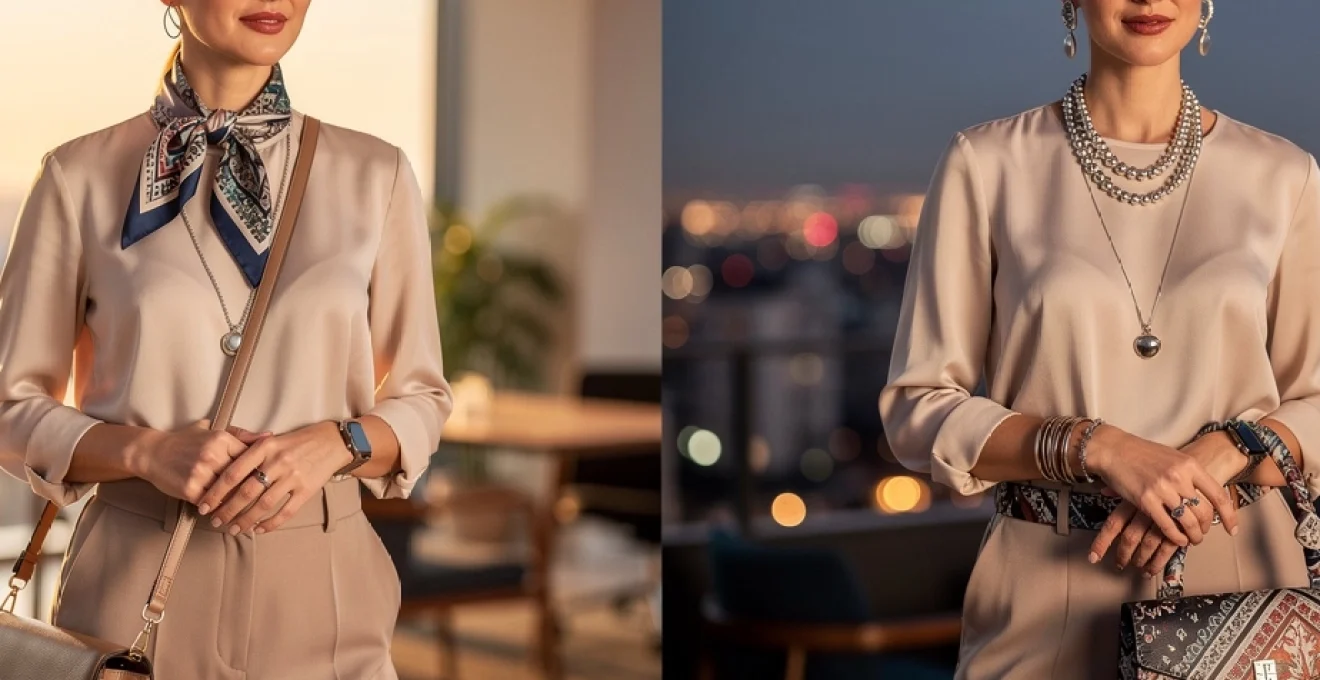
The modern professional navigates a world where the boundaries between work and social life blur constantly. One moment requires boardroom polish, the next calls for cocktail sophistication. Yet carrying multiple outfits isn’t practical, and dashing home between commitments wastes precious time. The solution lies in mastering the art of accessory transformation—a skill that turns a single outfit into multiple looks through strategic, intelligent styling choices.
Accessories possess remarkable transformative power. While your base garment remains constant, the right jewellery, handbag, or scarf can completely redefine your aesthetic. This approach isn’t about carrying excessive items; it’s about selecting versatile pieces designed for multiple configurations. From convertible necklaces to bags with detachable components, today’s accessory market offers sophisticated solutions for the time-pressed professional who refuses to compromise on style.
Strategic jewellery selection: convertible pieces for seamless Day-to-Evening transitions
Jewellery serves as the cornerstone of any effective day-to-night transformation strategy. Unlike clothing, accessories occupy minimal space yet deliver maximum visual impact. The secret lies in selecting pieces with inherent versatility—designs that function beautifully in professional settings whilst possessing the capability to elevate evening looks through simple modifications.
Contemporary jewellery designers have responded to this demand with increasingly sophisticated convertible pieces. These aren’t gimmicky novelties but genuinely thoughtful designs that respect both aesthetics and functionality. The market now offers jewellery that adapts as seamlessly as you move through your day, eliminating the need to carry separate collections for different occasions.
Reversible pendant necklaces: Dual-Finish designs from monica vinader and missoma
Reversible pendants represent one of the most elegant solutions for jewellery transitions. Brands like Monica Vinader and Missoma have perfected this concept, creating pendants with contrasting finishes on each side. One surface typically features a polished, understated finish suitable for professional environments, whilst the reverse showcases more dramatic elements—gemstone settings, textured metalwork, or bolder engravings.
The beauty of reversible pendants lies in their discretion. During business hours, you wear the subtle side facing forward, maintaining an appropriately refined appearance. When evening arrives, a simple flip reveals the statement side, instantly transforming your necklace from background elegance to focal point. This transformation takes seconds but creates the impression of a completely different piece. The dual-finish approach also offers excellent value, essentially providing two necklaces in one investment.
When selecting reversible pendants, consider the chain length carefully. Mid-length chains (approximately 45-50cm) offer the greatest versatility, sitting appropriately for both buttoned blouses and lower necklines. Material selection matters too—18-carat gold vermeil or sterling silver provides sufficient weight for the pendant to hang correctly whilst remaining comfortable for all-day wear.
Modular hoop earrings: detachable charm systems and jacket configurations
Modular hoop earrings have revolutionised convertible jewellery design. These ingenious pieces feature a base hoop with attachment points for removable charms, drops, or « jackets » that transform the earring’s profile. During daytime hours, you wear the simple hoop alone—sleek, professional, and unobtrusive. For evening transitions, you attach the additional elements, creating dramatic earrings that command attention.
The attachment mechanisms have become impressively sophisticated. Most systems use either hinged clips or magnetic connections, both allowing for quick, secure attachment without requiring mirrors or significant dexterity. You can transform your earrings discreetly in a taxi or restaurant powder room within moments. Some designs offer multiple charm options, providing varied evening looks from a single base pair of hoops.
Hoop diameter selection influences versatility significantly. Medium hoops (approximately 20-30mm diameter) work beautifully for professional settings whilst providing adequate structure for evening embellishments. Smaller hoops limit your transformation options, whilst oversized hoops may prove too casual or dramatic for certain workplace environments, regardless of whether you’ve added evening elements.
<h3
Layering techniques: transitioning from single-chain minimalism to multi-strand statement looks
Layering necklaces is one of the most efficient day-to-night accessories strategies because it allows you to build impact gradually. During office hours, a single fine chain with a discreet pendant keeps your neckline clean and professional, complementing blazers, shirts, and high-neck knitwear. As your schedule shifts into social mode, you can introduce additional strands of varying lengths and textures to create a more expressive, personality-driven look. The transformation feels intentional rather than abrupt, which is key when your day-to-night outfit needs to appear curated rather than improvised.
To make layering work in real life (and not just on Pinterest), focus on proportion and spacing. Start with a short base chain at 40–45cm, then add a mid-length piece around 50–55cm, and finish with a longer pendant or lariat at 60–70cm. This staggered approach prevents tangling and ensures each necklace is visible in its own right. Mixing chain styles—such as a fine cable chain, a slightly heavier curb chain, and a delicate snake chain—adds subtle depth without overwhelming the outfit. Think of it as adjusting the volume on your look rather than changing the entire song.
For a sleek day-to-night accessories capsule, look for sets specifically designed to be layered. Many contemporary brands now offer pre-curated layering trios with adjustable extenders, allowing you to fine-tune lengths based on necklines. These extenders are invaluable when you move from a buttoned-up work shirt to a lower-cut evening top and want your focal pendant to sit just right. If you tend to wear printed or textured clothing in the evening, keep your layered jewellery in the same metal family, so the overall effect remains harmonious rather than busy.
Worried about tangling as you move through a long day? Several jewellery houses have introduced connectors that link chains together at the clasp, creating a single, more stable closure. This small piece of hardware can dramatically reduce twisting, making your multi-strand statement necklace as practical as it is glamorous. Keep your additional chains in a slim pouch in your work bag; adding two pieces before stepping into a bar or restaurant takes less than a minute but visually signals a clear shift from daytime minimalism to evening confidence.
Cuff-to-bracelet transformations: adjustable width mechanisms in contemporary metalwork
Cuffs and bracelets offer another powerful route to effective day-to-night accessories without adding bulk to your bag. Modern metalwork has moved far beyond rigid bangles, embracing adjustable mechanisms that allow a single piece to shift from streamlined cuff to more dramatic, stacked effect. During the day, you might wear a slim, close-fitting cuff that sits quietly under a blazer sleeve. As you transition into the evening, you can widen or reposition that same piece, or attach complementary segments, to create a bolder wrist presence that reads more like jewellery and less like a discreet accent.
Look for designs that incorporate hinge systems, sliding bars, or flexible metal cores. These allow the bracelet’s profile to expand or contract, adapting both to your wrist size and to your styling intent. Some contemporary designers offer modular cuffs composed of interlocking segments: you wear a single band for a clean daytime look, then snap on additional segments to create a layered metal cuff for night. This approach mimics the look of multiple bangles while keeping the comfort and simplicity of one unified piece.
Material choice matters here as well. Brushed or satin-finish metals tend to feel more work-appropriate, particularly in conservative office environments, whereas highly polished or hammered finishes catch the light beautifully in low-lit evening spaces. Choosing a cuff that combines these finishes—matte on one side, polished on the other—lets you rotate the piece to suit the setting, much like a reversible pendant. If you have a smartwatch or a substantial timepiece on one wrist, position your adjustable cuff on the opposite arm to maintain balance rather than visual clutter.
For those concerned about comfort during long days, prioritise cuffs with slightly rounded inner edges and small flexibility. Rigid designs can dig into the skin as you type or commute, undermining the appeal of day-to-night accessories. Adjustable-width mechanisms not only transform the look but also allow you to loosen the bracelet after hours, when you’re less likely to be desk-bound and more likely to gesture, dance, or simply relax. The goal is seamless transformation: the piece should never remind you it’s there, even as it subtly announces your shift from business to after-dark elegance.
Functional handbag architecture: crossbody-to-clutch conversion systems
Handbags are the quiet workhorses of day-to-night accessories. While jewellery tends to steal the spotlight, the right bag architecture does the heavy lifting—both literally and stylistically. A well-designed crossbody-to-clutch bag moves with you from commute to cocktails, adapting its silhouette, strap configuration, and even capacity to match the moment. Instead of changing bags entirely (and risking forgotten essentials), you simply reconfigure hardware, tuck away straps, or extract interior components to reveal a sleeker evening-ready profile.
In an era where hybrid working and flexible schedules are the norm, this level of adaptability is more than a luxury; it’s a practical necessity. You might start the day hands-free, navigating public transport or meetings with a laptop in tow, then want something compact and elegant for an impromptu dinner. Think of functional handbag architecture as the engineering backbone of your day-to-night outfit strategy. When the form and function are thoughtfully resolved, the transformation from office to evening feels almost invisible—but the style impact is anything but.
Detachable strap mechanisms: mulberry’s bayswater and strathberry’s multrees collection
Detachable straps are the most obvious—and arguably most important—feature in crossbody-to-clutch conversion systems. Brands such as Mulberry and Strathberry have led the way with designs where straps clip on and off via discreet metal rings or concealed loops. During the day, you can wear the bag as a crossbody or shoulder bag, keeping your hands free and your posture balanced. When evening plans emerge, unclipping the strap turns the same piece into a polished clutch that works seamlessly with tailored dresses, structured blazers, or elevated denim.
The Mulberry Bayswater, for example, showcases how classic silhouettes can be reimagined through intelligent hardware placement. Some iterations feature a removable long strap in addition to top handles, so you can progress from satchel-style carry to underarm clutch with a few swift movements. Strathberry’s Multrees collection similarly offers elongated chain or leather straps that detach cleanly, leaving behind a refined, minimal body. Because the strap attachments are integrated into the overall design rather than added as an afterthought, the bag looks intentional in every configuration.
When assessing detachable strap mechanisms, pay attention to both aesthetics and ergonomics. Are the clasps robust enough for daily use, yet small enough not to overwhelm the bag’s proportions? Do the attachment points sit in positions that balance the bag close to your body, or does it tip awkwardly when worn crossbody? These details matter when you’re relying on one piece to carry you from boardroom to bistro. Consider also the strap material: a wide leather strap may feel more comfortable and professional for daytime wear, while a slimmer chain or leather strap can be kept in your bag as an instant evening upgrade.
Interior pouches and removable compartments: creating standalone evening bags
One of the cleverest developments in handbag design is the rise of removable interior pouches that double as standalone clutch bags. During the day, these compartments organise your essentials—phone, keys, cards, lipstick—within a larger tote or structured work bag. When your schedule shifts into social mode, you can simply lift out the pouch, detach any slim wristlet or chain provided, and you have an immediate evening bag containing everything you need. This strategy is ideal if you prefer a larger carry-all during working hours but want a lighter, more refined option after dark.
Designers are increasingly paying attention to the aesthetics of these interior components, treating them as fully fledged accessories in their own right. Instead of plain nylon inserts, you’ll find leather, faux leather, or textured fabric pouches with elegant hardware and considered silhouettes. Some even include card slots and subtle branding, ensuring that when they are used independently, they still look intentional and polished. For minimalists, a neutral pouch that harmonises with several of your main daytime bags can serve as a universal day-to-night bridge.
When choosing a bag with removable compartments, test how easily the insert can be extracted without disturbing the rest of your belongings. You don’t want to be reorganising your entire bag at 6pm in a crowded lobby. Ideally, your pouch should slide out smoothly and close securely with a zip or magnetic fastening. Look for subtle loops or D-rings that allow you to attach a wrist strap or fine chain; this small detail turns a functional organiser into a versatile clutch or mini-crossbody, further enhancing your day-to-night accessories toolkit.
Chain-length adjustment features: sliding hardware and reconfigurable carry options
Chain-length adjustment is an often-overlooked feature that dramatically increases a handbag’s versatility. Sliding hardware, multiple anchor points, and clever threading systems all allow a single chain to serve as crossbody, shoulder strap, or doubled-up handle. During the day, you may prefer a longer crossbody length for comfort and practicality. As evening approaches, shortening the chain to sit higher on the shoulder, or doubling it to create a hand-held or underarm carry, immediately shifts the bag’s visual language from functional to refined.
Some of the most effective systems borrow cues from jewellery design. Sliding beads or adjustable stoppers allow you to fine-tune strap length in centimetre increments, so the bag sits exactly where you want it against different hemlines and outerwear. Re-threading chains through additional grommets or rings can transform the silhouette further, creating a top-handle effect or even a backpack configuration for travel-heavy days. This modular approach echoes the logic behind convertible necklaces and bracelets: small hardware changes produce outsized style impact.
When evaluating chain-length features, consider both your height and your wardrobe. Petite frames often benefit from more granular adjustability, preventing the bag from hanging too low and disrupting the line of a dress or coat. Taller wearers, conversely, may need longer maximum lengths than many standard straps provide. A well-designed adjustable chain successfully bridges these differences, making the bag truly inclusive and adaptable. For maximum flexibility, seek pieces that combine a section of chain with a leather shoulder panel—this hybrid construction balances comfort, durability, and aesthetic polish across your day-to-night outfits.
Two-in-one structural designs: fold-over flaps and hidden magnetic closures
Structural transformation is the most visually dramatic form of handbag adaptability. Fold-over flaps, hidden magnetic closures, and collapsible gussets enable a bag to change shape and scale, much like a tailored blazer that can be worn open and relaxed or cinched and sharp. During the day, you might carry the bag fully extended to maximise capacity for notebooks, chargers, and cosmetic cases. For evening engagements, folding the top section over and securing it with concealed magnets or snaps creates a slimmer, clutch-like profile that sits neatly under the arm.
This two-in-one approach is particularly effective with soft yet structured leathers and high-quality faux leathers that retain their shape without feeling rigid. Designers often emphasise the transformation with contrasting textures or subtle seam lines, so the folded-over version looks intentional rather than improvised. Hidden magnets keep the new silhouette secure while preserving clean lines—no visible buckles or ties to disrupt the evening-appropriate aesthetic. The result is a piece that feels almost like two bags in one, perfectly aligned with the philosophy of thoughtful day-to-night accessories.
As with all convertible designs, testing is crucial. Before committing to a fold-over style, experiment with how the bag behaves when partially filled versus fully loaded. Does it fold cleanly, or does it bulge awkwardly? Are the magnetic closures strong enough to remain secure as you move through a busy commute or a crowded bar? These practicalities will determine whether your two-in-one bag truly supports your lifestyle or becomes an occasional novelty. Prioritise options where both configurations look equally refined; you shouldn’t have to sacrifice polish in one mode to achieve versatility in another.
Transformative scarf styling: multi-wear textile accessories for professional-to-social settings
Scarves are among the most underrated day-to-night accessories, often associated with practicality rather than polish. Yet a well-chosen silk or lightweight wool scarf can perform multiple style functions in a single day: neckwear for morning commutes, a soft layer against office air conditioning, a headwrap or belt for evening, even an impromptu cover-up over bare shoulders. Because scarves add colour, pattern, and texture without altering the structure of your outfit, they’re an ideal tool for transforming a neutral base into something far more expressive after hours.
The key is opting for fabrics and dimensions that invite experimentation. A classic 90x90cm silk square, a long rectangular stole, or a narrow printed twilly each offer distinct styling possibilities. Think of scarves as your wardrobe’s “filters”: you can dial the formality, femininity, or drama of an outfit up or down simply by changing how you fold, knot, or drape them. As workplace dress codes relax and hybrid schedules proliferate, mastering a few versatile scarf techniques ensures your day-to-night looks remain cohesive yet never boring.
Silk square configurations: hermès carré techniques from necktie to headwrap
The iconic Hermès Carré has long demonstrated the transformative power of a square silk scarf. While you don’t need a designer label to use these techniques, the underlying principles of folding and tying remain invaluable. During the day, a simple bias-folded silk square worn as a neat necktie or ascot lends polish to a blazer, knit, or shirt. The effect is subtle, professional, and comfortable, adding a touch of colour near the face without competing with jewellery or bold patterns.
As your schedule pivots to evening, that same square can become a chic headwrap, a softly draped halter-style accent over a camisole, or a shoulder-skimming bandanna tied at the nape of the neck. These configurations instantly relax the overall mood of your outfit, signalling a shift from structured professionalism to off-duty ease. Because silk catches the light beautifully, particularly in candlelit or low-lit environments, even a small amount of fabric can create a sense of luxury and occasion. It’s a textbook example of how day-to-night accessories can amplify impact without adding weight.
To make the most of a silk square, practice a few core folds in advance so you’re not improvising in a washroom mirror at 6:30pm. You might find it helpful to save reference images or short videos on your phone, especially for more intricate headwrap styles. When choosing prints, consider your existing wardrobe: a scarf that picks up one or two tones from your most-worn blouses or dresses will work harder for you than a statement print that clashes with everything. Over time, a small rotation of well-curated silk squares can dramatically expand your styling options without demanding new clothing purchases.
Belt-loop integration: converting printed scarves into waist-defining accessories
Using scarves as belts is a clever way to shape your silhouette and add visual interest without the rigidity of traditional leather belts. For daytime, threading a slim silk or cotton scarf through belt loops on tailored trousers or high-waisted skirts creates a subtle, textural accent that remains office-appropriate. The effect is softer than a standard belt, especially when you tuck the ends neatly or tie a small, off-centre knot. This can be particularly flattering over simple shirt dresses or shift dresses that benefit from a hint of waist definition.
In the evening, you can exaggerate this concept to create more impact. Loosen the knot, allow the ends to drape longer, or tie the scarf over a blazer or coat instead of through loops, transforming it into a waist sash. This approach immediately changes the proportions of your outfit, drawing the eye inward and creating a more dramatic, fashion-forward line. If you’re working with a monochrome base—say, an all-black or all-cream look—a printed scarf belt introduces just enough pattern and colour to prevent the ensemble from feeling flat, while still reading as chic and cohesive.
From a practical standpoint, scarves-as-belts also earn their place in your day-to-night accessories rotation because they pack down to almost nothing. You can fold a second, more statement-making print into your bag and swap it out before heading to a bar or dinner. As always, consider texture against the fabric of your outfit: lightweight silk glides easily through belt loops on tailored pieces, while slightly grippier fabrics like modal or fine wool work better over knitwear, preventing slippage as you move.
Handle embellishments: bag-wrap applications for instant luxury upgrades
Wrapping bag handles with narrow scarves or twillies is a styling trick borrowed from the luxury world that translates beautifully into everyday wardrobes. During the day, a discreet, tone-on-tone wrap can protect light-coloured leather from makeup, hand cream, and daily wear while adding a subtle point of interest. The effect is quiet but intentional—your bag looks cared for and customised, echoing the personalisation trend that continues to shape accessory design.
As evening approaches, swapping a neutral wrap for a bolder printed scarf instantly elevates the bag’s personality. The same structured tote or top-handle bag that felt corporate at 10am can feel playful and fashion-forward at 8pm, thanks purely to its updated handle detailing. This is especially powerful if you’re working with a minimal bag silhouette in black, tan, or cream; bright or patterned wraps introduce a dynamic contrast that reads as deliberate styling rather than last-minute improvisation.
To keep this technique functional, choose narrow scarves designed specifically for wrapping, or fold a standard square into a slim band. Begin at the base of the handle, wrapping tightly and overlapping slightly as you work towards the opposite end, then secure with a discreet knot or tuck. If you often transition between multiple bags in a week, you can dedicate one or two twillies to each, building a mini “wardrobe” of handle embellishments that sync with your broader day-to-night accessories strategy.
Optical eyewear transitions: photochromic lenses and frame-swapping technologies
Eyewear sits at the intersection of function and fashion, making it a critical yet often underutilised component of day-to-night accessories. For many professionals, glasses are non-negotiable, but that doesn’t mean they need to look purely utilitarian. Advances in lens technology and frame design now allow a single pair (or system) to adapt to changing environments, from bright commute to dimly lit restaurant, without sacrificing visual clarity or personal style. The right choices can subtly shift your look from focused and professional to relaxed and social in seconds.
Photochromic lenses—those that darken in response to UV exposure—remain one of the most practical solutions for people who wear prescription eyewear. During the day, particularly if you’re moving between office and outdoor meetings, these lenses provide sun protection without requiring a separate pair of sunglasses. As light levels drop in the evening, the tint fades, revealing clear lenses better suited to indoor spaces. Modern formulations have improved dramatically in recent years, offering faster transitions and more nuanced tints that look closer to designer sunglasses than medical devices.
For those who prefer a more distinctly aesthetic shift between day and night, frame-swapping systems present an appealing alternative. These involve a base set of lenses and hinges onto which you can clip or slide different front pieces or outer frames. Imagine wearing a classic tortoiseshell or thin metal frame in the office, then switching to a bolder, more sculptural outer frame for an after-hours event. The process typically takes less than a minute and can be done without tools, making it a genuinely practical addition to your day-to-night accessories repertoire.
When exploring optical transitions, consider how your eyewear interacts with other elements of your look—particularly jewellery and makeup. A bold evening frame might reduce the need for statement earrings or heavy eye makeup, while a minimal daytime frame can be complemented with more expressive accessories without overwhelming your features. It’s helpful to think of glasses as part of your overall styling architecture rather than a separate, purely functional item. As eyewear continues to be recognised as a key style category, investing in one or two transformative options can deliver an outsized impact on your daily outfits.
Timepiece versatility: interchangeable watch straps for occasion-appropriate wrist presence
Watches occupy a unique place within the universe of day-to-night accessories: part jewellery, part tool, part quiet status symbol. Even as smartwatches gain ground, traditional timepieces remain central to many professionals’ style identities. The good news is that you no longer need separate watches for each context. Interchangeable strap systems allow a single watch head to move effortlessly between NATO, leather, metal, and rubber straps, recalibrating its character to suit your schedule. Think of the watch case as your constant and the strap as the outfit change.
This modularity is more than a trend; it responds directly to contemporary lifestyles where you might move from office to gym to dinner without passing through home. By carrying one or two extra straps in a slim case, you can adjust your watch from utilitarian to elegant in moments. Crucially, many modern systems are designed for tool-free use, so you’re not reliant on a jeweller or repair kit to implement these changes. Once you’re familiar with your watch’s mechanism, swapping straps can take less time than changing a pair of earrings.
Quick-release spring bar systems: NATO to leather strap conversions
Quick-release spring bars have transformed what used to be a fiddly, technical process into something accessible and user-friendly. These bars incorporate small built-in levers that you can operate with a fingernail, instantly detaching one strap and reattaching another. This is particularly useful when alternating between NATO straps—often made from nylon or fabric—and more formal leather options. During the day, especially on casual Fridays or in creative workplaces, a NATO strap reads relaxed, functional, and slightly sporty. For evening engagements, a smooth leather strap immediately sharpens the watch’s profile, aligning it with tailored clothing and dress shoes.
From a comfort perspective, NATO straps are hard to beat for busy days involving travel or variable weather; they’re breathable, adjustable, and easy to clean. However, they can sometimes feel too informal for high-level client dinners or theatre outings. That’s where a quick leather conversion comes into its own, transforming the same watch case into something more akin to classic dress wear. You effectively own one watch that behaves like two or three, depending on your strap rotation.
When building a small strap collection, it’s worth investing first in a high-quality black or dark brown leather strap, then adding one or two NATO options in neutral or muted tones. This ensures you always have at least one combination that feels unequivocally evening-appropriate, alongside more easy-going daytime choices. As with all day-to-night accessories, the aim is to maximise versatility without compromising polish in any single context.
Metal bracelet-to-rubber strap transitions: cartier santos and omega seamaster adaptability
At the higher end of the market, luxury watchmakers like Cartier and Omega have embraced strap interchangeability as a core design feature. Models such as the Cartier Santos and Omega Seamaster often ship with both metal bracelet and rubber strap options, plus integrated quick-change systems. The metal bracelet, with its polished and brushed links, naturally leans towards boardroom elegance and formal events. In contrast, the rubber strap introduces a sporty, contemporary energy better suited to travel days, weekends, or particularly dynamic work environments.
For day-to-night transitions, this duality allows you to play with contrasts. You might wear the rubber strap for a day of site visits, presentations, or commuting in changeable weather, appreciating its durability and comfort. Before an evening engagement, a swift switch to the metal bracelet instantly elevates the watch, catching the light and aligning with cufflinks, jewellery, or metallic accents on your bag and shoes. The watch becomes a bridge between practicality and luxury—precisely what effective day-to-night accessories should achieve.
While these systems are often associated with higher price points, the principle filters down across many brands and price ranges. Whether you’re working with a heritage Swiss piece or a well-made microbrand watch, investigate strap options and compatibility. A single rubber or metal addition can dramatically expand your styling possibilities, ensuring your watch never feels out of place, regardless of how your day unfolds.
Dial reflectivity and finish selection: matte workday versus polished evening aesthetics
Dial design might not be the first element you consider when thinking about day-to-night accessories, but it plays a subtle yet significant role. Matte or lightly textured dials tend to minimise glare under bright office lighting, making them practical for long workdays spent at a desk or in meetings. These finishes also project a quiet, understated sophistication—ideal in environments where overly flashy accessories could feel inappropriate. In contrast, sunburst or highly polished dials come alive in softer, evening lighting, reflecting ambient glow and adding a touch of drama to wrist movements.
If you’re selecting a single watch to serve both contexts, look for a dial finish that sits comfortably between these extremes. A gentle sunray pattern, for instance, will catch the light without producing harsh reflections, offering a pragmatic balance between legibility and visual interest. Dial colour also influences versatility: neutrals like black, white, navy, or champagne integrate seamlessly into most wardrobes, while more saturated or unconventional tones (forest green, burgundy, deep blue) can double as subtle statement pieces after dark.
Indices and complications add further nuance. Clean baton markers and minimal complications feel crisp and professional, while applied indices, Roman numerals, or open-heart elements introduce a more luxurious, evening-friendly character. The key is cohesion: your watch should feel like a natural extension of both your work attire and your social looks. When dial design, case shape, and strap modularity align, your timepiece becomes one of the most powerful and enduring components of your day-to-night style strategy.
Hosiery and legwear strategies: opacity transitions and embellishment timing
Hosiery may seem like a small detail, but in the context of day-to-night accessories, it can have a surprisingly large impact on how polished or playful your outfit appears. During office hours, many professionals gravitate towards matte, semi-opaque tights in neutral tones—black, charcoal, navy, or sheer nude—because they create a smooth, cohesive line and pair easily with structured footwear. These choices keep the focus on tailoring and silhouette, aligning with most workplace dress codes while offering warmth and coverage.
As the day shifts into evening, however, legwear becomes a powerful tool for adding texture, pattern, or subtle shine. Swapping semi-opaque tights for sheer black, back-seam styles, or delicate micro-patterns (dots, herringbone, fine fishnet) can instantly increase the sense of occasion without requiring a change of dress or skirt. This is particularly effective if your base outfit is simple—think black shift dress, pencil skirt, or tailored shorts suit—because the hosiery provides visual interest where clothing remains streamlined.
Opacity timing is crucial. In highly formal or conservative offices, sheer or patterned styles may feel out of place during the day but become entirely appropriate after dark. One pragmatic approach is to carry a second pair of tights or hold-ups in your work bag, changing them just before your evening engagement. Like switching from a work tote to an evening clutch, this small adjustment communicates a shift in context and intention. To minimise the risk of snags or discomfort, opt for higher denier (thicker) versions of more intricate patterns, ensuring durability through long evenings that might include standing, commuting, or dancing.
Embellishments—think subtle shimmer, lace tops, or strategically placed motifs—are best reserved for post-6pm wear. They can catch the light in a way that feels delightful in a bar or restaurant but potentially distracting under harsh office fluorescents. If you anticipate a particularly long day with little time for full outfit changes, lean on legwear that straddles the line: semi-sheer black tights with a barely-there micro-dot, for example, can read professional at a distance but reveal more personality up close. As with all smart day-to-night accessories, the goal is flexibility. By curating a small selection of well-chosen hosiery options, you gain another subtle but effective lever for transforming your look, proving that even the most functional wardrobe elements can contribute to effortless, around-the-clock style.