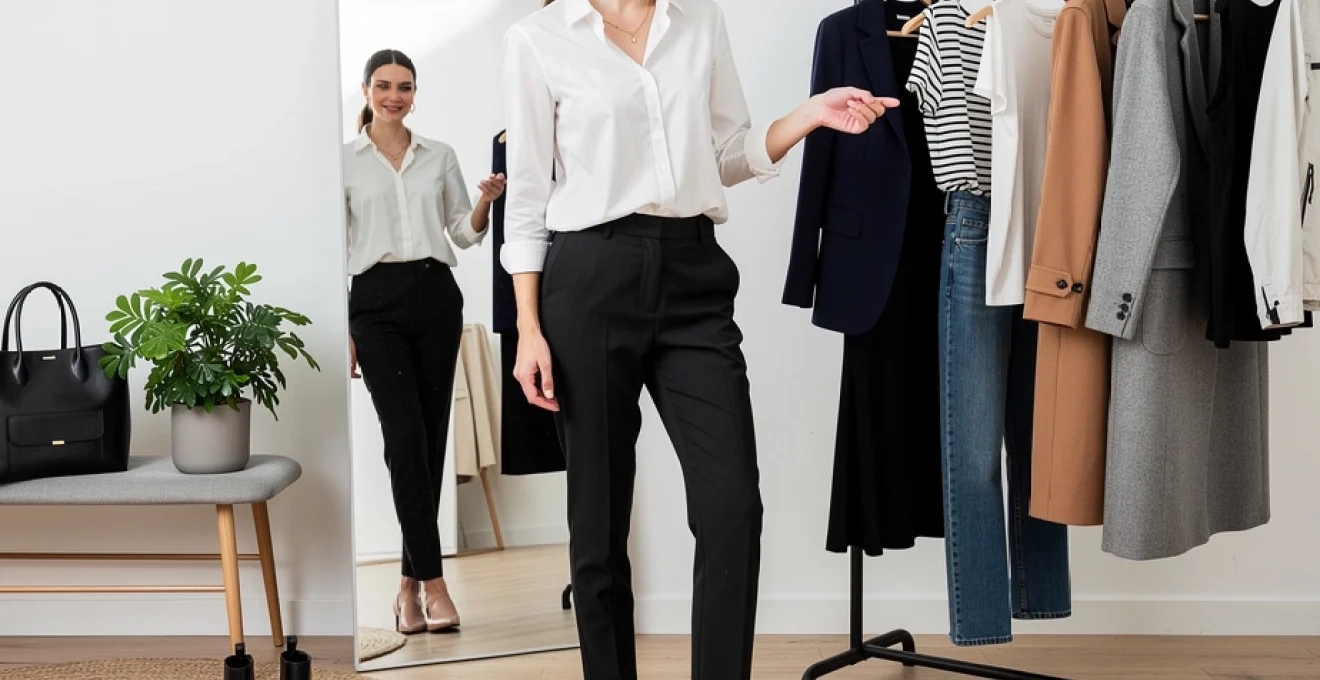
The fashion industry generates over £2.5 trillion annually, yet countless individuals find themselves overwhelmed by overflowing wardrobes filled with unworn garments. This paradox reveals a fundamental truth about modern consumption: more clothes don’t necessarily equate to better style or increased confidence. The minimalist wardrobe movement challenges conventional fashion wisdom by demonstrating that strategic curation can deliver far greater impact than mindless accumulation.
Contemporary fashion psychology research indicates that decision fatigue from extensive clothing choices can negatively affect daily performance and mental wellbeing. Industry leaders from tech entrepreneurs to fashion editors have embraced minimalist approaches, discovering that thoughtfully selected pieces can create exponentially more outfit combinations than randomly accumulated items. The mathematics of minimalist wardrobes reveals a compelling truth: thirty carefully chosen pieces can generate over 1,000 unique outfit permutations when strategically coordinated.
This shift towards conscious consumption represents more than aesthetic preference—it embodies a sophisticated understanding of personal branding, sustainable practices, and efficient resource allocation. Modern minimalist wardrobes leverage advanced fabric technologies, colour theory principles, and investment-grade construction to maximise versatility whilst minimising environmental impact.
Capsule wardrobe architecture: building maximum versatility through strategic piece selection
Successful capsule wardrobes function like architectural blueprints, where each element serves multiple purposes whilst contributing to the overall structural integrity. The foundation begins with establishing core categories that address every lifestyle requirement: professional attire, casual wear, formal occasions, and athletic activities. This systematic approach ensures comprehensive coverage without redundant purchases or functional gaps.
Investment piece hierarchy: premium quality over quantity methodology
The investment pyramid strategy prioritises premium quality for frequently worn foundational pieces whilst allowing flexibility for trend-responsive accessories. Top-tier investment categories include outerwear, tailored blazers, and well-fitted trousers, as these pieces endure heavy rotation and significantly impact overall appearance quality. Mid-tier investments encompass knitwear, shirts, and versatile dresses that bridge casual and professional contexts.
Contemporary luxury brands like Brunello Cucinelli and The Row demonstrate this philosophy through their emphasis on exceptional materials and timeless silhouettes. Their pieces justify higher price points through superior construction techniques, premium fibres, and classic designs that transcend seasonal trends. Cost-per-wear calculations often favour these premium pieces over fast fashion alternatives when analysed across multi-year usage periods.
Colour palette curation: monochromatic and neutral foundation systems
Effective colour palette curation operates on mathematical principles, where primary neutrals form the backbone whilst secondary colours provide strategic accent opportunities. Navy, charcoal, cream, and black create infinite combination possibilities, whilst carefully selected accent colours like burgundy or forest green add personality without compromising versatility. Research from the Fashion Institute of Technology indicates that monochromatic dressing can increase perceived authority and sophistication in professional environments.
The French approach to colour coordination exemplifies this strategy through their preference for tonal dressing within neutral families. Parisian women typically maintain wardrobes comprising 70% neutrals and 30% strategic colour additions, enabling effortless coordination regardless of seasonal changes or trend fluctuations.
Fabric technology integration: performance materials for Multi-Functional wear
Modern minimalist wardrobes leverage technical fabric innovations to eliminate the need for separate garments across different contexts. Merino wool blends provide temperature regulation, moisture-wicking properties, and odour resistance, making them suitable for everything from business meetings to weekend adventures. Japanese textile manufacturers like Toray Industries have developed synthetic blends that mimic luxury fibres whilst offering superior performance characteristics.
Brands such as Outlier and Wool & Prince have pioneered the integration of aerospace-grade materials into everyday garments, creating pieces that perform equally well in boardrooms and hiking trails. Their approach demonstrates how technical innovation can expand garment functionality without compromising aesthetic appeal.
Seasonal transition strategies: Year-Round adaptability through layering principles
Effective layering systems eliminate the need for seasonal wardrobe rotations by creating adaptable combinations suitable for varying weather conditions. Base layers,
mid-layers, and outer layers must be chosen with intentional overlap in function. Lightweight merino tees, fine-gauge turtlenecks, and slim down or wool coats can be combined to create outfits that work from early autumn through late spring. By prioritising breathable fabrics and consistent silhouettes, you can add or remove layers without disrupting the overall aesthetic or fit of your minimalist wardrobe.
Think of your layering system like climate control for your style: thin, breathable base layers regulate temperature, mid-layers add insulation and texture, and outerwear provides protection and structure. A trench coat, a wool overcoat, and a packable down jacket, for example, can collectively cover rain, cold, and travel scenarios without requiring dozens of separate pieces. Strategic layering allows a minimalist wardrobe to remain functional and visually coherent across seasons, locations, and changing dress codes.
Fashion mathematics: calculating outfit combinations from minimal core pieces
Minimalist dressing becomes far more compelling when you understand the basic mathematics behind outfit creation. Each new core piece multiplies potential outfits, rather than simply adding one or two looks. By thinking in terms of combinations instead of individual garments, you quickly see how a 10-item capsule can outperform a 50-piece conventional wardrobe in both flexibility and impact.
This combinatorial approach borrows concepts from basic probability theory. Tops, bottoms, layers, and shoes are treated as variables in an equation where each item can pair with most or all others. The more compatibility you build into your minimalist wardrobe, the more exponential the style return becomes. In practice, this means prioritising silhouettes, colours, and fabrics that play well together across multiple contexts.
The 10-item formula: creating 50+ outfit permutations
A classic minimalist wardrobe example involves 10 core pieces: four tops, three bottoms, two layers, and one pair of versatile shoes. Even without accessories, this basic structure can produce more than 50 distinct looks when pieces are fully interchangeable. Add a second pair of shoes and a few accessories, and you easily cross 80–100 outfit permutations.
Consider the formula in simple terms. If each of the four tops can be worn with each of the three bottoms, you already have 12 combinations. Add two layers that work over all top-and-bottom pairings, and the permutations double or triple depending on whether you wear no layer, layer A, or layer B. This is why a small set of well-chosen garments often feels much larger than a cluttered wardrobe full of isolated, hard-to-style pieces.
Mix-and-match algorithms: strategic pattern and texture coordination
To maximise combinations in a minimalist wardrobe, you can apply what is essentially a personal mix-and-match algorithm. The rule is simple: for every patterned item, ensure at least three solid partners in complementary colours and textures. This prevents visual chaos and guarantees that even your statement pieces remain highly wearable rather than one-off novelties.
Textures function like subtle patterns and deserve equal consideration. Pairing a smooth silk blouse with matte wool trousers, then topping with a textured bouclé jacket, creates depth without needing bold prints or loud colours. Think of it as designing a user interface: too many competing elements overwhelm the eye, but a careful balance of contrast and cohesion makes the whole system intuitive and easy to navigate.
Cost-per-wear analysis: ROI maximisation through versatile garment selection
Cost-per-wear (CPW) transforms minimalist wardrobe decisions from emotional purchases into measurable investments. The calculation is straightforward: divide the total cost of an item by the number of times you realistically expect to wear it. A £300 blazer worn twice a week for two years has a CPW of roughly £1.44—often significantly lower than a £40 trend piece worn three times.
When you prioritise versatility and durability, your CPW naturally drops over time. High-quality denim, leather boots that can be resoled, and classic knitwear all yield strong returns because they integrate seamlessly into dozens of outfits. Minimalist wardrobes excel here: because each item works harder and appears more frequently in rotation, premium garments justify their price while still supporting a more sustainable, intentional approach to fashion.
Celebrity minimalist icons: real-world applications of effortless style mastery
Minimalist wardrobes are not theoretical concepts; they are visible in the daily lives of influential figures across tech, politics, and fashion. By examining how style icons use limited palettes, consistent silhouettes, and uniform principles, we gain practical templates for our own closets. These examples show that minimalism can project authority, creativity, and ease—often simultaneously.
Although their aesthetics differ, these minimalist icons share one common strategy: they reduce unnecessary outfit decisions so they can focus on higher-value work. The result is a recognisable personal brand built on repetition, refinement, and strategic restraint rather than constant reinvention.
Steve jobs’ uniform philosophy: the psychology of decision fatigue elimination
Steve Jobs famously adopted a personal uniform of black turtlenecks, jeans, and trainers, a choice grounded in cognitive science rather than fashion trends. Decision-making research from institutions like Stanford and Columbia has shown that humans have a finite capacity for high-quality decisions each day. By standardising his daily outfit, Jobs preserved mental bandwidth for complex product and strategic choices.
This philosophy can be adapted to any minimalist wardrobe, even if you do not wear the exact same outfit every day. Perhaps you choose a “work uniform” of tailored trousers and a rotation of neutral shirts, or a weekend uniform of dark denim and structured knitwear. The psychological effect is similar: fewer low-stakes decisions, less morning stress, and a more consistent personal image.
French girl chic: jeanne damas and caroline de maigret’s effortless approach
French minimalist style, embodied by figures like Jeanne Damas and Caroline de Maigret, illustrates how a small wardrobe can deliver disproportionate visual impact. Their looks typically revolve around a few essentials—straight-leg jeans, white shirts, blazers, trench coats, and simple dresses—styled in endlessly repeatable ways. Rather than constant novelty, the emphasis is on proportion, attitude, and subtle variation.
What appears “effortless” is actually the result of strict editing. Colours remain largely neutral, with the occasional red lip or patterned scarf providing interest. Fabrics are chosen for drape and comfort, not just appearance. This approach demonstrates how a minimalist wardrobe can still feel romantic and expressive, particularly when you focus on fit, fabric, and a handful of personal style signatures.
Scandinavian design principles: COS and arket’s functional aesthetic philosophy
Scandinavian brands such as COS and Arket have built global followings on minimalist aesthetics grounded in function. Their collections prioritise clean lines, modular silhouettes, and high-quality materials that layer easily across seasons. The result is a wardrobe system where almost every piece can be combined, much like building blocks in a well-designed toolkit.
Scandi minimalism translates well into professional and casual contexts because it avoids extremes. Oversized wool coats, structured shirting, and relaxed trousers can be dressed up with leather shoes or down with trainers, maintaining a cohesive visual language. By studying these brands’ lookbooks, you can reverse-engineer capsule combinations and apply the same design logic to your own closet—regardless of budget.
Japanese minimalism: uniqlo’s heattech and airism technology integration
Japanese minimalism brings a technological edge to the minimalist wardrobe conversation. Brands like Uniqlo have popularised fabric innovations such as Heattech and Airism, which provide thermal regulation and moisture management without bulk. These pieces form an invisible infrastructure beneath visible outfits, allowing you to stay comfortable across temperature shifts while keeping your outer wardrobe small.
The philosophy behind Japanese minimalism emphasises harmony, utility, and subtlety. Simple cuts, soft neutrals, and thoughtfully engineered fabrics support a lifestyle that values efficiency and calm. Integrating similar base layers into your minimalist wardrobe means your visible garments can remain lightweight and versatile, while technical underpinnings quietly handle comfort and performance.
Sustainable fashion economics: environmental impact through conscious consumption
Minimalist wardrobes align strongly with sustainable fashion principles, not because they are inherently austere, but because they reduce unnecessary production and waste. The fashion industry accounts for an estimated 8–10% of global carbon emissions and vast water consumption. Every unworn garment hanging in a crowded wardrobe represents resources extracted, processed, and transported with little real value gained.
By investing in fewer, higher-quality pieces, you directly lower your individual demand for fast-fashion cycles and impulse purchases. This shift towards conscious consumption has compounding effects: less textile waste in landfills, reduced microfibre pollution from low-quality synthetics, and greater support for brands that prioritise ethical labour and durable construction. A minimalist wardrobe becomes not just a style choice, but an economic vote for a slower, more responsible fashion system.
Professional wardrobe engineering: boardroom to weekend transition strategies
Designing a minimalist wardrobe that performs from boardroom to weekend requires the same precision as engineering a multi-use product. Each item must flex across at least two or three scenarios: client meetings, remote workdays, social events, and casual downtime. The key is selecting garments whose formality can be dialled up or down through simple styling shifts rather than entirely different wardrobes.
For example, a navy blazer worn over a crisp shirt and tailored trousers functions as traditional business attire. The same blazer over a striped tee and dark denim becomes a refined weekend outfit. A slip dress layered with a blazer and heels suits presentations, while the dress alone with flat sandals transitions to evening or holiday wear. When you think of your clothes as modular components rather than fixed outfits, professional dressing becomes simpler, not more restrictive.
Digital age minimalism: instagram-ready outfits without wardrobe excess
In the era of social media, it is easy to assume that “outfit repeating” is a faux pas and that a constantly changing wardrobe is required to stay relevant. In reality, many of the most compelling style accounts on Instagram and TikTok are built on the opposite principle: a recognisable aesthetic anchored by a handful of core pieces styled in creative ways. Minimalist wardrobes excel here, providing visual consistency that strengthens your personal brand.
By focusing on silhouette, colour palette, and a few signature accessories, you can create Instagram-ready outfits from a minimal selection of garments. Repetition becomes a feature, not a flaw, signalling confidence and clarity rather than scarcity. When you master this digital-age minimalism, your wardrobe works harder for you both offline and online—delivering maximum impact without the need for endless shopping or constant novelty.