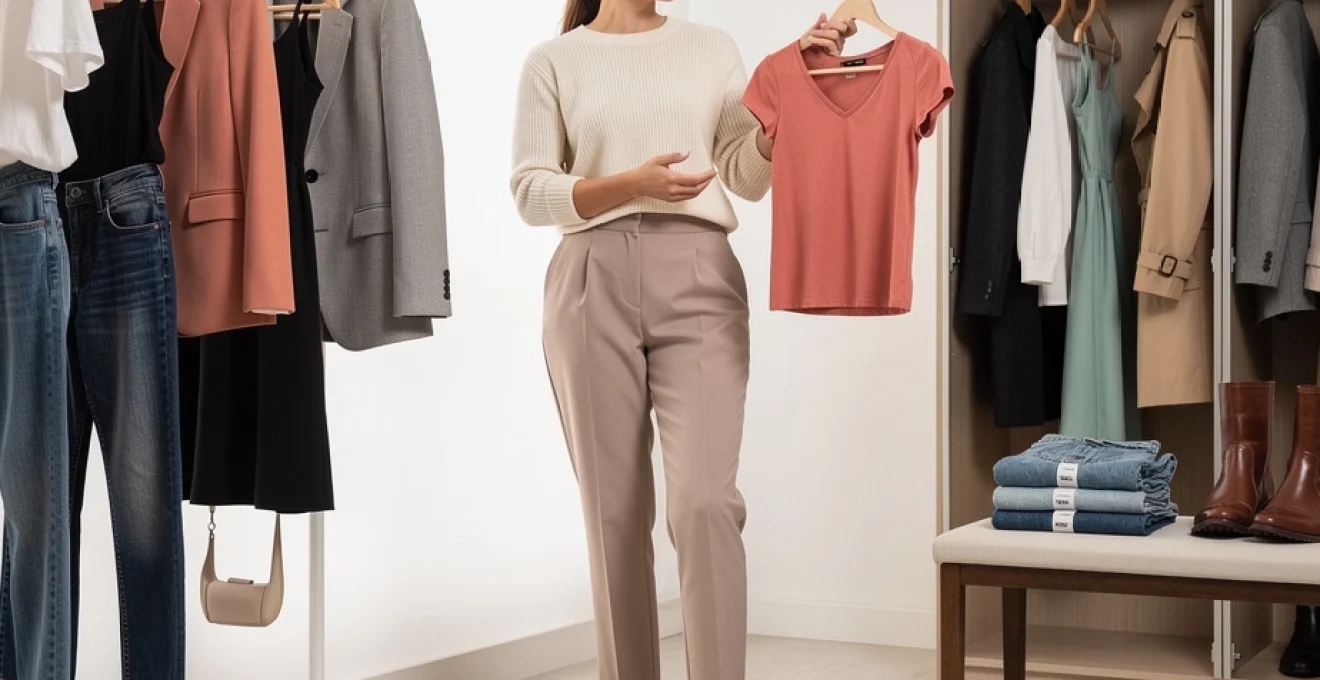
The average British woman owns approximately 118 items of clothing, yet research consistently reveals that only 30% of wardrobe contents see regular rotation. This disconnect between ownership and usage represents not merely a storage challenge but a fundamental misunderstanding of how strategic wardrobe development functions. The impulse-driven acquisition model promoted by fast fashion retailers has created closets brimming with items that fail to serve their owners’ lifestyles, body shapes, or authentic style preferences. Before embarking on any wardrobe update, understanding the mechanics of garment selection, fabric performance, and personal style architecture transforms reactive shopping into intentional curation. This shift from consumer to curator represents the difference between spending £4,000 annually on clothing that languishes unworn and building a functional collection that genuinely serves your life.
Wardrobe audit methodology: evaluating your current clothing inventory
Conducting a thorough wardrobe audit requires systematic evaluation rather than emotional attachment. The process begins by removing every garment from storage and categorising items by type—separating tops, bottoms, outerwear, and dresses into distinct groupings. This physical separation creates visual clarity about volume and reveals purchasing patterns that may previously have gone unnoticed. Many women discover they own fourteen white shirts but lack a single pair of well-fitting trousers, exposing gaps that repetitive purchasing fails to address.
The evaluation phase employs three critical filters: physical condition, current fit, and lifestyle relevance. Garments exhibiting pilling, permanent staining, stretched fabric, or structural degradation should be retired regardless of original purchase price. The sunk cost fallacy—continuing to house items because of their initial expense—prevents wardrobe evolution and occupies valuable storage capacity. Similarly, clothing that no longer accommodates your current body shape serves only to generate negative emotional responses. The most challenging filter addresses lifestyle alignment: does this garment serve activities you actually engage in, or does it reflect an aspirational version of life that remains unrealised? That cocktail dress purchased for events you never attend represents wasted resources better allocated elsewhere.
The capsule wardrobe framework: marie kondo vs. courtney carver approaches
Two dominant philosophies guide contemporary wardrobe minimisation: Marie Kondo’s joy-focused methodology and Courtney Carver’s Project 333 quantitative approach. Kondo’s system centres on emotional resonance, advocating retention only of items that « spark joy » when held. This subjective framework works well for individuals with strong intuitive responses but can prove challenging for those whose relationship with clothing involves complex feelings about body image, financial investment, or identity expression.
Conversely, Carver’s Project 333 establishes concrete parameters: 33 items including clothing, accessories, jewellery, outerwear, and shoes for a three-month period. This numerical constraint forces ruthless prioritisation and reveals genuine wardrobe workhorses. The limitation creates an interesting pressure that highlights which pieces genuinely serve multiple functions versus single-purpose garments. However, this approach may prove overly restrictive for individuals whose professional lives demand extensive wardrobe variety or whose hobbies require specialised attire.
A hybrid methodology combines quantitative boundaries with qualitative assessment. Establishing category-specific limits—perhaps eight tops, five bottoms, three dresses, two coats—whilst simultaneously evaluating each item’s emotional and functional value creates practical constraint without sacrificing personal resonance. This middle path acknowledges that effective wardrobe development requires both rational assessment and emotional authenticity.
Cost-per-wear analysis: calculating Long-Term investment value
Cost-per-wear calculation provides objective metrics for evaluating garment value beyond initial purchase price. The formula divides the item’s cost by the number of times worn, revealing the true expense of each use. A £200 coat worn 100 times across five years costs £2 per wear, whilst a £30 dress worn twice before abandonment costs £15 per wear. This mathematical framework exposes the fallacy that inexpensive purchases necessarily represent better value.
Applying this analysis prospectively during purchasing decisions requires honest assessment of likely usage frequency. Consider your lifestyle patterns: how many times weekly could this garment realistically feature in outfits? Does it require specific complementary pieces
with it to look right? Does it demand high-maintenance care that will limit how often you reach for it? When you factor in dry-cleaning, alterations, or special footwear, the realistic cost-per-wear of many “bargains” increases dramatically. Using this lens, investment pieces that integrate seamlessly into your existing wardrobe and can be styled multiple ways usually deliver superior long-term value, even if the initial outlay feels higher.
During a wardrobe update, it is helpful to retrospectively review your current clothes using cost-per-wear. Identify three of your best-value items and three of your worst. What patterns do you notice? Perhaps your best-value pieces are neutral, comfortable, and easy to launder, whereas the worst are statement items that never felt quite “you”. This insight becomes a decision-making filter: prioritise items you can imagine wearing weekly across several years, not just once for a single event.
Fabric longevity assessment: identifying natural fibres vs. synthetic blends
Fabric composition directly affects how long your clothes will last and how elegant they will look as they age. Natural fibres such as cotton, linen, wool, silk, and cashmere typically offer superior breathability and often develop a softer hand-feel over time. However, they can also be more prone to creasing, shrinking, or moth damage if not cared for properly. Synthetic fibres like polyester, nylon, and acrylic are more resistant to wrinkles and often cheaper, but they can pill, trap odour, and feel less comfortable against the skin.
Blended fabrics attempt to combine advantages from both camps: for example, cotton with 2–5% elastane for stretch, or wool blended with polyester for increased durability. When evaluating blends, check where the synthetic fibre is adding performance and where it may be a cost-cutting measure that shortens the garment’s elegant lifespan. A high percentage of acrylic in knitwear, for instance, often results in rapid pilling and a “tired” appearance after a single season.
From a wardrobe curation perspective, consider reserving synthetics for items where technical performance matters—such as sportswear or raincoats—and favour natural or high-quality blended fibres for everyday basics and investment pieces. Run your fingers over the fabric: does it feel smooth, dense, and substantial, or thin and plasticky? Hold it up to the light to assess transparency and weave tightness. The goal is not perfection, but to become fluent enough in fibre content that you can predict how a garment will behave after fifty wears and multiple washes, not just how it looks in the fitting room.
Seasonal rotation strategies: transitional piece identification
One of the most cost-effective ways to update your wardrobe without constant shopping is to master seasonal rotation. Rather than thinking in rigid “summer” and “winter” categories, focus on identifying transitional pieces that can bridge multiple seasons. Lightweight merino knits, midi dresses that work with both sandals and boots, trench coats, and ankle boots are classic examples of garments that earn high cost-per-wear by spanning spring, autumn, and even milder winter days.
During your wardrobe audit, create three small groupings: warm-weather items, cold-weather items, and true transitional pieces. Ask yourself which garments can be layered rather than replaced. Can your summer slip dress be worn over a thin knit with tights and ankle boots? Could your white shirt function as a lightweight jacket over a vest top in warmer months? By training yourself to see layering possibilities, you reduce the need to buy an entirely new wardrobe every time the temperature shifts.
Practical seasonal rotation also involves physically moving off-season clothes out of your main wardrobe, whether into storage boxes or a secondary rail. This simple act reduces visual clutter and helps you fully utilise what is current and climate-appropriate. Each time you rotate, review items for wear, fit, and relevance to your present lifestyle. Over time, you will build a core of trans-seasonal workhorses that provide continuity as trends and weather patterns change.
Body shape analysis and garment silhouette matching techniques
Updating your wardrobe effectively depends as much on understanding your body architecture as it does on following trends. When silhouettes harmonise with your proportions, clothes stop feeling like costumes and start functioning as a second skin. Instead of asking, “Is this in fashion?” a more powerful question becomes, “Does this support my vertical line, bone structure, and natural movement?” This technical yet empowering viewpoint reframes style as collaboration between your physical form and your clothing, rather than a battle to disguise perceived flaws.
Kibbe body typing system: understanding your vertical line and bone structure
The Kibbe system, originally developed in the 1980s by David Kibbe, offers a sophisticated approach to body typing that goes beyond simple “pear” or “apple” labels. It considers your vertical line (whether you read as visually petite, moderate, or tall), the sharpness or softness of your bone structure, and how flesh sits on your frame. The system groups people into style “families” such as Dramatic, Classic, Romantic, Natural, and Gamine, along with various combinations. Each family is associated with silhouettes, fabrics, and details that harmonise with that particular blend of structure and softness.
For example, a Dramatic type with a long vertical line and angular bones is generally flattered by clean, elongated shapes, sharp shoulders, and minimal fuss. Conversely, a Romantic type with a shorter vertical line and rounded features often looks best in drapey fabrics, defined waists, and soft curves. Neither is “better”; they are simply different design briefs. Understanding your Kibbe type can stop the cycle of buying clothes that look stunning on a friend or influencer but feel wrong on you, because they are designed for a different line and energy.
You do not need to commit dogmatically to one Kibbe category to benefit from the framework. Instead, use it as a diagnostic tool. Examine your favourite outfits: do they align more with structured or soft lines, long or cropped lengths, minimal or ornate details? When you next update your wardrobe, prioritise silhouettes that echo your natural lines. This alignment creates the subtle yet powerful effect where people notice you first and your clothes second—a hallmark of truly successful style.
Colour season analysis: determining your undertone using the seasonal colour theory
Colour has a profound impact on how healthy, rested, and confident you appear. Seasonal colour analysis divides people into four primary seasons—Spring, Summer, Autumn, Winter—based on undertone (warm or cool), value (light or deep), and chroma (soft or clear). Within each season sit more refined categories, but even identifying your general direction can transform how cohesive your wardrobe feels. The aim is not to follow rigid rules, but to understand why certain colours make your eyes sparkle while others leave you looking washed out.
A simple starting point is to determine your undertone. Hold a piece of pure white paper next to your bare face in natural light. Do you appear more peachy, golden, or olive (warm), or more rosy, pink, or blue-based (cool)? You can repeat this test using silver and gold jewellery: many women find that one looks more harmonious against their skin. Warm undertones typically shine in earthy, golden-based palettes (camel, olive, coral), while cool undertones glow in blue-based shades (charcoal, raspberry, jewel tones).
Once you have a working hypothesis about your season, audit your existing clothes. Which colours do you instinctively reach for, and in which outfits do you receive the most compliments? Gradually concentrate your wardrobe around a core palette of 6–10 flattering colours, mixing neutrals and accents. This limited yet strategic palette makes outfit-building faster and reduces the chance of buying beautiful but incompatible pieces that never quite work together. Over time, your wardrobe will function much like a professional designer’s collection: curated, cohesive, and remarkably mixable.
Proportion balancing: high-waisted vs. mid-rise trouser selection
Trouser rise is a technical detail that dramatically affects proportion, comfort, and confidence. High-waisted styles visually lengthen the legs and define the waist, which can be ideal if you have a longer torso or prefer to emphasise your midsection. Mid-rise cuts, sitting just below the natural waist, often feel more relaxed and balanced on shorter torsos or those who dislike fabric cutting across the narrowest part of the waist. Low-rise trousers, while cyclically trendy, can be challenging for many women as they shorten the leg line and demand constant adjustment.
To determine your optimal rise, stand side-on in a full-length mirror wearing fitted leggings and a tucked-in top. Note where your natural waistline sits in relation to your bust and hips. If your torso is relatively long, high-rise trousers can restore visual balance, creating the impression of evenly divided upper and lower body. If your torso is short, a very high rise may crowd your frame, so a mid-rise that gently follows your natural waist without sitting above it will usually be more harmonious.
When updating your wardrobe, try on several rises in the same brand and leg shape, noting not only how they look but how they feel when you sit, walk, and climb stairs. Ask yourself: can I imagine wearing these for a full day at work or travel? A beautiful waistband that digs into your midsection will quickly become a that-looks-great-but-I-never-wear-it purchase. Prioritising fit and proportion—especially with core basics like trousers and jeans—ensures that your wardrobe foundation supports every outfit you build upon it.
Neckline engineering: v-neck, scoop, and crew neck applications
Necklines act as visual frames for your face and upper body, influencing how broad your shoulders appear, how long your neck looks, and even how formal or relaxed an outfit feels. The three most common everyday necklines—V-neck, scoop, and crew—each serve different engineering purposes. A V-neck creates vertical lines that elongate the neck and torso, making it a powerful tool for balancing fuller busts or shorter necks. Scoop necks soften angular features and can subtly highlight the collarbones, offering a feminine yet approachable effect.
Crew necks, sitting higher at the base of the neck, project a cleaner, more preppy aesthetic and can be ideal for those with longer necks, smaller busts, or narrow shoulders needing visual breadth. However, on fuller busts or shorter necks, a tight crew neck can create a blocky effect, compressing the upper body visually. The goal is not to eliminate any neckline from your wardrobe, but to understand which ones are most flattering for your proportions and in which contexts they excel—V-necks for elongation, scoops for softness, and crews for polish or layering.
As you refine your wardrobe, pay attention to how different necklines interact with your face shape, hairstyle, and jewellery. Try photographing yourself in similar outfits that differ only by neckline; often the most flattering option becomes obvious when viewed objectively. This small technical refinement can make existing clothes suddenly feel more or less successful and will guide future purchases toward pieces that support rather than fight your natural lines.
Sustainable fashion purchasing: ethical brand vetting and certification standards
Modern wardrobe updates must reckon with the environmental and social impact of clothing production. The fashion industry is responsible for an estimated 8–10% of global carbon emissions and generates millions of tonnes of textile waste annually. Moving from impulse buying to intentional curation is not only beneficial for your budget and personal style; it is a meaningful sustainability strategy. Yet with so much “green” marketing, how can you distinguish genuine ethical practice from superficial claims?
The key is to combine three lenses: recognised certification standards, transparent business models, and your own usage patterns. Certifications and third-party audits can verify specific aspects of a garment’s life cycle, such as organic fibre content or absence of harmful chemicals. Transparency initiatives reveal where and how clothes are made. Finally, your personal commitment to wearing items often and caring for them well closes the loop, preventing even the most responsibly made garments from becoming waste.
GOTS and OEKO-TEX certifications: decoding textile quality markers
Two of the most widely respected textile certifications you will encounter are GOTS and OEKO-TEX. GOTS, the Global Organic Textile Standard, applies to natural fibres like cotton, wool, and linen. For a garment to carry the GOTS label, at least 70% of its fibres must be certified organic, and the production process must meet strict criteria regarding chemical use, wastewater treatment, and social conditions in factories. In simple terms, GOTS helps you identify pieces where both the farming and processing stages adhere to higher environmental and ethical standards.
OEKO-TEX, by contrast, focuses on the finished product. Its Standard 100 label indicates that every component of a garment—from thread to button—has been tested for harmful substances and found safe within defined limits. While OEKO-TEX does not guarantee organic fibres or fair wages, it does offer reassurance that your clothing is unlikely to contain a long list of problematic chemicals. This is particularly relevant for items worn next to the skin, such as underwear, T-shirts, and bedding.
When updating your wardrobe, you do not need every item to be certified. Instead, use these markers as one of several decision filters, especially for high-use basics and investment pieces. If you are comparing two similar garments at different price points, the one carrying credible certifications may justify a modest premium because it signals both quality and responsibility. Over time, familiarity with labels like GOTS and OEKO-TEX will enable you to scan product pages or tags quickly and reward brands that invest in better practices.
Circular fashion models: vestiaire collective and depop resale platforms
Circular fashion aims to keep clothing in active use for as long as possible, reducing the demand for new production. Resale platforms such as Vestiaire Collective, Depop, Vinted, and The RealReal have made it easier than ever to buy and sell pre-loved garments. For wardrobe updates, this opens two powerful possibilities: sourcing high-quality items at reduced prices and recouping value from pieces you no longer wear. The net effect is a more sustainable and financially efficient approach to style evolution.
Vestiaire Collective specialises in authenticated designer and premium brands, making it an excellent resource for investment pieces such as trench coats, leather boots, or cashmere knitwear. Depop and similar apps skew younger and more eclectic, ideal for trend-led items, vintage finds, or experimenting with a new aesthetic without committing full retail prices. By searching for specific brands, fabrics, and colours aligned with your style strategy, you can treat these platforms like curated archives rather than random treasure hunts.
To make circular fashion work for you, establish a simple rule: for every substantial new purchase, consider whether there is a similar item you could sell or donate. This not only maintains wardrobe volume at a manageable level but also reminds you that clothes hold value only when they are worn. When listing items, include accurate measurements, fibre content, and clear photos; when buying, read listings carefully and check seller ratings. Done thoughtfully, resale platforms allow you to elevate your wardrobe with pieces that would otherwise be out of reach, while participating in a more responsible fashion ecosystem.
Transparent supply chain verification: everlane and reformation case studies
Some contemporary brands have built their identity around transparency, making it easier for consumers to understand the story behind their clothes. Everlane, for example, publishes detailed information about its factories, cost breakdowns, and material choices. While no brand is perfect, this level of disclosure gives you tools to evaluate whether pricing aligns with production realities and whether workers are likely to be treated fairly. Transparency also facilitates more informed comparison between brands when you are choosing, say, a white shirt or a pair of tailored trousers.
Reformation offers another instructive case of a brand positioning itself around sustainability. It discloses the environmental footprint of individual garments—such as water usage and CO₂ emissions—and often uses deadstock or recycled fabrics. Reformation’s aesthetic leans toward trend-conscious femininity, illustrating that sustainability does not have to mean sacrificing style. However, the higher price point underscores an important reality: ethical production usually costs more than fast fashion, which is precisely why making fewer, better choices is central to wardrobe updating.
When evaluating any brand, ask: do they share factory locations, wage policies, and material sourcing details, or only broad statements about “caring for the planet”? Are sustainability reports backed by third-party audits, or are claims vague and unverifiable? In an age of information, opacity is itself a form of data. The more you reward transparent brands with your custom, the more incentive the broader industry has to improve standards.
Fabric technical specifications: understanding textile performance characteristics
Beyond aesthetics, the technical performance of fabrics determines how comfortable, durable, and versatile your clothes will be. Two tops may look nearly identical on the hanger yet behave very differently in real life because of their weave, fibre length, or finishing treatments. Developing a basic literacy in textile terminology empowers you to predict performance before purchase, much like reading nutrition labels helps you select food that supports your health.
Key factors to pay attention to include thread count, weave type, fibre fineness, and the presence of performance fibres like elastane or merino. Far from being esoteric details reserved for designers, these specifications can help you answer practical questions: Will this shirt crease badly during my commute? Will these jeans bag out at the knees by lunchtime? Is this knit likely to pill after a few wears? With a little practice, technical labels become a shortcut to smarter, more sustainable wardrobe decisions.
Thread count and weave patterns: percale vs. sateen in cotton garments
Thread count refers to the number of horizontal (weft) and vertical (warp) threads in one square inch of fabric. While it is most often discussed in relation to bed linen, the concept also applies to cotton shirts, dresses, and trousers. A higher thread count generally indicates a denser, smoother fabric, but only up to a point; beyond roughly 400, extremely high counts can be marketing rather than meaningful quality. The weave pattern—how those threads interlace—plays an equally important role in how a garment feels and performs.
Percale is a plain weave where each weft thread crosses over and under each warp thread in a consistent pattern. This produces a matte, crisp fabric that feels cool and breathable on the skin, making percale ideal for summer shirts, blouses, and pyjamas. Sateen, by contrast, is a satin weave where threads float over multiple others before interlacing. This creates a smoother, more lustrous surface that drapes elegantly and resists wrinkling, at the cost of slightly less breathability.
When updating your wardrobe, consider how you will wear each cotton garment. If you run warm, travel frequently, or prioritise a sharp, polished look, percale-style weaves may serve you well. If you prefer a softer hand-feel and subtle sheen for evening shirts or dresses, sateen can be a luxurious choice. Either way, understanding weave patterns helps you move beyond vague impressions of “nice fabric” to deliberate selection grounded in performance.
Merino wool temperature regulation properties for year-round wear
Merino wool is one of the most versatile fibres you can introduce into your wardrobe. Unlike traditional wool, which can feel bulky or itchy, merino fibres are exceptionally fine, making them soft against the skin. Their natural crimp creates tiny air pockets that trap warmth in cold conditions while still allowing excess heat and moisture to escape. This dynamic temperature regulation means a lightweight merino jumper or base layer can keep you comfortable across a wide range of climates and activities.
From a wardrobe strategy perspective, merino excels as a trans-seasonal foundation. Thin merino knits layer effortlessly under blazers, trench coats, or dresses without adding bulk, yet they can also be worn alone in spring or autumn. Because merino is naturally odour-resistant and wrinkle-resistant, garments require less frequent washing and travel especially well. This extends their lifespan and improves cost-per-wear, making them strong candidates for investment.
When shopping, look for 100% merino or blends where merino is the dominant fibre. Check the knit density—finer gauges are better for layering, while heavier knits suit outerwear. As with all animal fibres, consider certifications relating to animal welfare and environmental standards where possible. A small collection of merino essentials—a long-sleeve top, a fine-knit crew or V-neck, and perhaps a sleeveless shell—can dramatically increase the flexibility of your existing wardrobe.
Elastane percentage: stretch recovery and garment lifespan correlation
Elastane (also known as spandex or Lycra) is a synthetic fibre prized for its exceptional elasticity. Incorporated in small percentages—typically 1–8%—into garments like jeans, trousers, and knit tops, it provides comfort and shape retention. However, higher elastane content does not automatically equal better performance; in fact, too much can reduce structural integrity, causing garments to stretch out permanently or deteriorate more quickly under heat and friction.
For denim and structured trousers, 1–3% elastane usually offers sufficient flexibility while preserving the fabric’s ability to bounce back after wear. Activewear and body-hugging pieces may contain up to 15–20% elastane, but they are designed for shorter lifespans and higher turnover. If your goal is a long-lasting wardrobe, treat very high-stretch everyday pieces with caution, particularly when they are made from low-cost base fabrics.
Care practices also influence elastane longevity. High heat from tumble dryers and ironing can damage elastic fibres, leading to sagging waistbands and knees. When updating your wardrobe, check labels not only for elastane percentage but also for recommended care. If you know you will never hand-wash or line-dry, prioritise garments whose fibre compositions and care instructions match your real-life habits, ensuring their shape and support endure beyond the first season.
Pre-shrunk vs. sanforized denim: understanding raw denim aging
Denim is a cornerstone of many wardrobes, yet few women are aware of the technical differences between types of denim fabric. Two important terms to understand are pre-shrunk and sanforized. Pre-shrunk denim has been washed after weaving to remove most of the shrinkage before cutting and sewing. This is standard in mass-market jeans and means the pair you try on in-store will remain relatively consistent in size after washing, aside from minor tightening or relaxing.
Sanforized denim, often used in higher-quality or raw denim, has undergone a specific mechanical process that stabilises the fabric and significantly reduces shrinkage without fully washing out the indigo dye. Raw (or dry) denim, whether sanforized or not, is typically sold unwashed, with a deep, rich colour and stiffer hand-feel. Over time, as you wear and gradually wash these jeans, they mold to your body and develop unique fade patterns—a personalised patina that many denim enthusiasts prize.
For most everyday wardrobes, pre-shrunk denim in a mid-weight fabric will be the most practical. However, if you are willing to endure a breaking-in period and follow specific care instructions, investing in a pair of high-quality sanforized raw jeans can deliver exceptional longevity and a customised fit. The critical point is to understand what you are buying so you can set realistic expectations about comfort, maintenance, and ageing. This prevents disappointment and ensures each denim purchase aligns with both your lifestyle and your patience level for garment evolution.
Investment piece selection: classic wardrobe staples with timeless construction
Investment pieces are the structural beams of your wardrobe—garments and accessories that anchor countless outfits and remain relevant across years, even decades. They are not defined solely by price but by a combination of factors: timeless design, high-quality materials, robust construction, and alignment with your personal style and lifestyle. A well-cut trench coat, a pair of black leather ankle boots, a navy blazer, or a simple black slip dress can all function as investment pieces if chosen wisely.
When evaluating potential investments, apply a multi-factor checklist. First, assess silhouette: is it classic enough to transcend short-lived trends but not so conservative that it feels unlike you? Second, inspect construction details—stitching, lining quality, hardware, and seam finishing. Third, consider versatility: can you immediately imagine at least five outfits using items you already own? Finally, run a prospective cost-per-wear calculation over three to five years. An expensive coat worn three times a week each winter may ultimately cost less per wear than a cheaper, trend-led jacket replaced annually.
It is also crucial to pace your investment purchases. You do not need to acquire every staple at once. Instead, use your wardrobe audit to identify the highest-impact gaps—perhaps you are missing a neutral handbag that works for both work and weekends, or your only black heels are uncomfortable and dated. Prioritise one or two key upgrades per season, focusing on areas where quality is most visible and functionally important: outerwear, footwear, tailoring, and bags. Over time, these enduring pieces will quietly elevate even your simplest outfits, reducing the urge to chase every new trend.
Garment care infrastructure: establishing professional maintenance protocols
No matter how carefully you select fabrics or how much you invest in construction, your wardrobe will only be as durable as your maintenance habits. Garment care is the often-overlooked final pillar of a successful wardrobe update. Think of it as establishing an infrastructure: the right tools, services, and routines that protect your clothes and extend their useful life. This includes everything from appropriate hangers and storage solutions to a trusted tailor, cobbler, and, when truly necessary, dry cleaner.
Start by aligning care labels with your real-world behaviour. If you never hand-wash, be conservative about buying delicate silks that require it. Invest in gentle detergents, mesh laundry bags, a fabric shaver for pilling knits, and a handheld steamer to refresh garments without constant washing. For shoes and bags, basic care such as regular polishing, weatherproofing sprays, and proper stuffing or shaping when stored can add years to their lifespan. These small, inexpensive actions dramatically improve cost-per-wear and preserve the aesthetic integrity of your investment pieces.
Professional support is equally important. A skilled tailor can refine off-the-rack garments to fit your body perfectly, turning good purchases into great ones and rescuing near-misses that might otherwise hang unworn. A reliable cobbler can resole boots, replace heel tips, and stretch slightly tight shoes, all at a fraction of replacement cost. When choosing a dry cleaner, look for one that specialises in delicate fabrics and offers eco-friendlier cleaning methods where available. By viewing care and maintenance as an integral part of your wardrobe strategy rather than an afterthought, you transform your closet from a revolving door of disposables into a curated collection designed to serve you—beautifully and reliably—for years to come.