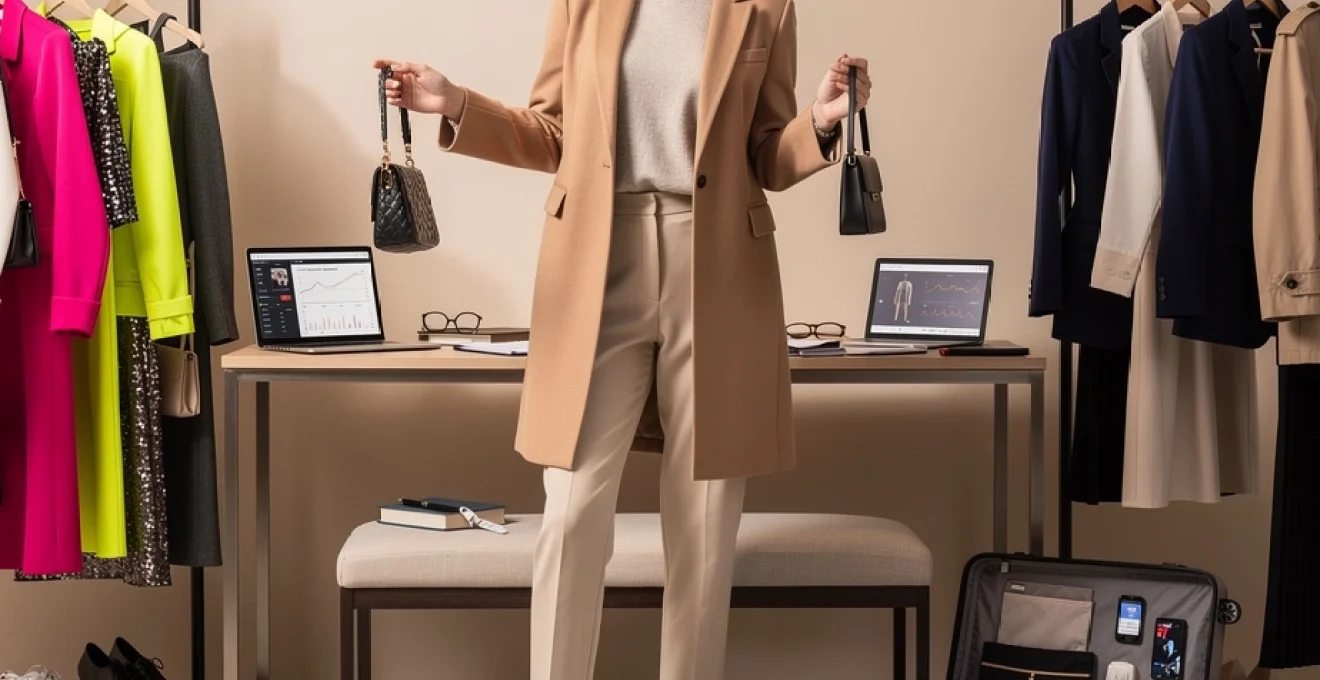
Fashion psychology reveals fascinating insights about how consumers navigate between fleeting trends and enduring wardrobe investments. The eternal struggle between staying current and building a lasting personal style reflects deeper cognitive processes that influence every purchase decision. Understanding these psychological mechanisms can transform your approach to wardrobe curation, leading to more strategic choices that satisfy both immediate desires and long-term satisfaction.
Modern consumers face unprecedented fashion choices, with social media accelerating trend cycles and fast fashion making every style accessible. Yet beneath this overwhelming array of options lies a fundamental question: how do you create a wardrobe that feels both contemporary and enduring? The answer requires understanding not just fashion trends, but the psychological forces that drive our clothing decisions and the strategic frameworks that lead to optimal wardrobe outcomes.
Psychological anchoring theory in consumer fashion Decision-Making
Anchoring theory plays a crucial role in how you evaluate fashion purchases, particularly when comparing trend pieces to timeless investments. This cognitive bias occurs when your brain relies heavily on the first piece of information encountered when making decisions. In fashion contexts, anchoring might manifest when you see a designer piece priced at £800, making a similar style at £200 seem remarkably reasonable, even if that price point exceeds your typical budget.
Cognitive bias impact on wardrobe investment choices
Several cognitive biases systematically influence wardrobe investment decisions beyond anchoring. Confirmation bias leads consumers to seek information that supports their existing style preferences, often causing them to overlook versatile pieces that don’t fit their current aesthetic vision. Availability bias makes recently seen trends appear more important than they actually are, leading to impulsive purchases of items that may quickly lose relevance.
The sunk cost fallacy particularly affects fashion decisions when you continue wearing pieces you no longer love simply because they were expensive. This bias prevents optimal wardrobe curation by keeping outdated or ill-fitting items in rotation rather than making strategic replacements. Understanding these biases enables more rational decision-making processes that prioritise long-term wardrobe functionality over short-term emotional responses.
Social proof mechanisms in Trend-Driven purchase behaviour
Social proof powerfully influences trend adoption, with consumers looking to peers, influencers, and celebrities for style validation. This mechanism explains why certain trends achieve viral status whilst others fail to gain traction, regardless of their aesthetic merit or practical value. The fear of missing out intensifies social proof effects, creating urgency around trending items that may not align with individual style goals or wardrobe needs.
Digital platforms amplify social proof through engagement metrics, making popular trends appear more desirable than they might be in offline contexts. However, effective wardrobe curation requires distinguishing between authentic personal attraction to trends and social pressure to conform. Recognising when social proof influences your decisions allows for more intentional choices that reflect genuine style preferences rather than external validation-seeking behaviours.
Loss aversion principles applied to timeless piece acquisition
Loss aversion, the tendency to feel losses more acutely than equivalent gains, significantly impacts how consumers approach timeless piece investments. The higher upfront costs of quality timeless items trigger loss aversion, making the financial commitment feel disproportionately painful compared to the anticipated benefits. This psychological response often leads to choosing multiple cheaper trend pieces over single, higher-quality investments, despite the latter offering superior long-term value.
Overcoming loss aversion in timeless piece acquisition requires reframing the purchase decision. Instead of focusing on immediate financial loss, consider the opportunity cost of not investing in quality pieces. Calculate potential savings from reduced future purchases and improved cost-per-wear ratios. This analytical approach helps counteract emotional responses to high-quality item pricing and promotes more strategic investment decisions.
Endowment effect influencing Long-Term wardrobe curation
The endowment effect causes people to overvalue items they already own, leading to wardrobe stagnation and resistance to necessary updates. This bias manifests when you hold onto clothes that no longer fit properly, suit your lifestyle, or reflect your evolving aesthetic preferences simply because you own them. The effect becomes particularly problematic with expensive pieces, where the financial investment creates additional psychological attachment.
Successful long-term wardrobe curation requires regularly challenging endowment effect influences.
Begin by conducting regular wardrobe audits where you assess each item against your current lifestyle, fit, and style direction. If you would not purchase the piece again today, that is a clear signal the endowment effect may be at play. Creating objective criteria for keeping or releasing items—such as minimum wear frequency, versatility across outfits, and alignment with your signature style—helps you detach emotionally and treat your wardrobe more like a carefully managed portfolio than a sentimental archive.
Practical strategies like photographing outfits, tracking wears in an app, or setting a “trial separation” box for uncertain pieces introduce distance that weakens the endowment effect. You might decide to store questionable items out of sight for 60 days and only reintroduce what you genuinely miss. By systematically challenging your attachment to underperforming pieces, you free up physical and mental space for timeless investments and carefully chosen trends that truly serve your evolving style.
Strategic wardrobe architecture using Core-Satellite investment models
Applying a core-satellite investment model to wardrobe planning provides a structured framework for balancing timeless pieces with fashion trends. In finance, the core represents stable, long-term holdings, while satellites are smaller, higher-risk positions that add potential upside. Translated into fashion, your core wardrobe consists of versatile, high-quality garments you wear repeatedly, while satellite pieces capture current trends and seasonal experimentation.
This strategic wardrobe architecture helps you avoid overexposure to short-lived trends while still feeling fashion-forward. By intentionally defining what percentage of your wardrobe budget and closet space goes to core versus satellite items, you introduce discipline to your shopping habits. The result is a wardrobe that feels cohesive, intentional, and resilient to changing trend cycles, rather than a chaotic collection of impulse purchases.
Foundation garment allocation methodologies
Foundation garments form the core of your wardrobe architecture—these are the timeless pieces that anchor outfits across seasons and style phases. A practical allocation methodology is to dedicate 60–70% of your wardrobe budget to such foundation garments: tailored blazers, neutral trousers, high-quality denim, classic coats, well-cut shirts, and versatile dresses. These items should align with your most frequent dress codes, whether that’s business casual, creative professional, or relaxed minimalist.
To determine the right balance for your lifestyle, start by mapping your week: how often do you attend formal meetings, social events, or casual outings? Your foundation garment allocation should mirror this distribution. If you work in an office five days a week, invest heavily in timeless workwear that mixes and matches easily. If your schedule is more flexible, your foundation might lean towards elevated casual pieces. This data-driven approach ensures your timeless wardrobe pieces are not just classic in style but deeply relevant to your daily reality.
Trend exposure risk management through capsule wardrobe systems
Capsule wardrobe systems offer an effective way to manage your exposure to fashion trends while maintaining a streamlined, timeless closet. By limiting yourself to a set number of items per season—often between 30 and 40 pieces—you naturally curate more carefully and question whether each trend-driven item earns its place. This built-in constraint functions much like a risk cap in an investment portfolio, preventing excessive allocation to high-volatility fashion trends.
You can further refine trend exposure by creating mini-capsules within your main wardrobe, such as a “seasonal trend capsule” with 5–8 items that express current styles. When the season ends, evaluate which pieces truly integrated into your timeless wardrobe and which felt purely momentary. This reflective practice helps you recognise patterns: are you repeatedly drawn to certain silhouettes, colours, or textures that may actually belong in your core? Over time, capsule wardrobe systems turn trend experimentation into a controlled, strategic process instead of an impulsive response to each new micro-trend.
Cost-per-wear calculations for investment piece justification
Cost-per-wear calculations offer a rational framework for deciding when a timeless piece is worth a higher upfront investment. The formula is simple: divide the purchase price by the estimated number of wears. A £400 coat worn 120 times over four winters has a cost per wear of just £3.33, which may be lower than a £60 trendy jacket worn only six times before feeling dated. Thinking in cost-per-wear terms helps you overcome loss aversion and see timeless pieces as long-term assets rather than one-off expenses.
To make this calculation meaningful, be honest about your actual wearing habits. Look at past items you have worn hundreds of times: what characteristics did they share? Comfortable fabrics, neutral colours, or certain cuts? Use those insights to project realistic wear counts for future purchases. You can even keep a simple note or app-based log for key investments to track real cost per wear over time. This data will quickly reveal that “expensive” timeless wardrobe staples often deliver superior value compared to cheaper, trend-driven fashion purchases.
Seasonal portfolio rebalancing techniques
Just as investors rebalance portfolios to maintain target asset allocations, you can rebalance your wardrobe each season to keep the right mix of timeless and trendy pieces. At the start or end of every season, review your clothing by category—outerwear, knitwear, dresses, footwear—and assess whether your core-satellite ratio still reflects your style goals. If you notice an overflow of trend items crowding your closet, it is time to divest less-worn pieces and reinvest in higher-quality essentials.
Seasonal rebalancing can follow a simple three-step process: audit, adjust, and acquire. First, audit wear frequency and satisfaction levels, noting which items felt indispensable and which remained untouched. Second, adjust by selling, donating, or repurposing underperforming pieces, especially those purchased purely for trends that did not integrate into your timeless wardrobe. Finally, acquire only what fills genuine gaps—perhaps a classic trench that will serve for years or a pair of timeless boots that match multiple outfits. Over time, this disciplined cycle keeps your wardrobe lean, functional, and aligned with both timeless style principles and selective trend adoption.
Trend lifecycle analysis and optimal entry points
Understanding the lifecycle of fashion trends enables you to time your purchases more strategically, avoiding early overpayment or late adoption of soon-to-fade styles. Trends typically move through identifiable stages—from innovation and early adoption to peak popularity and eventual decline. By recognising where a trend sits on this curve, you can decide whether it is worth incorporating into your wardrobe and, if so, how heavily to invest.
Strategic trend lifecycle analysis shifts your focus from reacting to every new style to choosing optimal entry points that balance freshness with longevity. This approach is particularly important when you are aiming to maintain a timeless wardrobe foundation while still enjoying selected trend-driven accents. Instead of asking, “Is this in right now?” you begin to ask, “Where is this trend headed, and how does it fit within my long-term style narrative?”
Fashion diffusion theory: rogers’ adoption curve application
Rogers’ diffusion of innovations theory provides a useful framework for understanding how fashion trends spread through different adopter groups. Innovators and early adopters, who make up roughly 16% of the population, are quickest to embrace new styles, often at higher price points and with greater risk of misalignment with timeless aesthetics. The early and late majority, comprising about 68%, adopt trends once they are widely visible and commercially available, while laggards join only as trends are waning.
For a wardrobe that balances trends and timeless pieces, positioning yourself around the early majority can be optimal. At this stage, you have enough information to assess a trend’s staying power—has it appeared across multiple seasons, brands, and demographics?—without paying the premium or risking the extremes of early adoption. By waiting until a trend proves its versatility and adaptability to different style contexts, you elevate the likelihood that your chosen pieces will integrate smoothly with your existing timeless wardrobe.
Peak trend identification using google trends and social media analytics
Digital tools such as Google Trends, Instagram hashtags, and TikTok view counts can help you identify when a fashion trend is approaching or passing its peak. A rapid spike followed by plateauing search interest often indicates that a trend is nearing mass saturation. If you enter at this peak, you risk investing in items that will soon feel overexposed and quickly lose perceived value, both stylistically and in terms of resale.
Instead, monitor gradual, sustained growth curves that suggest a trend is evolving into a new classic—think of the extended rise of minimalist sneakers or tailored loungewear. When search interest and engagement metrics show steady, multi-season momentum rather than sharp, one-season spikes, a trend may have sufficient longevity to justify integrating it more deeply into your wardrobe. Treat these analytics as you would market data: they do not dictate your choices, but they can inform when and how strongly you commit to a given style.
Fast fashion depreciation rates versus designer resale value
From an economic standpoint, fast fashion items tend to depreciate rapidly, often holding little to no resale value after a single season. In contrast, certain designer and heritage brand pieces may retain 50–80% of their retail price on the resale market, and iconic items can even appreciate over time. Platforms such as Vestiaire Collective, The RealReal, and eBay make these resale dynamics visible, offering real-world data on how timeless vs. trend-driven pieces perform financially.
When deciding between a low-cost trendy piece and a higher-priced, timeless investment, consider not only cost-per-wear but also potential resale value. A classic designer blazer in a neutral colour, for example, often remains desirable for years and can be resold if your style evolves, effectively lowering its net cost. Fast fashion trend pieces, by contrast, typically have a near-zero resale recovery rate. Factoring depreciation into your wardrobe strategy encourages you to favour high-quality, timeless garments that behave more like assets than disposable goods.
Micro-trend filtering through influencer engagement metrics
Micro-trends—short-lived styles propelled by viral moments—often emerge and fade within a few months, particularly on platforms like TikTok and Instagram Reels. To avoid overcommitting to these fleeting fashions, you can analyse influencer engagement metrics with a critical eye. Are multiple, diverse creators organically integrating a trend into different outfits, or is it concentrated among a few sponsored posts and highly stylised shoots? Broad, sustained engagement suggests more staying power than a brief burst of promotional hype.
A useful filter is to ask whether you can imagine wearing the trend beyond the current season and across multiple contexts. If the style only seems appropriate for highly curated, social media–friendly outfits, it may belong in the micro-trend category and warrant a small, low-cost experiment at most. By using influencer metrics as one input—rather than the sole driver—of your decisions, you protect your timeless wardrobe from being overwhelmed by pieces that feel outdated almost as soon as they arrive.
Timeless design principles and heritage brand analysis
Timeless wardrobe pieces share consistent design principles that transcend specific fashion eras: balanced proportions, restrained detailing, quality materials, and functional versatility. These characteristics allow garments to adapt to evolving trends without losing their relevance. A well-cut camel coat, a crisp white shirt, or a simple black dress can be styled countless ways across decades, acting as a stable canvas for changing accessories, colours, and silhouettes.
Heritage brands—labels with decades or even centuries of history—often exemplify these timeless design principles. They refine rather than radically reinvent core silhouettes, investing heavily in craftsmanship and fabric innovation. Analysing the signature pieces of such brands can help you identify what makes a design truly enduring. Ask yourself: is the appeal of this garment rooted in external hype, or does it stem from intrinsic qualities like fit, comfort, and material longevity? When you learn to recognise those intrinsic markers, you become better equipped to find timeless pieces at every price point, not just within luxury collections.
Digital styling technologies and wardrobe optimisation tools
Digital styling technologies have transformed how you can plan, test, and optimise your wardrobe before making new purchases. Wardrobe management apps allow you to photograph your clothes, categorise them, and create virtual outfits, making it easier to see gaps and redundancies. Some tools even use algorithms to suggest new combinations, helping you maximise the use of your timeless pieces and spotlighting which items genuinely earn their space.
Virtual try-on features, augmented reality filters, and AI-powered styling assistants further reduce the risk of ill-considered trend purchases. Before committing to a bold colour or experimental silhouette, you can visualise how it interacts with your existing wardrobe and body shape. Over time, these technologies act like a personal stylist and data analyst combined, revealing patterns such as which garments you wear most and which timeless investments deliver the highest cost-per-wear. By embracing these tools, you shift from reactive, emotion-driven shopping to a more informed, strategic approach grounded in real usage data.
Sustainable fashion economics and circular wardrobe strategies
Balancing trends and timeless pieces is not only a style choice but also a sustainability decision with economic implications. The fashion industry accounts for an estimated 8–10% of global carbon emissions, and overproduction of short-lived trend items contributes significantly to textile waste. A wardrobe anchored in timeless, durable garments naturally reduces consumption frequency, lowering both environmental impact and long-term spending.
Circular wardrobe strategies extend this impact by keeping garments in active use for as long as possible through repair, resale, swapping, and rental. Instead of discarding a high-quality timeless piece when your style evolves, you might resell it, allowing another person to integrate it into their wardrobe. Likewise, renting trend-focused items for special occasions enables you to experience new looks without permanent additions to your closet. By viewing your wardrobe as part of a circular ecosystem—where pieces flow in and out thoughtfully rather than accumulating indefinitely—you support a more sustainable, economically rational approach to fashion that honours both current trends and enduring style.