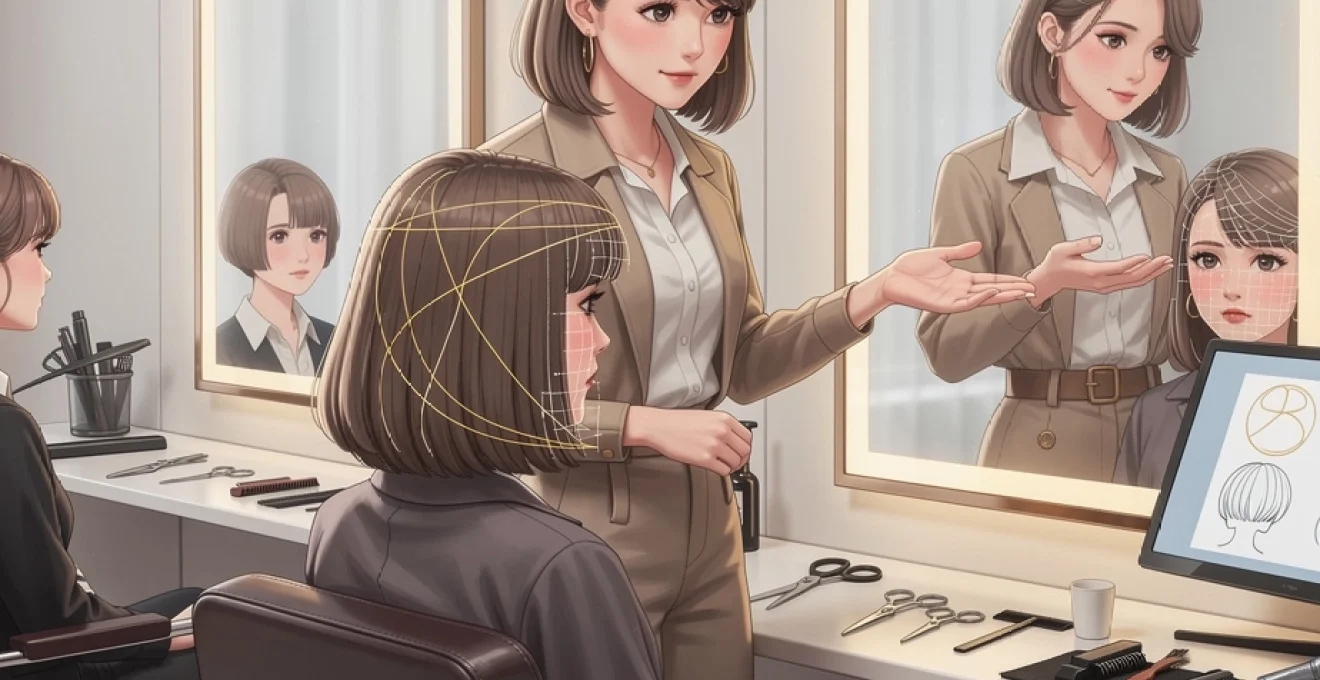
Selecting the perfect hairstyle transcends simple aesthetic preference—it requires a sophisticated understanding of facial geometry, proportional relationships, and how different cutting techniques interact with your unique bone structure. Professional stylists recognise that the most flattering hairstyles emerge from careful analysis of facial dimensions, angular characteristics, and the mathematical principles that govern visual harmony. This scientific approach to hairstyle selection transforms an ordinary haircut into a powerful tool for enhancing natural features whilst creating the illusion of perfect facial proportions.
The difference between a mediocre haircut and an exceptional one often lies in the stylist’s ability to assess facial architecture with clinical precision. Modern hair design incorporates elements of geometry, visual psychology, and artistic composition to create looks that complement rather than compete with natural features. Understanding these fundamental principles empowers you to make informed decisions about your next hairstyle, whether you’re working with a professional stylist or evaluating potential cuts for your facial structure.
Understanding facial geometry and proportional analysis for hairstyle selection
Professional hairstyle analysis begins with comprehensive facial mapping—a methodical process that evaluates the relationship between various facial landmarks and their proportional significance. This analytical approach considers the mathematical ratios present in facial structure, recognising that certain proportions create inherent visual harmony whilst others may benefit from strategic hair placement to achieve optimal balance.
Golden ratio principles in face measurement techniques
The golden ratio, approximately 1.618:1, serves as a fundamental principle in professional facial analysis for hairstyle selection. This mathematical relationship appears throughout nature and art, creating inherently pleasing proportions that the human eye finds aesthetically compelling. Professional stylists utilise golden ratio principles when assessing the relationship between forehead height, facial length, and the positioning of features to determine optimal hair placement strategies.
Measuring techniques based on golden ratio principles involve dividing the face into specific segments and comparing their proportional relationships. The distance from the hairline to the eyebrows should ideally relate to the distance from eyebrows to the nose tip, which in turn relates to the distance from nose tip to chin bottom. When these measurements align with golden ratio proportions, hairstyles can enhance this natural harmony, whilst deviations suggest specific styling strategies to create visual balance.
Identifying angular versus curved bone structure elements
Bone structure analysis forms the cornerstone of professional hairstyle consultation, distinguishing between angular and curved facial elements to inform cutting and styling decisions. Angular bone structures feature pronounced jawlines, defined cheekbones, and distinct facial planes that create strong geometric lines. These features benefit from softening techniques that introduce curves and movement through strategic layering and texture creation.
Curved bone structures present gentler transitions between facial features, with rounded cheekbones, softer jawlines, and flowing contours. These facial types typically benefit from angular elements introduced through precise cutting techniques, structured layers, and geometric styling approaches that add definition and create visual interest. Understanding your dominant bone structure characteristics guides the selection of complementary hairstyle elements.
Vertical and horizontal proportion assessment methods
Professional proportion assessment examines both vertical and horizontal facial dimensions to determine optimal hairstyle characteristics. Vertical assessment considers the relationship between facial length and width, identifying whether the face appears elongated, compressed, or proportionally balanced. This analysis directly influences decisions about hair length, volume placement, and fringe positioning.
Horizontal assessment focuses on the width relationships between forehead, cheekbones, and jawline, identifying the broadest and narrowest points of the face. These measurements inform strategic volume placement, with hair positioned to create width where narrowness exists and to minimise prominence where excessive width occurs. The interplay between vertical and horizontal proportions creates a comprehensive framework for hairstyle decision-making.
Facial thirds division and symmetry evaluation
The facial thirds analysis divides the face into three equal horizontal sections: upper third (hairline to eyebrows), middle third (eyebrows to nose tip), and lower third (nose tip to chin). Ideally, these sections should appear roughly equal in length, though individual variations provide unique character and beauty. Professional stylists use this analysis to determine optimal fringe lengths, hair parting positions, and overall hairstyle proportions.
When one of these thirds is noticeably longer or shorter, a skilled stylist will use targeted cutting and styling to visually correct the imbalance. For example, an elongated lower third can be balanced with a fuller fringe and mid-length layers that draw the eye upward, whereas a short forehead may benefit from higher volume at the crown and lighter, more open hairlines. Symmetry evaluation also considers left–right balance, hair growth patterns, and parting behaviour, ensuring the final hairstyle supports natural movement rather than fighting it.
Oval face shape styling strategies and technical considerations
Oval face shapes are often considered the benchmark for balanced proportions, but that does not mean every haircut will automatically be flattering. Professional hairstyling for oval faces focuses on maintaining proportional harmony rather than dramatically altering it. The goal is to support the natural symmetry of the face while incorporating technical cutting decisions that reflect your lifestyle, hair density, and texture. Because almost every haircut is available to you, the question becomes not “What can I wear?” but “What will maximise my features?”
Layered bob variations for enhanced facial balance
For oval faces, layered bob haircuts offer a precise way to frame the features without distorting the underlying facial geometry. A classic one-length bob that sits between the jaw and collarbone preserves the vertical balance of an oval shape, while soft internal layers add movement without collapsing the perimeter. For clients seeking more structure, a graduated or stacked bob can introduce a subtle angle from back to front, keeping weight towards the nape whilst maintaining openness around the cheekbones.
Texturised bobs, created through point cutting or slicing techniques, are particularly effective for thick or coarse hair on oval faces. These methods remove bulk while preserving length, preventing the hairstyle from overwhelming the facial features. When you combine a tailored bob with the right parting—centre for classic symmetry or slightly off-centre for a more editorial effect—you enhance the natural balance of an oval face shape without creating unnecessary width or length.
Fringe placement techniques for forehead proportion optimisation
Because oval faces already sit close to ideal proportions, fringe (bangs) must be placed with surgical precision to avoid shortening or elongating the face excessively. A light, curtain fringe that splits softly in the centre works exceptionally well, as it preserves vertical length while offering framing around the eyes and cheekbones. Stylists often cut these fringes slightly longer at the temples and shorter in the centre, mirroring the natural curve of the brow and maintaining proportional integrity.
For clients with taller foreheads, a denser, eyebrow-skimming fringe can create a sophisticated, balanced look without overloading the upper third of the face. Conversely, if the forehead is already shorter than the other thirds, micro-fringes or heavy, blunt bangs are typically avoided, since they compress the upper third visually. Instead, the fringe is cut wispy, starting farther back on the head, allowing more skin to show and preventing the face from appearing compact.
Volume distribution methods for maintaining natural symmetry
On an oval face shape, volume should be distributed to support existing symmetry rather than to correct imbalance. Vertical volume at the crown can subtly elongate the profile, while lateral volume near the cheekbones can create a soft, romantic effect. However, concentrating too much fullness at a single level—such as heavy volume at the jawline—can interrupt the natural flow of the oval silhouette and make the face appear shorter or wider than it is.
Professional stylists often use layering and blow-drying techniques to create a graduated volume profile: light lift at the roots, controlled fullness around the mid-lengths, and softened ends. This approach is especially effective for fine hair, where over-layering can easily remove structure. For thicker hair, internal debulking and directional drying allow you to enjoy movement without sacrificing the clean lines that flatter an oval face.
Length selection guidelines for maximising versatility
Because the oval face shape tolerates a broad spectrum of lengths, the primary considerations become hair quality, lifestyle, and styling preferences. Short crops and pixie cuts expose the natural symmetry and bone structure, creating a high-fashion, editorial look that works particularly well if you enjoy low-maintenance styling with a strong visual impact. Mid-length cuts—between the collarbone and the upper chest—offer the most versatility, allowing for updos, waves, and sleek finishes without overwhelming the face.
Very long hairstyles, extending beyond the chest, can be stunning on oval faces when properly layered to avoid dragging the features downward. Subtle face-framing layers that start around the lips or chin help maintain openness around the face while preventing a “curtain” effect. When you choose your ideal length, consider how often you wear your hair up, how much time you invest in styling, and whether you prefer your face more exposed or softly framed.
Round face shape contouring through strategic hair placement
Round face shapes are characterised by soft curves, equal or near-equal width and length, and minimal angularity at the jawline. The central objective when choosing a hairstyle for a round face is to create visual verticality—that is, to elongate the face so it appears closer to an oval in proportion. Rather than attempting to hide the cheeks completely, professional stylists use targeted length, layering, and parting techniques to sculpt the silhouette and introduce subtle definition.
Strategic hair placement begins with length. Cuts that fall below the chin, ideally between the collarbone and upper chest, help to stretch the overall facial outline, especially when styled straight or with gentle, vertical waves. Deep side parts are powerful tools for round faces because they disrupt the horizontal symmetry, drawing the eye diagonally across the face instead of straight across the widest point. Have you ever noticed how a simple shift in parting can instantly make your face look slimmer? That is facial contouring through hair placement in action.
Volume management is equally important. Excessive fullness at the cheeks or sides of the head amplifies width, making the face appear even rounder. Professional techniques such as internal layering, slide cutting, or thinning shears are used to reduce bulk at cheek level while preserving movement. In contrast, a controlled lift at the crown and in the upper third of the head adds height, which tricks the eye into perceiving a longer, more oval face shape. Styles such as a long, layered cut with face-framing layers starting below the cheekbones or a textured lob with an off-centre part are excellent options for slimming a round face.
Square and angular face shape softening techniques
Square and strongly angular face shapes typically exhibit a broad forehead, wide cheekbones, and a pronounced jawline that share similar widths. These geometric characteristics can look powerful and striking, but some clients prefer to soften the intensity of these lines with strategic hairstyling. The technical goal is to introduce curves, diagonals, and movement that visually offset the strong horizontals and verticals of the bone structure.
Rather than disguising the jawline completely, contemporary styling focuses on diffusing its sharpness. This is achieved through asymmetric cuts, diagonal partings, and texture-building methods that create softness without sacrificing structure. By carefully choosing where the hair begins and ends in relation to the jaw, a stylist can minimise the boxy effect and produce a more fluid, elongated profile that still respects the client’s natural bone architecture.
Asymmetrical cutting methods for jawline minimisation
Asymmetry is one of the most effective tools for softening a square face shape. When one side of the hair is cut slightly longer or styled with more volume, it breaks up the visual symmetry of the jawline and reduces the focus on its width. Popular approaches include asymmetrical lobs, where the front lengths fall below the jaw on one side and just at or slightly above it on the other, creating an elegant diagonal line that draws attention downward and inward.
Technically, asymmetrical cutting for square faces often involves maintaining a longer, sweeping perimeter near the front and gradually shortening toward the back. This forward movement creates a visual veil that partly overlaps the jawline without appearing heavy or blunt. Subtle graduation and undercutting at the nape can further streamline the silhouette, keeping the shape modern and refined rather than bulky.
Side-swept styling approaches for angular feature reduction
Side-swept styling is especially beneficial for clients with prominent jawlines or broad foreheads. A deep side part combined with a sweeping fringe introduces diagonal lines that cross the face, softening the perception of straight, horizontal edges. Imagine drawing a gentle slash of light across a square frame—that is what a side-swept fringe does for your facial architecture. It directs attention towards the eyes and cheekbones instead of the corners of the jaw.
For medium to long hair, side-swept layers that curve toward the face at the cheek or collarbone level help to round out the profile. When styling at home, using a round brush or curling iron to bend the hair away from the jaw and toward the neckline can create an “S” shaped wave pattern that visually softens sharp corners. This approach is especially effective when paired with subtle face-framing layers that begin just below the jawline, ensuring the hair supports, rather than duplicates, the angular structure.
Texture creation techniques using point cutting and razor work
Texture is crucial in reducing the visual sharpness of an angular or square face shape. Highly blunt, heavy perimeters tend to accentuate strong jawlines, whereas diffused, feathered edges create a gentle transition between skin and hair. Professional stylists often use point cutting—where the scissors are angled into the ends of the hair—to soften lines and introduce micro-variations in length that scatter light and movement.
Razor work, when used with care on suitable hair types, can further break up rigidity by creating delicate, tapered ends and internal texture. This technique is especially useful for medium to thick hair, as it removes bulk while retaining fluidity. However, on very fine or fragile hair, excessive razor use may lead to fraying or lack of control, so precision scissor techniques are typically preferred. The overarching principle is clear: the more fragmented and multidimensional the texture, the less attention is drawn to strict geometric facial lines.
Heart-shaped face structure and chin enhancement strategies
Heart-shaped faces are characterised by a wider forehead that tapers down to a narrower jawline and often a pointed chin. The aim of professional hairstyle design for this face shape is to balance the upper and lower thirds by visually widening the lower face and gently reducing emphasis on the forehead. Rather than concealing the forehead completely, modern techniques focus on redistributing perceived width and adding softness around the jaw and chin area.
Length plays a pivotal role for heart-shaped face hairstyles. Cuts that sit between the chin and the shoulders are especially effective because they introduce fullness where the face is naturally narrower. For example, a textured lob that breaks at or just below the collarbone, combined with loose waves, visually broadens the jawline area and creates a more harmonious silhouette. If you prefer longer hair, layered lengths that start around the collarbone and flow outward from the face help avoid an elongated, top-heavy look.
Fringe and parting decisions are equally important. Soft curtain bangs or side-swept fringes that overlap a portion of the forehead reduce its apparent width while drawing attention to the eyes and cheekbones. A deep side part creates diagonal lines that counteract the triangular outline of the face, shifting the focal point away from the widest area. Around the chin, stylists often introduce subtle layering or soft curls to add visual volume and counterbalance the narrowness; this can be as simple as flipping the ends outward slightly or using a large-barrel iron to create a rounded, chin-embracing wave.
For clients who enjoy wearing their hair up, strategic styling becomes essential. High, tight ponytails or top knots can accentuate the width of the forehead, whereas lower, softer updos with face-framing tendrils around the jaw can create a more balanced effect. Think of these tendrils as a tailored “soft-focus filter” for the chin, gently blurring its pointiness and enhancing the overall harmony of the heart-shaped face.
Professional consultation methodologies and digital analysis tools
While understanding face shapes and haircut principles is empowering, the most precise results often come from a structured professional consultation. Advanced salons integrate facial mapping, lifestyle analysis, and digital imaging to design haircuts that align with both your facial geometry and your daily routine. During a thorough consultation, a stylist will typically evaluate your face from multiple angles, assess your natural hair fall, consider your maintenance preferences, and discuss your long-term hair goals.
Digital analysis tools have become increasingly prominent in modern hair studios. High-resolution cameras and specialised software can measure facial proportions, simulate different hair lengths and fringe options, and even predict how colour placement might influence perceived facial width or length. Some systems offer augmented reality try-ons, allowing you to “preview” potential hairstyles in real time before any cutting begins. This technology reduces guesswork and supports more collaborative decision-making between you and your stylist.
From a methodological perspective, many professionals follow a structured sequence: initial visual assessment, measurement-based analysis, discussion of problem areas (such as a strong jawline or short forehead), then presentation of targeted solutions using both traditional sketches and digital mock-ups. Have you ever struggled to explain a picture from social media to your stylist? These tools help bridge that gap by translating inspiration images into concrete shape, length, and volume parameters tailored to your specific face.
In addition, some salons now maintain digital client profiles that record face shape analysis, past haircuts, growth patterns, and product responses. Over time, this data set allows your stylist to refine each haircut with increasing precision, much like a tailor perfecting a bespoke suit over multiple fittings. By combining expert eye, structured consultation methodology, and digital analysis, the process of choosing the perfect hairstyle for your face shape becomes less about trial and error and more about informed, collaborative design.