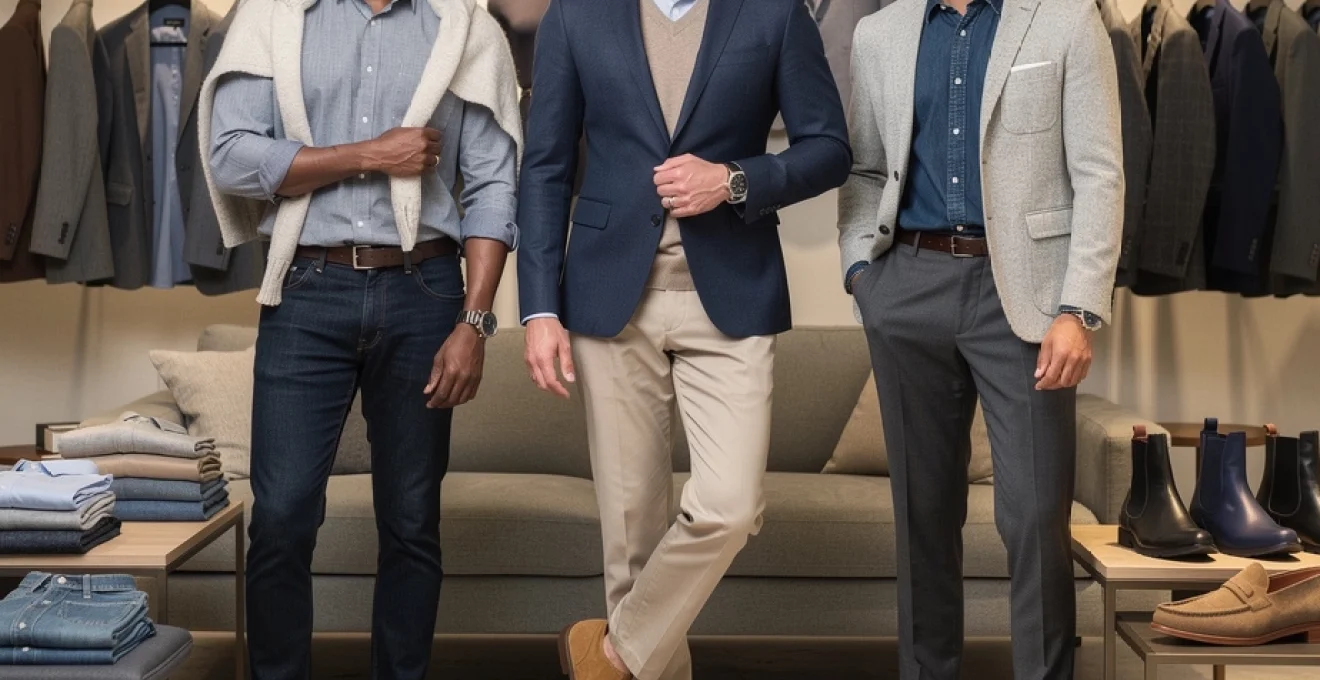
# Where Casual Meets Refined: Mastering That In-Between Aesthetic
The modern wardrobe exists in a state of perpetual negotiation between formality and comfort, between tradition and innovation. As workplace dress codes continue to evolve and social occasions demand increasing versatility, the ability to navigate this sartorial middle ground has become essential. The in-between aesthetic—that carefully calibrated balance between dressed-up and dressed-down—represents more than just a dress code. It embodies a sophisticated understanding of context, quality, and personal presentation that transcends rigid categorisation. This approach to dressing allows you to move seamlessly from professional environments to social settings without the need for complete wardrobe changes, whilst maintaining an air of considered elegance throughout your day.
Defining smart casual: the sartorial sweet spot between formal and relaxed
Smart casual occupies a fascinating position in contemporary menswear, serving as the bridge between the structured formality of business attire and the unrestrained ease of weekend wear. Unlike traditional dress codes with clearly delineated rules, smart casual demands interpretative skill and contextual awareness. It’s a philosophy rather than a prescription, encouraging you to think critically about garment selection, fabric quality, and overall presentation. The beauty of this approach lies in its flexibility—it allows for personal expression whilst maintaining professional polish, creating outfits that feel authentic rather than costume-like.
Understanding smart casual requires moving beyond simplistic formulas. It’s not merely about removing a tie or swapping dress shoes for trainers. Rather, it represents a holistic approach to dressing that considers proportion, texture, colour harmony, and the subtle signals that clothing sends about your attention to detail and respect for context. When executed properly, smart casual outfits communicate competence, creativity, and confidence without appearing stuffy or overly formal.
Deconstructing the dress code spectrum from black tie to streetwear
The dress code spectrum functions as a continuum rather than discrete categories. At one extreme sits black tie with its rigid conventions and formal requirements; at the other, streetwear embraces comfort and self-expression with minimal concern for traditional sartorial rules. Smart casual exists approximately two-thirds of the way from formal to casual—more polished than business casual, less structured than traditional business attire. This positioning gives you considerable latitude whilst maintaining certain non-negotiable standards of presentation.
Within this spectrum, smart casual serves as the most versatile zone, adaptable to the widest range of contemporary situations. It acknowledges that most professional and social contexts today require neither the full formality of suiting nor the complete relaxation of athletic wear. Understanding where smart casual sits relative to other dress codes helps you make calibrated adjustments—knowing when to dress slightly up or down within this flexible framework depending on specific circumstances.
Historical evolution of smart casual from 1950s ivy league to contemporary interpretations
The roots of smart casual trace back to mid-century American collegiate style, where Ivy League students pioneered a relaxed approach to traditional menswear. They kept the quality fabrics and tailored silhouettes of their fathers’ generation whilst introducing softer construction, unlined jackets, and a more playful approach to colour and pattern. This represented a subtle rebellion against post-war conformity—maintaining respectability whilst asserting individuality through sartorial choices.
Throughout subsequent decades, smart casual evolved in response to broader cultural shifts. The 1980s introduced power dressing that elevated business casual; the 1990s brought Silicon Valley’s tech-casual aesthetic; and the 2010s saw the rise of elevated basics and polished separates as workplace formality continued declining. Today’s interpretation synthesises these influences, incorporating performance fabrics, athletic silhouettes, and streetwear elements whilst maintaining the foundational principles of quality construction and intentional presentation.
Cultural variations: british tailoring tradition versus american preppy aesthetic
British and American interpretations of smart casual diverge in meaningful ways that reflect deeper cultural attitudes towards formality and presentation. British smart casual tends towards more structured garments with cleaner lines—think tailored chinos paired with knitted polo shirts, desert boots, and subtly patterned shirts. There’s an underlying formality even in relax
British smart casual tends towards more structured garments with cleaner lines—think tailored chinos paired with knitted polo shirts, desert boots, and subtly patterned shirts. There’s an underlying formality even in relaxed looks, often anchored by traditional fabrics such as flannel, tweed, and cavalry twill. American smart casual, by contrast, leans more heavily on the preppy aesthetic: Oxford cloth button-downs, chino shorts, boat shoes, and varsity-inspired knitwear. The silhouettes are softer, the colour palette often lighter, and there is a greater willingness to incorporate visible sportswear references. Neither approach is inherently superior; understanding these cultural variations simply gives you a broader vocabulary when you want to shift your in-between aesthetic slightly sharper or more relaxed.
As global dress codes continue to blur, elements of both British tailoring and American prep now coexist in many wardrobes. You might pair a softly constructed Italian blazer (a nod to European sprezzatura) with American-style dark denim and minimalist trainers, or ground a collegiate cable-knit with crisply pressed, British-style trousers. Paying attention to how different cultures resolve the tension between smart and casual helps you refine your own approach. Are you more drawn to the discipline of structured jackets and pressed creases, or the ease of rolled sleeves and worn-in chinos? Once you can answer that, you can start to curate smart casual outfits that feel coherent rather than randomly assembled.
Industry terminology: understanding elevated basics and polished separates
Modern menswear language around the in-between aesthetic frequently revolves around two concepts: elevated basics and polished separates. Elevated basics are everyday items—T-shirts, sweatshirts, chinos—that have been upgraded through superior fabric, refined fit, and subtle design details. Polished separates, meanwhile, refer to individual tailored pieces like blazers, trousers, and knitwear that can be mixed and matched rather than worn as a rigid suit. Together, these categories form the backbone of smart casual wardrobes.
Understanding this terminology helps you decode brand messaging and make more intelligent purchasing decisions. When a label describes a crew-neck as an elevated basic, you should expect a denser cotton jersey, clean neckline finish, and a fit that neither clings nor billows. When you see polished separates, think of an unstructured sport coat in a wool-linen blend that pairs equally well with flannel trousers or dark denim. Approaching your wardrobe through this lens allows you to build modular outfits, much like a capsule collection, where each piece easily combines with others to create multiple smart casual looks without feeling repetitive.
Foundation garments: building blocks for versatile wardrobe capsules
Mastering the in-between aesthetic begins with a deliberate approach to foundation garments—the pieces you reach for repeatedly that quietly underpin most outfits. Rather than accumulating an excess of trend-led items, focus on a concise selection of shirts, trousers, knitwear, and light tailoring that can be recombined in numerous ways. Think of these items as the grammatical structure of your style; once they are in place, you can play with accents, colour, and accessories to alter the overall tone. A well-curated smart casual capsule wardrobe reduces decision fatigue whilst ensuring you are rarely under- or overdressed.
When evaluating potential foundation pieces, consider three criteria: fabric quality, cut, and versatility. Does the material drape well and feel comfortable against the skin across a full day? Is the silhouette modern yet restrained enough not to date quickly? Can the item be worn in at least three distinct outfit combinations, from office settings to weekend dining? If you can confidently answer yes to these questions, you are likely looking at a strong candidate for your in-between wardrobe core.
Oxford cloth button-downs and chambray shirts as transitional staples
Oxford cloth button-down (OCBD) shirts and chambray shirts are arguably the most important shirts for smart casual dressing, precisely because they sit instinctively between formal poplin and casual flannel. Oxford cloth has a slightly nubby, basketweave texture that softens the formality of a collared shirt, making it ideal with both tailored trousers and dark denim. Chambray, often mistaken for denim, offers a similar casual ease in a lighter, more breathable package that works across seasons. Both can be worn open at the neck without looking unfinished, which is crucial when dress codes are ambiguous.
In practical terms, a rotation of white, light blue, and soft striped OCBDs provides significant styling mileage. Pair a white OCBD with navy chinos and suede loafers for a minimal, office-ready smart casual outfit, then swap the chinos for dark jeans and roll the sleeves for evening drinks. Chambray shirts excel as layering pieces: wear one under a navy unstructured blazer for client meetings or over a white T-shirt with olive chinos for weekend brunch. By treating these shirts as transitional staples, you create a reliable bridge between more tailored and more relaxed elements in your wardrobe.
Chinos, tailored trousers, and dark denim: navigating bottom-half flexibility
The lower half of your outfit often carries much of the responsibility for setting overall formality. Chinos, tailored trousers, and dark denim represent a graduated spectrum that allows you to fine-tune your smart casual look. Chinos sit squarely in the middle: cleaner and sleeker than jeans, but less formal than wool trousers. A slim or straight leg, minimal pockets, and a slight taper at the ankle will help them read as refined rather than purely casual. Tailored trousers in lightweight wool, cotton twill, or technical blends push the outfit closer to business territory without requiring a full suit.
Dark denim, when cut simply and free from distressing, remains a cornerstone of the in-between aesthetic. A raw or rinsed indigo pair with a clean hem can be worn with everything from knit polos to sport coats and minimalist leather trainers. The key is to avoid excessive fading, rips, or overly skinny silhouettes, which drag the overall outfit towards pure casual. When you learn to treat chinos, tailored trousers, and dark denim as interchangeable modules, you can easily adjust your bottom-half selection to match context—chinos for creative offices, wool trousers for presentations, dark denim for elevated weekend dining.
Knitwear layering: merino wool jumpers, cashmere cardigans, and structured polos
Knitwear is one of the most effective tools for mastering smart casual style because it naturally softens sharp tailoring and elevates basic separates. Fine-gauge merino wool jumpers, for instance, slide comfortably under unstructured blazers without adding bulk, offering temperature control and visual refinement. A crew neck over an Oxford shirt with the collar neatly tucked can feel professional in a modern workplace; the same jumper worn alone with chambray and chinos becomes an easy off-duty look. Merino’s breathability and resilience mean it maintains its shape even with frequent wear.
Cashmere cardigans, whilst more of an investment, introduce an unmistakable sense of quiet luxury to the in-between aesthetic. Worn open over a T-shirt and tailored trousers, they create an intentionally relaxed yet thoughtful silhouette, especially in neutral tones like oatmeal, navy, or charcoal. Structured knit polos—knitted from cotton or merino rather than standard jersey—are another smart casual powerhouse. With their clean collars and substantial fabric, they can substitute for shirts under a blazer, particularly in settings where a full button-down might feel overdressed. Think of knitwear as your dial for formality: swap a T-shirt for a knit polo, or a hoody for a merino crew, and you immediately shift the outfit several notches towards refined.
Unstructured blazers and deconstructed sport coats in wool-linen blends
No single garment encapsulates the in-between aesthetic more effectively than the unstructured blazer or deconstructed sport coat. Unlike traditional suiting jackets with heavy canvassing and sharp padding, these pieces feature softer shoulders, minimal lining, and lightweight construction. The result is a jacket that moves with you like a cardigan but still carries the visual authority of tailoring. Wool-linen or wool-cotton blends are particularly valuable for this category: they combine the breathability and texture of linen or cotton with the drape and crease resistance of wool.
In practice, an unstructured navy blazer can anchor an astonishing number of smart casual outfits. Wear it with grey wool trousers and a white OCBD for important meetings, then switch to dark denim and a chambray shirt for dinner. A lighter, textured sport coat in herringbone or subtle checks pairs beautifully with neutral chinos and suede boots for weekend engagements. By treating these jackets less as rigid formalwear and more as sophisticated outer layers, you unlock their full potential as everyday companions rather than occasional pieces reserved for rare dressy events.
Fabric selection and textile theory for in-between dressing
At the heart of refined casual style lies an understanding of fabric behaviour—how different fibres, weaves, and finishes influence both comfort and perceived formality. Two garments with identical silhouettes can read entirely differently depending on textile choice. A cotton poplin shirt appears sharper and more businesslike than the same shirt cut in Oxford cloth; a blazer in smooth worsted wool feels far more formal than one in slubby hopsack. Learning to read these subtleties is akin to understanding the difference between speaking in formal prose and relaxed conversation.
For smart casual wardrobes, prioritise fabrics that offer both structure and ease. Blends that incorporate natural fibres with discreet technical components can enhance stretch, breathability, and crease resistance without appearing overtly synthetic. As hybrid work patterns and longer days become the norm, these textiles support your lifestyle by maintaining a presentable appearance from morning meetings to late dinners. When you start to treat fabric selection as a strategic decision rather than an afterthought, you gain far more control over how “dressed” your outfits feel.
Performance fabrics: four-way stretch cotton and technical wool innovations
The rise of performance tailoring over the past decade has transformed what we expect from smart casual clothing. Four-way stretch cotton, for example, allows chinos and shirts to move with the body in a way that traditional weaves cannot, making them more comfortable for commuting, travel, or long days at the office. Technical wool blends, often incorporating a small percentage of elastane or high-twist yarns, resist wrinkles and recover their shape quickly, which is invaluable for blazers that spend time draped over chairs or packed in carry-on luggage.
Crucially, the best modern performance fabrics manage to deliver these functional benefits while preserving a natural, matte appearance. You want your trousers to feel as comfortable as athleisure, but not to shine like gym wear under office lighting. When evaluating garments marketed as technical or performance pieces, pay close attention to hand-feel and surface sheen. If the fabric feels plasticky or overly slick, it may undermine the refined element of your in-between aesthetic. Aim for the sweet spot where you gain movement and durability without sacrificing the visual language of classic menswear.
Seasonal adaptability through weight and weave density considerations
Beyond fibre composition, fabric weight and weave density play a crucial role in seasonal adaptability. Lightweight poplin, open-weave hopsack, and linen blends excel in warmer months because they allow air to circulate, preventing overheating when you layer shirts, knitwear, and jackets. In cooler weather, denser twills, flannels, and brushed cottons trap warmth and provide a more substantial drape that visually aligns with autumn and winter landscapes. Think of these transitions much like adjusting the ISO setting on a camera: you are fine-tuning sensitivity to environmental conditions.
For a truly versatile smart casual wardrobe, consider building a small rotation of season-specific versions of your key pieces. A navy blazer in lightweight, half-lined hopsack for spring–summer, and a similar silhouette in mid-weight flannel or serge for autumn–winter, will cover most scenarios. Likewise, swapping crisp cotton chinos for moleskin or corduroy trousers as temperatures drop maintains the same outfit formulas with seasonally appropriate textures. By planning around weight and weave density, you ensure that your in-between aesthetic remains comfortable and contextually correct across the calendar.
Texture mixing: combining matte and lustrous finishes for visual interest
Texture is one of the most powerful yet underused tools in smart casual dressing. When you cannot rely on overt formality cues like ties or highly structured suiting, mixing textures becomes a subtle way to introduce depth and sophistication. Combining matte and slightly lustrous finishes—such as pairing a brushed cotton shirt with a smoother wool blazer—creates visual interest without resorting to loud patterns or colours. It’s similar to interior design: a room feels richer when you combine linen upholstery, wooden surfaces, and metal accents rather than using one material everywhere.
In practical terms, consider anchoring outfits with one smooth element and one textured piece. Dark, clean denim (smooth) worn with a nubby wool cardigan (textured) reads relaxed yet intentional. A silk-blend pocket square in a matte wool jacket introduces a hint of sheen that catches the light without dominating. The aim is balance; too many shiny surfaces can make an outfit look flashy, while all-matte combinations risk feeling flat. By consciously incorporating texture mixing into your smart casual strategy, you can keep even a tightly edited capsule wardrobe feeling dynamic.
Footwear strategy: bridging athletic comfort and dress shoe formality
Footwear often makes or breaks a smart casual look because shoes are one of the first elements people subconsciously register. Trainers instantly pull an outfit towards the casual end of the spectrum, whilst sleek Oxfords push it sharply formal. The art of the in-between aesthetic lies in selecting shoes that borrow comfort from athletic design and refinement from traditional dress styles. Rather than asking, “Are trainers allowed?” a better question is, “How can my shoes echo the level of polish in the rest of my outfit?”
Building a small, versatile footwear rotation geared towards smart casual settings gives you immense flexibility. With three or four considered pairs—perhaps a suede boot, a minimalist leather trainer, a loafer, and a lightweight brogue—you can adapt the same foundational clothing pieces to dramatically different contexts. By adjusting only your shoes, you can shift a look from creative office-appropriate to weekend relaxed or evening-ready in seconds.
Desert boots, chukkas, and suede chelsea boots as transitional options
Desert boots, chukkas, and suede Chelsea boots occupy a highly versatile space between dress shoes and sneakers. Their origins in military and workwear environments lend them an inherently casual DNA, yet their clean lines and high-quality leather or suede uppers introduce a note of refinement. Desert boots, with their crepe soles and rounded toes, pair naturally with chinos and denim, softening sharp outfits without appearing sloppy. Chukkas, especially in darker suede with slimmer profiles, step a notch closer to dress shoes and work seamlessly with tailored trousers.
Suede Chelsea boots may be the most elegant of the trio, thanks to their sleek silhouette and elastic side panels that create an uninterrupted line from trouser hem to toe. In dark brown or tobacco, they bring a sophisticated edge to slim dark denim and an unstructured blazer, ideal for dinner dates or gallery openings. Because these boots share design language with both casual and formal footwear, they function as excellent transitional options when you are uncertain about dress code expectations. Slip them on and you instantly signal that you have made an effort without trying too hard.
Minimalist leather trainers from common projects and axel arigato
The rise of minimalist leather trainers over the past decade has fundamentally reshaped smart casual footwear norms. Brands like Common Projects and Axel Arigato popularised the idea that a low-profile, monochrome sneaker could function almost like a modern loafer when styled appropriately. The key characteristics here are clean uppers, minimal branding, and a restrained colour palette—typically white, black, or muted neutrals. In high-quality leather with careful finishing, these trainers complement everything from cropped wool trousers to refined joggers and dark denim.
When incorporating minimalist trainers into an in-between aesthetic, context and condition are crucial. A pristine pair of white leather sneakers worn with pressed chinos and a navy knit polo can look sharp enough for many creative offices; the same trainers, scuffed and paired with distressed jeans, will skew fully casual. Treat them as you would dress shoes: keep them clean, rotate pairs to allow recovery, and be intentional about sock choice. Thin, invisible socks or tonal dress socks preserve a streamlined look, especially when you sit and your trouser hem rises.
Belgian loafers and driving moccasins for sockless sophistication
For warmer months and more polished environments, Belgian loafers and driving moccasins offer a refined alternative to sneakers that still feels relaxed. Belgian loafers, characterised by their slim profiles and often bow-tied vamps, are inherently elegant but lack the stiffness of traditional penny loafers. They work particularly well with cropped trousers or chinos, showing a hint of ankle and reinforcing a continental, holiday-ready smart casual vibe. Driving moccasins, with their rubber pebble soles and supple leather, provide slipper-like comfort while maintaining a sophisticated silhouette.
Both styles are typically worn sockless or with invisible socks, which contributes to their leisurely character. Paired with an Oxford shirt, lightweight blazer, and tailored shorts or chinos, they create an outfit that would feel at home on a yacht deck or at a relaxed terrace restaurant. The key is to ensure the rest of your look remains structured enough—pressed shorts, a belt, perhaps a linen sport coat—so that the inherent informality of sockless footwear does not tip the entire outfit into beachwear territory. Think of these shoes as tools to inject a touch of Riviera nonchalance into otherwise composed ensembles.
Brogue detailing and wingtip patterns in casual contexts
Brogues and wingtip shoes, with their decorative perforations and wing-shaped toe caps, traditionally belonged to country wear but have become staples of urban smart casual outfits. The brogue detailing softens the formality of classic dress shoe shapes, making them easier to pair with denim and chinos. In grain leather or suede, a wingtip derby shoe bridges the gap between the boardroom and the bar, particularly in versatile shades like tan, chocolate, or oxblood. The additional visual texture created by punching details adds personality without resorting to loud colours.
To keep brogues aligned with an in-between aesthetic rather than full business attire, pay attention to sole construction and overall silhouette. Chunkier rubber or commando soles read more casual and pair naturally with heavier fabrics like flannel and denim, whereas thin leather soles feel more formal. A semi-brogue (with detailing on the toe cap but not along every seam) can strike a pleasing balance when you want something dressier than sneakers but less stiff than plain Oxford shoes. Used thoughtfully, brogue detailing functions much like tasteful jewellery: it provides interest and individuality while still supporting a cohesive, polished impression.
Accessorising principles: elevating outfits through considered details
Accessories are the final layer that transforms a collection of garments into a coherent smart casual outfit. In the absence of ties and pocket watches as everyday defaults, subtler elements—belts, watches, bags, and even eyewear—carry more visual weight. The goal is not to pile on extras, but to make a few strategic choices that reinforce the balance between casual and refined. Much like seasoning in cooking, a little goes a long way; an overabundance of accessories can feel try-hard, while a single well-chosen piece can pull everything together.
When accessorising within the in-between aesthetic, aim for materials and finishes that echo your clothing choices. A matte leather belt that matches your shoes, a brushed metal watch that complements your jacket buttons, or a suede weekend bag that harmonises with your boots—all these details subconsciously signal intentionality. Scarves in lightweight wool or cashmere can add both warmth and sophistication, especially when draped casually rather than knotted formally. If you wear jewellery, keep it streamlined: a simple cuff, signet ring, or slim chain can add character without overwhelming the outfit.
Practical accessories also play a role in how your smart casual look is perceived. A structured leather or canvas tote feels markedly more considered than a gym backpack, even if both serve the same functional purpose. Similarly, upgrading from a phone-only carry habit to a slim cardholder or wallet can subtly shift your presence from student to professional. Ask yourself: do my accessories tell the same story as my clothes, or are they undermining my efforts? Aligning these elements helps ensure that your overall presentation feels cohesive rather than accidental.
Context-specific applications: navigating occasions from creative offices to weekend dining
Even the most thoughtfully curated smart casual wardrobe must ultimately answer to real-world contexts. The same blazer, knit, and trouser combination will read differently in a creative agency, a corporate co-working space, or a neighbourhood restaurant. Mastering the in-between aesthetic, therefore, is less about owning specific pieces and more about calibrating their combinations for particular scenarios. Think of yourself as a DJ mixing familiar tracks in different sequences to suit the mood of each crowd.
In creative offices, you often have license to lean further into relaxed elements—minimalist trainers, knit polos, and unstructured blazers—provided everything remains clean and intentional. A typical outfit might include dark denim, a merino crew neck over an Oxford shirt, and suede Chelsea boots, easily elevated with a deconstructed sport coat for client meetings. For more traditional workplaces that have eased away from formal suiting, swap denim for tailored trousers and trainers for loafers or brogues, keeping shirts pressed and outerwear structured. The goal is to project reliability and professionalism without appearing anachronistically overdressed.
When it comes to weekend dining, the spectrum widens further. Casual brunches may call for smart jeans, a chambray shirt, and desert boots, perhaps finished with a lightweight bomber or field jacket. For evening reservations at a more refined restaurant, consider chinos or wool trousers, a knit polo or OCBD, and Belgian loafers, anchored by an unstructured blazer. In both cases, subtle grooming details—neatly trimmed facial hair, pressed garments, clean shoes—reinforce the impression that you respect the environment and the people you are with. By continuously reading the room and fine-tuning your outfits accordingly, you turn smart casual from a confusing dress code into a powerful tool of self-presentation.