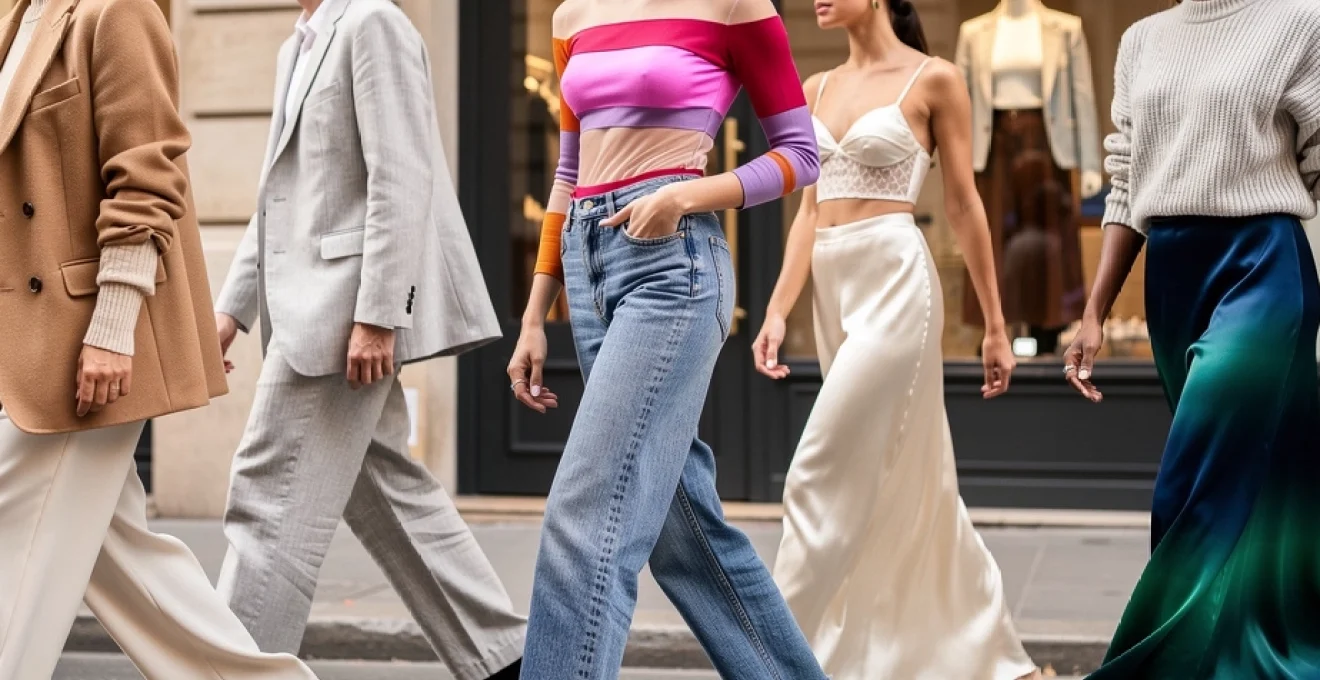
Fashion’s current landscape presents a fascinating paradox: whilst trends proliferate across social media at unprecedented speed, the most stylish individuals are building wardrobes rooted in versatility rather than virality. The outfits dominating street style from London to New York share a common thread—they’re constructed from investment pieces styled with intention, creating looks that feel both timely and timeless. Understanding how to interpret these trending aesthetics within your existing wardrobe transforms the constant pressure to consume into an opportunity for creative expression. The following analysis deconstructs the five most prevalent outfit formulas circulating through fashion capitals, examining the technical elements that make them work and providing actionable strategies for adapting them to your personal style.
Oversized blazer styling: the hailey bieber effect on contemporary silhouettes
The oversized blazer has transcended its status as a wardrobe staple to become the foundation piece upon which entire outfit ecosystems are built. This renewed prominence stems from a collective shift towards silhouettes that prioritise comfort without sacrificing polish—a balance that resonates particularly strongly with professionals navigating hybrid work environments. The contemporary approach to blazer styling departs significantly from traditional tailoring conventions, embracing deliberate disproportion and unexpected styling contexts.
Deconstructed tailoring techniques for Shoulder-Heavy proportions
The technical success of an oversized blazer outfit hinges on understanding shoulder construction and sleeve length. Stylists recommend selecting blazers where the shoulder seam extends approximately 2-3 centimetres beyond your natural shoulder line—sufficient to create visual interest without overwhelming your frame. The sleeve should ideally break at the wrist bone when arms hang naturally, allowing for deliberate pushing or scrunching that reads as intentional rather than ill-fitting. Deconstructed tailoring, characterised by minimal shoulder padding and softer canvas interfacing, creates the relaxed drape that defines current iterations of this trend.
Monochromatic layering strategies with Wide-Leg trousers
Monochromatic blazer outfits dominate current street style precisely because they solve the proportional challenges inherent in oversized tailoring. When you pair a voluminous blazer with wide-leg trousers in matching or tonal shades, the eye reads the outfit as a continuous vertical line rather than competing horizontal sections. This creates an elongating effect that counterbalances the width introduced by both garments. Black, navy, camel, and ecru remain the most versatile colour choices, offering maximum mixing potential across your existing wardrobe whilst maintaining the sophisticated restraint that characterises elevated casual dressing.
Micro-bag pairing: bottega veneta and the row accessories integration
The micro-bag phenomenon exists in direct contrast to oversized blazer proportions, creating visual tension that elevates the overall composition. Miniature structured bags from houses like Bottega Veneta and The Row have become signature accessories within this styling formula, their compact dimensions emphasising the deliberate oversizing elsewhere in the outfit. From a practical standpoint, micro-bags necessitate edited carry essentials—typically a cardholder, keys, phone, and lipstick—which aligns with the intentional minimalism underlying contemporary wardrobe philosophy. For those requiring additional carrying capacity, layering a micro-bag with a larger tote creates dimension whilst maintaining functionality.
Fabric weight considerations: wool blends versus linen structures
Seasonal adaptation of the oversized blazer formula requires strategic fabric selection. Mid-weight wool blends (typically 250-300gsm) provide structure sufficient to maintain the desired silhouette whilst offering year-round wearability in temperature-controlled environments. Linen and linen-blend blazers, conversely, introduce textural interest ideal for warmer months but require careful consideration of wrinkling tendencies—an element some style enthusiasts embrace as evidence of natural fibres whilst others find incompatible with polished aesthetics. The emerging cotton-hemp blends offer compelling middle ground, combining linen’s breathability with enhanced wrinkle resistance.
The oversized blazer represents more than a trend; it’s a
styling framework that can be recalibrated endlessly—by playing with proportion, texture and accessories, you can recreate the Hailey Bieber-inspired blazer outfit formula using pieces you already own rather than starting from scratch each season.
Barrel-leg denim dominance: the Post-Skinny jean revolution
The shift from skinny jeans to barrel-leg denim marks one of the most visible outfit changes everyone is wearing right now. The curved, sculpted leg line feels directional but, when cut well, is surprisingly wearable. Unlike straight-leg or mom jeans, barrel silhouettes introduce volume through the thigh and knee, then taper slightly at the ankle, creating a modern, architectural shape. The key to making this jean trend yours is understanding how rise height, hem treatment and shoe choice affect your overall proportions.
Mid-rise versus High-Rise waistband positioning for body proportion balance
Waistband placement is the technical detail that determines whether barrel-leg jeans flatter or overwhelm. High-rise styles (sitting at or just above the natural waist) visually lengthen the leg, which is particularly effective if you are styling them with cropped knits, tucked-in shirts or bra-as-top looks. For longer torsos or those who prefer not to emphasise the waist, a mid-rise cut that sits a few centimetres below the navel can create a more balanced ratio between upper and lower body. You want the rise to meet the point where your torso naturally bends—this prevents excess fabric pooling at the front and keeps the silhouette clean.
To decide which rise supports your personal style, consider your go-to outfit formulas. If you live in oversized shirts and blazers worn open, high-rise barrel jeans anchor the volume on top and create a clear waistline even when the waistband is mostly covered. If you prefer fitted tops or bodysuits, mid-rise options can feel less constricting across the stomach while still delivering that sculpted leg shape. As with all trending denim, fit is non-negotiable: tailoring the waistband by even one or two centimetres can transform how contemporary jeans integrate with the rest of your wardrobe.
Raw hem finishing techniques and ankle break calculations
The hem finish on barrel-leg denim has an outsized impact on how modern your outfit appears. Raw hems remain a dominant detail because they introduce an intentional roughness that counterbalances polished elements like structured coats or pointed flats. When trimming a raw hem at home, mark the desired length while wearing your usual shoes, then cut no more than 1–1.5 centimetres below that mark to allow for natural fraying without compromising the ankle break. Think of the ankle break—the point where the fabric meets or skims the shoe—as the punctuation mark of your outfit: too long and the line looks sloppy, too short and the proportions skew awkwardly cropped.
For a contemporary silhouette that suits most heights, aim for the hem to sit 1–2 centimetres above the top of your shoe for flats, and just at the shoe line for heeled boots or sandals. Petite dressers often benefit from a slightly shorter inseam to avoid pooling that adds unnecessary bulk, whereas taller individuals can lean into a touch more length to showcase the full barrel curve. If DIY isn’t your preference, many alterations specialists now offer intentional raw hem finishes, using subtle stitching a few millimetres above the cut edge to control fraying while keeping that undone feel.
Levi’s wellthread and agolde capsule collections analysis
Among the labels shaping how everyone is wearing barrel-leg denim right now, Levi’s Wellthread and Agolde stand out for their combination of design and sustainability. Levi’s Wellthread focuses on circular design principles, using organic cotton, water-saving dye processes and threads engineered for easier recycling. Their barrel and “balloon” cuts tend to have a gentler curve and more relaxed rise, which suits readers building a casual, everyday capsule wardrobe. Agolde, by contrast, leans into sharper silhouettes and premium denim blends, often incorporating a slightly stiffer hand feel that holds the sculptural shape across multiple wears.
If you are deciding where to invest, look beyond trend-driven washes and focus instead on versatility. A mid- or light-indigo barrel jean from Levi’s Wellthread integrates easily with minimalist basics and soft tailoring, making them ideal for hybrid work and weekend dressing. Agolde’s ecru or faded black styles, on the other hand, feel almost like tailored trousers in denim form, pairing seamlessly with oversized blazers, pointed slingbacks and micro-bags for an elevated, city-ready uniform. The wider post-skinny jean revolution is less about abandoning skinnies entirely and more about expanding your denim toolkit so you can choose silhouettes that support your favourite outfit formulas.
Footwear coordination: ballet flats versus chunky loafers
Footwear is where barrel-leg denim outfits either click or collapse. Ballet flats have re-emerged as a key partner to sculpted jeans because their low vamp and delicate profile offset the volume through the leg. When you pair soft leather or mesh ballet flats with barrel denim cropped at the ankle bone, the resulting negative space visually slims the leg line and creates a subtly Parisian mood. Opt for styles with a small heel or structured sole if you require more support; they preserve the dainty look whilst remaining practical for day-long wear.
Chunky loafers, by contrast, amplify the contemporary edge of barrel-leg jeans. Think of them as the visual counterweight to the curved silhouette: the substantial sole grounds the outfit and introduces a deliberate, editorial heaviness. To avoid feeling weighed down, ensure a sliver of ankle remains visible between hem and shoe, particularly if you are petite. You might find that swapping just your shoes—ballet flats for loafers or vice versa—completely changes the mood of your barrel-denim outfit, offering two distinct looks from the same core pieces.
Sheer layering architecture: transparency trend execution
The sheer trend has moved from runway novelty to everyday styling tool, with fashion insiders using transparency to add depth rather than overt exposure. The most wearable interpretation focuses on layering sheer pieces over and under wardrobe staples to create outfits with intentional reveals. Successful sheer outfits work like architectural models: each layer has a role, and the structure only holds if opacity and transparency are precisely balanced.
Mesh underlayer construction with strategic opacity placement
Mesh underlayers are the quiet heroes of sheer dressing, allowing you to participate in the trend without compromising comfort or coverage. A fitted, long-sleeve mesh top worn under a slip dress or oversized shirt introduces subtle texture and can add an extra colour dimension to otherwise neutral outfits. When selecting mesh, pay attention to the density of the knit around key areas such as the bust, shoulders and upper arms. Slightly tighter weaves in these zones provide more coverage where you need it while still reading as sheer elsewhere.
Strategic opacity placement works much like zoning in interior design: you decide which areas of the body you’re comfortable highlighting, then build your outfit architecture accordingly. For instance, you might pair a semi-sheer blouse with an opaque camisole that matches your skin tone, allowing the transparency to show at the sleeves and neckline only. Alternatively, a sheer long skirt layered over cycling shorts or a slip mini plays with length and movement while keeping your core modestly covered. By thinking in terms of panels—opaque here, translucent there—you’ll find it easier to bring sheer pieces into your daily rotation.
Bra-as-top styling: Intimates-as-Outerwear garment selection
The bra-as-top look is one of the most visible outfits everyone is wearing on social media, but it’s also one of the most misunderstood. The most successful interpretations treat the bra more like a structured crop top or bralette than underwear, focusing on fabric quality, strap placement and coverage across the cup. Look for pieces in matte stretch jersey, ribbed knit or satin-backed crepe with a slightly longer underband; this extra depth helps the garment integrate seamlessly under blazers, sheer shirts and co-ordinated sets.
To make the bra-as-top styling formula wearable beyond nightlife, think in terms of contrast and containment. A minimalist bra top worn with high-waisted barrel jeans and an oversized blazer reads as a modern take on suiting rather than overtly revealing. Similarly, pairing a lace bralette under a partially buttoned sheer blouse offers just a suggestion of lingerie while still feeling considered. If you’re unsure how much skin feels right, start by treating the bra top as a layering piece rather than the focal point: you can always adjust buttoning, drape and coverage as your confidence grows.
Fabric denier ratings for appropriate coverage levels
Understanding fabric denier—the measurement of fibre thickness—gives you a far more precise way to navigate sheer dressing than relying on guesswork. Lower denier numbers generally indicate more transparency, whereas higher numbers imply greater opacity and durability. For everyday sheer layering, fabrics around 20–40 denier strike a practical balance: translucent enough to reveal underlying silhouettes but substantial enough to resist minor snags and stretching. Mesh tops and tights in this range offer the “soft focus” effect that defines current transparency trends.
When shopping online, few product descriptions explicitly state denier for tops and dresses, but you can approximate coverage by examining close-up images and fabric compositions. Blends with a higher percentage of nylon or elastane tend to be finer and more transparent, while the addition of cotton or modal introduces density. Think of denier like SPF for your outfit: you adjust the level based on context, from ultra-sheer looks for evening to semi-opaque layers for office-appropriate styling. With a little experimentation, you’ll quickly identify which transparency levels align with your comfort zone.
Maxi skirt resurgence: column silhouette styling mechanics
Maxi skirts—particularly clean, column silhouettes—have re-emerged as a core component of the outfits fashion people are rotating on repeat. They offer the drama of a dress with the versatility of separates, allowing you to re-style one piece across casual and formal contexts. The most current iterations skim rather than cling, falling in a continuous line from waist to hem. Achieving that effortless, elongated look depends on careful attention to length, fabrication and the proportions of the tops you wear with them.
Waistband-to-hem ratio calculations for height optimisation
To optimise height with a maxi skirt, you need to think in terms of ratios rather than absolute length. A useful guideline is the 1:2 rule: aim for your skirt length (from waistband to hem) to occupy roughly two-thirds of your visible body line, with your top covering the remaining third. This proportion naturally elongates the lower body, especially when combined with a high-waisted skirt that sits at the narrowest point of your torso. For many people, this means hemming the skirt so it hovers 1–3 centimetres above the floor when worn with your typical shoes.
If you are petite, consider a slightly shorter maxi—just above the ankle bone—to avoid overwhelming your frame and to showcase more of your footwear. Taller individuals can lean into true floor-skimming lengths, particularly with column silhouettes that don’t add bulk at the hem. Footwear also factors into the equation: a low heel or platform sandal subtly extends the leg line, whereas flat sandals create a more grounded, relaxed effect. By adjusting just a few centimetres, you can transform the same skirt from “almost right” to the piece you reach for multiple times each week.
Slip skirt fabrication: silk versus Satin-Back crepe
Within the maxi family, slip skirts are especially prevalent, and fabrication is what separates a premium-looking piece from one that clings or creases awkwardly. Silk slips offer unparalleled drape and lustre, skimming the body in a way that feels luxurious even when paired with a simple white tee. However, silk is more delicate, often requires specialised cleaning and can show water marks, which may make it less practical if you want a high-rotation wardrobe workhorse. Satin-back crepe, by contrast, delivers a similar sheen on the outer face with a slightly weightier, matte reverse that improves structure and opacity.
If your goal is a year-round, office-to-evening slip skirt, satin-back crepe or viscose blends usually provide the best cost-per-wear. They resist minor creasing, layer smoothly over tights in colder months and offer enough substance that you don’t feel exposed in bright daylight. Silk slips excel for occasion wear or when you’re building a tightly edited capsule of elevated basics. Whichever fabrication you choose, focus on how the skirt moves when you walk—fluid but not clingy—and check that the lining (if present) matches the outer fabric’s stretch and weight to avoid twisting.
Cropped knitwear proportioning with High-Waisted skirt lines
One of the easiest ways to make the maxi skirt trend yours is to pair column or slip silhouettes with cropped knitwear. A slightly boxy, waist-length jumper or cardigan naturally aligns with high-waisted skirt lines, eliminating the need for constant tucking and re-adjusting. This combination also honours the 1:2 proportion rule, clearly defining the waist while allowing the skirt’s vertical line to do the elongating work. Opt for fine to mid-weight knits in merino, cotton or cashmere blends; ultra-chunky yarns can add bulk at the torso and compete with the clean column below.
If your existing knits are longer, you can mimic a cropped effect by employing subtle styling tricks: half-tuck the front of the jumper into the waistband, or use a thin belt over the knit then gently pull fabric up and over to create a blouson effect that finishes at the right point. This small adjustment often makes the difference between a maxi outfit that feels frumpy and one that echoes the silhouettes you see on street style photographers’ favourites. Remember, the goal is not necessarily to show skin at the midriff but to show shape—a defined waistline that keeps the overall look sharp.
Colour blocking formulas: dopamine dressing palette construction
Dopamine dressing—the practice of using colour to boost mood—has evolved into sophisticated colour-blocking formulas that appear across the outfits everyone is wearing right now. Instead of relying solely on neutrals, style leaders are integrating saturated hues in thoughtful combinations that feel intentional rather than chaotic. The secret lies in applying basic colour theory to your wardrobe so you can build vibrant outfits from pieces you already own, whether that’s a cobalt blazer, a fuchsia slip skirt or a pair of lime-green heels.
Complementary versus analogous colour theory application
Two core colour strategies underpin most successful dopamine outfits: complementary and analogous pairings. Complementary combinations sit opposite each other on the colour wheel—think blue and orange, violet and yellow, red and green. When you wear these pairings in solid blocks (for example, a bright blue oversized blazer with an orange barrel-leg trouser), the result is bold and graphic, ideal if you want your outfit to make a statement. To keep the look polished, anchor the pairing with neutral accessories in black, tan or metallics, rather than introducing a third bright at random.
Analogous palettes, by contrast, use colours that sit side-by-side on the wheel, such as pink–red–orange or blue–teal–green. These combinations feel more harmonious and are easier to integrate into everyday outfits. You might style a magenta slip skirt with a red knit and burgundy micro-bag, creating a refined gradient within the same colour family. If you’re new to bold colour, start with analogous pairings—they read as considered rather than experimental, much like layering different neutrals, just in a higher register.
Pantone seasonal forecasting: viva magenta and digital lavender integration
Pantone’s seasonal colour forecasts often filter directly into the outfits we see across Instagram and street style reports. Shades such as Viva Magenta and Digital Lavender have proven particularly enduring because they slot easily into both minimalist and maximalist wardrobes. Viva Magenta—a rich, crimson-leaning pink—pairs beautifully with classic pieces you may already own, such as dark denim, charcoal tailoring and camel outerwear. Integrating this hue via a single hero piece, like a blazer or maxi skirt, instantly updates your existing silhouettes without requiring a full wardrobe overhaul.
Digital Lavender, a soft, slightly futuristic purple, works almost like a modern neutral. It sits comfortably with greys, creams and navy, yet also plays well with other pastels and metallic accessories. For a subtle nod to the trend, consider accessories—a lavender micro-bag, mesh top or ballet flats—that can be layered into your regular outfit formulas. By treating these Pantone shades as plug-in modules rather than mandates, you maintain control over your aesthetic while still tapping into what feels current.
Tonal gradation techniques for Monochrome-to-Contrast transitions
One of the most refined ways to approach colour blocking is through tonal gradation—building an outfit that moves from light to dark within a single colour family. Imagine a look that starts with a pale blue mesh underlayer, shifts to a mid-blue oversized blazer, and finishes with deep indigo barrel-leg jeans. This approach offers the visual interest of colour without the abrupt contrast of complementary pairings, and it works especially well if you’re transitioning from a largely neutral wardrobe into more expressive dressing.
To construct these monochrome-to-contrast transitions, think of your outfit in vertical sections: top, mid and bottom. You can either deepen the colour as you move down the body or reverse the order depending on which area you’d like to emphasise. Introducing a single contrasting accessory—a magenta micro-bag with an all-blue outfit, for example—adds a focal point without disrupting the harmony. Much like gradient lighting in interior design, tonal dressing allows you to control where the eye lands first and how it travels across your look.
Investment piece acquisition strategy: Cost-Per-Wear calculations
Amidst a constantly shifting trend cycle, the most stylish wardrobes are grounded in investment pieces chosen with strategic rigour. Rather than chasing every new silhouette, fashion insiders evaluate potential purchases through a cost-per-wear lens, ensuring each addition has both immediate styling potential and long-term relevance. Understanding how to calculate and apply cost-per-wear transforms shopping from impulse-based to intentional, which is crucial if you want to recreate the outfits everyone is wearing without compromising your budget or your values.
Wardrobe gap analysis for Trend-Driven purchases
Before investing in the latest oversized blazer or barrel-leg jean, it’s worth conducting a simple wardrobe gap analysis. Start by listing your most frequent weekly outfit scenarios—office days, work-from-home, evenings out, travel—and noting which pieces you rely on repeatedly. Are there silhouettes you’re constantly trying to recreate from saved inspiration images but can’t quite achieve with what you own? Those recurring frustrations often point directly to your high-impact investment opportunities: perhaps a neutral maxi skirt, a structured micro-bag or a mid-weight blazer in a versatile shade.
Next, cross-check each potential purchase against three criteria: compatibility (does it work with at least five items you already wear weekly?), longevity (will the silhouette still feel relevant in two to three years?) and adaptability (can it shift across seasons or dress codes with simple styling tweaks?). When a trend-driven piece scores highly across these measures, it’s more likely to achieve a low cost-per-wear. Conversely, if you can only imagine styling it in one very specific, viral way, it may be better suited to rental rather than ownership.
Rental platform alternatives: by rotation and HURR collective cost comparisons
Rental platforms such as By Rotation and HURR Collective have become integral to how fashion-conscious consumers access trend-led outfits without committing to full purchase prices. These services are particularly useful for statement items—think crystal-embellished bras, vivid colour-blocked gowns or ultra-sheer dresses—that deliver high visual impact but may only be worn a handful of times. When you compare the day-rate rental cost to the realistic number of wears you’d get from owning the piece, rental often wins on both financial and sustainability grounds.
To decide whether to rent or buy, run a quick cost-per-wear calculation. If a blazer costs £350 and you anticipate wearing it twice a week across two years (roughly 200 wears), your cost-per-wear falls to £1.75—a strong justification for ownership. If a party dress costs the same but you’ll realistically wear it twice, ownership shoots the cost-per-wear to £175. In that scenario, renting the dress on HURR for £40 for a weekend becomes the smarter option. By blending investment purchases with strategic rentals, you can participate in the outfits everyone is wearing right now while keeping your wardrobe lean and purposeful.
Vintage sourcing methodology for designer archive pieces
Finally, many of the most compelling “new” outfits on the street are actually built around vintage or archive designer pieces. Sourcing these items requires patience and a clear methodology, but the payoff is significant: you gain access to high-quality tailoring, unique fabrics and silhouettes that feel fresh precisely because they’re not everywhere. Begin by identifying the specific categories where vintage excels for you—perhaps it’s men’s oversized blazers, ’90s slip skirts or early-2000s barrel-leg denim. This focus prevents you from feeling overwhelmed when browsing online marketplaces and physical stores.
When evaluating a potential vintage investment, pay close attention to fibre content, lining condition and alteration potential. Natural fibres like wool, silk and high-cotton denim tend to age better and accept tailoring more gracefully than synthetics. Check seams, hems and underarm areas for stress or discolouration, and factor in the cost of professional cleaning or minor repairs to your overall budget. In many cases, a vintage blazer or maxi skirt that requires a small tailoring tweak will still deliver a better cost-per-wear than a brand-new fast-fashion equivalent, while also giving your outfits a distinct, personal edge that transcends seasonal trends.