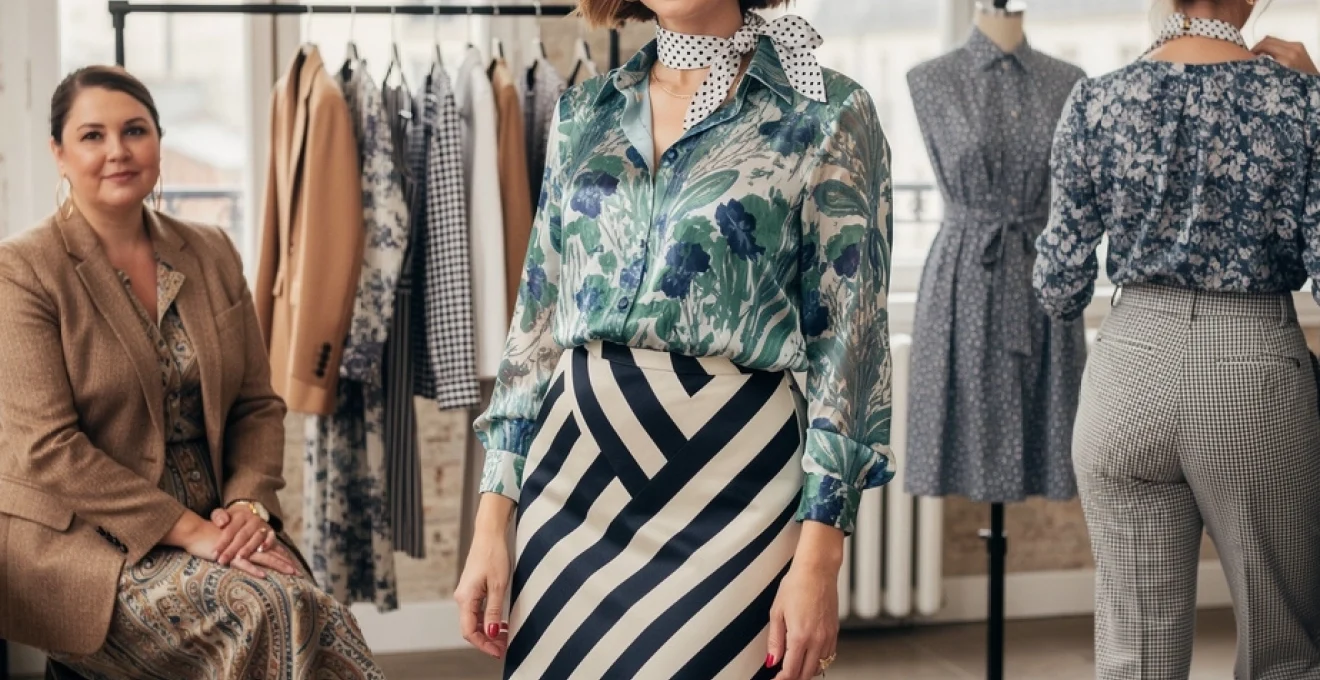
The art of combining patterns in fashion has evolved from tentative experimentation to confident self-expression. What once seemed like an exclusive skill reserved for professional stylists has become an accessible technique for creating dynamic, visually engaging outfits. Print mixing transforms your existing wardrobe into a playground of possibilities, where strategic combinations can multiply your styling options exponentially whilst maintaining sophistication and intentionality.
Modern fashion embraces the philosophy that clothing should reflect personality rather than conform to rigid rules. The key lies in understanding the fundamental principles that make certain combinations work harmoniously whilst others create visual chaos. Mastering print coordination requires both technical knowledge and intuitive understanding of how patterns interact with colour, scale, and texture to create cohesive looks.
Pattern theory fundamentals: scale, proportion, and visual weight in print coordination
Understanding the mathematical principles behind successful print mixing provides the foundation for creating visually balanced outfits. Pattern theory encompasses several key elements that determine whether combinations feel intentional or accidental. The relationship between different prints depends on their visual weight, which encompasses factors such as colour intensity, pattern density, and geometric complexity.
Visual weight operates similarly to physical weight on a scale – heavier elements need to be balanced by lighter ones or distributed strategically throughout an outfit. A bold leopard print carries significant visual weight, requiring either a delicate accompanying pattern or strategic placement to avoid overwhelming the overall look. This principle applies whether you’re working with two patterns or attempting more complex multi-pattern combinations.
Fibonacci ratio applications in stripe and polka dot combinations
The Fibonacci sequence provides a mathematical framework for creating pleasing proportional relationships between patterns. When combining stripes with polka dots, applying the golden ratio (approximately 1:1.618) to the scale relationship creates naturally harmonious pairings. A stripe measuring 5mm pairs beautifully with dots measuring approximately 8mm in diameter, following this mathematical principle.
This ratio application extends beyond simple measurements to encompass spacing and density. Fibonacci-based spacing between pattern elements creates visual rhythm that feels comfortable to the eye. Professional stylists often use this principle intuitively when selecting combinations that “just work” without understanding the mathematical foundation supporting their choices.
Dominant pattern selection using the 60-30-10 design rule
Interior designers rely on the 60-30-10 rule for balanced colour schemes, and this principle translates seamlessly to print mixing in fashion. The dominant pattern should occupy approximately 60% of the visual space, the secondary pattern 30%, and accent patterns or solid colours fill the remaining 10%. This distribution prevents any single element from overwhelming the composition whilst ensuring sufficient variety to maintain interest.
In practical application, this might manifest as a large floral print dress (60%) paired with a striped cardigan (30%) and leopard print shoes (10%). The proportional distribution creates hierarchy and guides the eye through the outfit in a controlled manner rather than creating competing focal points.
Visual weight balance through geometric versus organic pattern pairing
Contrasting geometric and organic patterns creates dynamic tension that energises an outfit without creating visual conflict. Geometric patterns – including stripes, checks, and abstract shapes – possess structured, predictable elements that provide stability. Organic patterns such as florals, paisleys, and animal prints introduce movement and softness that prevents rigidity.
The interplay between these contrasting pattern families generates sophisticated visual interest. Geometric stability anchors the outfit whilst organic elements add personality and movement. This pairing technique works particularly well when the patterns share colour elements, creating unity through chromatic connection despite their structural differences.
Scale progression techniques for seamless Multi-Pattern integration
Successfully combining three or more patterns requires careful attention to scale progression. Each pattern should occupy a distinctly different size category – micro, small, medium, or large – to prevent visual competition. This technique allows multiple patterns to coexist by ensuring each occupies its own visual space without overlapping or conflicting.
Scale progression also applies to pattern complexity. Simple patterns can be paired with more intricate designs provided their scales differ sufficiently. A micro-dot pattern works harmoniously with medium-scale florals and large
paisley motif when each occupies a different visual tier. Think of this as a staircase of scale: your eye moves smoothly from the smallest pattern to the largest, rather than getting stuck on a single busy area. When in doubt, assign one micro-print, one medium print, and one statement print, and let that hierarchy guide your combinations.
Colour harmony systems: analogous and complementary schemes in mixed prints
Once you understand scale and visual weight, the next layer of print mixing without guesswork is colour harmony. Even the most complex pattern clash can feel intentional when the colour story is controlled. Using established colour systems such as analogous and complementary schemes helps you decide which prints will cooperate and which will fight for attention.
Colour harmony in mixed prints works much like musical chords: certain notes naturally sound pleasant together, while others feel jarring. When you intentionally choose prints that share undertones or sit in a planned colour scheme, you reduce the risk of looking mismatched. Instead of relying purely on instinct, you can lean on practical frameworks to guide your choices.
Pantone colour bridge method for print coordination
The Pantone Colour Bridge system, originally designed to help translate Pantone colours into CMYK and RGB values, offers a surprisingly useful tool for wardrobe planning. By using a physical or digital colour bridge, you can identify the closest shared hues between two patterned garments and immediately see whether they will coordinate. This is particularly helpful when your prints come from different brands or seasons and do not look like obvious matches at first glance.
In practice, you can hold your garments up to a Pantone swatch fan and look for overlapping colour codes, or use a digital colour picker on photos of your clothes. If both prints share a similar Pantone reference or neighbouring swatches, they are likely to mix well in an outfit. This method takes the guesswork out of colour matching and is especially valuable when you want to create advanced print outfits for a capsule wardrobe without buying new pieces.
Monochromatic layering with tonal variations in liberty and toile prints
Monochromatic print mixing relies on one hue expressed at different intensities, which makes even bold pattern combinations feel refined. Classic Liberty florals and Toile de Jouy prints are ideal for this technique because they often come in restrained, two-colour palettes. When you layer Liberty and Toile in the same colour family—such as navy, burgundy, or forest green—you get instant harmony despite the differing motifs.
To make monochromatic layering work in everyday outfits, choose one pattern with more negative space and one with denser coverage. For example, a navy Toile blouse with white ground pairs beautifully with a Liberty-style skirt featuring a tighter navy floral on a matching white or off-white base. Because all elements sit within one colour family, you can afford to be more daring with scale and motif without the ensemble feeling chaotic.
Split-complementary schemes in paisley and gingham combinations
For those who enjoy bolder, editorial-style looks, split-complementary colour schemes offer a structured way to create striking contrast in mixed prints. A split-complementary scheme uses one base colour and the two adjacent colours to its direct complement on the colour wheel, giving you energy without the harshness of a strict complementary pairing. In print mixing, this is particularly effective with traditional motifs such as paisley and gingham.
Imagine a teal paisley blouse as your base print. On the colour wheel, the complement to teal is a warm coral; its split-complements might be soft peach and muted terracotta. A small-scale peach gingham skirt or trousers would then echo this split-complementary scheme without clashing. Because paisley is organic and swirling while gingham is rigid and geometric, you gain both structural contrast and colour sophistication in one outfit.
Neutral anchor points using camel, navy, and cream base tones
Neutral anchors act as the quiet framework that allows your mixed prints to shine. Camel, navy, and cream are particularly effective because they sit comfortably with both warm and cool palettes and appear frequently across seasonal collections. When you feel uncertain about a print clash, introducing one of these base tones in a solid garment or accessory immediately calms the composition.
In practice, you might pair a cream cable-knit jumper with a patterned skirt and printed scarf, or use a camel coat to soften a bold stripe-and-leopard combination. Navy trousers or denim function as a visual “grounding wire,” absorbing some of the visual energy from competing prints. By treating these neutrals as your outfit’s infrastructure, you create a safe backdrop for even daring print-mixing experiments.
Pattern categories and mixing hierarchies: from florals to geometrics
Not all patterns carry the same visual personality, and understanding broad pattern categories helps you build reliable mixing hierarchies. Florals, geometrics, abstract prints, animal motifs, and conversational prints each communicate a different mood. When you assign them roles—such as foundation, support, or accent—you reduce the risk of every piece shouting at once.
A simple hierarchy might position geometrics (stripes, checks, grids) as structural foundations, florals and paisleys as softeners, and animal prints or novelty motifs as accents. You could, for example, treat a pinstripe blazer as your “neutral,” layer a medium-scale floral blouse beneath, and then add a small leopard-print belt as a subtle tension point. By deciding in advance which category plays lead and which plays backup, you can compose complex outfits that still feel coherent.
Texture integration methods: incorporating tweed, silk, and corduroy elements
Texture is the often-overlooked ally of successful print mixing. While not technically prints, textured fabrics such as tweed, silk, corduroy, and bouclé add visual interest in a way that mimics subtle patterns. When you incorporate these fabrics, you gain depth and richness without introducing additional motifs that might compete with your existing prints.
Tweed, with its flecks of colour and woven complexity, behaves like a micro-print and can stand in for a patterned neutral. A tweed blazer over a printed dress, for example, gives the impression of pattern layering while remaining surprisingly easy on the eye. Corduroy’s ridged texture functions like a low-key stripe, offering structure that complements florals, abstract prints, and animal motifs. Silk, especially when matte or sand-washed, softens the overall effect and allows bold prints to drape fluidly rather than feeling stiff or overwhelming.
To integrate texture without clutter, consider a three-part formula: one obvious print, one textured “pseudo-print,” and one solid. For instance, pair a floral blouse (print) with corduroy trousers (texture) and a plain wool coat (solid). You still achieve the dimensionality of mixed prints, but the textural variation keeps the look sophisticated and wearable for day-to-day life.
Proportional guidelines for body silhouettes and print placement strategy
Beyond theory, print mixing becomes most powerful when you tailor it to your specific body silhouette. Strategic print placement can enhance your favourite features and de-emphasise areas you feel less confident about. Instead of thinking of prints as risky, you can treat them as tools—much like strategic lighting in photography—to direct where the eye lands first.
The key is aligning print density, scale, and brightness with the parts of your body you want to highlight. High-contrast, large-scale prints draw attention, while low-contrast, smaller patterns recede. When you combine this principle with basic knowledge of your body shape—hourglass, apple, pear, rectangle, or petite—you can plan outfits that feel both expressive and flattering.
Hourglass figure optimisation with diagonal and vertical print combinations
Hourglass figures typically feature balanced shoulders and hips with a defined waist, making them well-suited to print combinations that reinforce vertical and diagonal lines. Vertical stripes, chevrons, and diagonal plaids help elongate the body while still celebrating curves. When mixing prints, placing the bolder pattern either above or below the waist and using diagonal or vertical elements through the midsection keeps the overall effect balanced.
For example, an hourglass silhouette might pair a fitted vertical-stripe blouse with a medium-scale floral skirt, cinched with a solid belt to emphasise the waist. Diagonal patterns on dresses, such as wrap styles with cross-body stripes or angled geometrics, can visually sculpt the torso while allowing a secondary print in accessories—like a polka-dot scarf—to add nuance. By ensuring that the primary print supports the body’s natural lines, you avoid the boxy effect that sometimes occurs with horizontal or overly dense patterns.
Apple shape enhancement through strategic floral and abstract positioning
Apple-shaped bodies often carry more volume through the midsection with comparatively slimmer legs and arms. The goal in print placement is to draw attention vertically and towards the face and lower body, while keeping the central torso visually calm. Abstract prints with soft edges and medium-scale florals work well when placed on areas you wish to highlight, such as sleeves, hemlines, or necklines.
A practical strategy is to choose tops with vertical or diagonal print placement along the sides or sleeves and keep the central panel more subdued. Alternatively, you can opt for a softly patterned kimono or open-front jacket in a flowing fabric layered over a solid column of colour underneath. Pair this with patterned trousers—perhaps a subtle check or micro-print—to showcase the legs. This way, you still enjoy mixed prints, but the visual energy shifts away from the midsection and into more flattering zones.
Petite frame techniques using micro-prints and delicate pattern scales
Petite frames can be easily overwhelmed by large-scale, high-contrast prints, particularly when multiple patterns are involved. To avoid being “swallowed” by your clothes, favour micro-prints, fine stripes, narrow checks, and delicate motifs that respect your proportions. When mixing prints, keeping the scale relatively small across all pieces usually yields the most harmonious results.
One effective approach is to pair a tiny floral blouse with slim pinstripe trousers and then add a textured rather than printed outer layer, such as a cropped tweed jacket. Because all patterns stay within a similar, delicate scale, the overall look remains cohesive and lengthening. Monochromatic or low-contrast colour schemes further prevent visual chopping, helping you appear taller while still engaging in creative print coordination.
Plus-size styling with bold graphics and statement print focal points
Plus-size styling benefits significantly from intentional print placement and the confident use of bold graphics. Contrary to outdated advice that suggested avoiding prints altogether, current research into body image and style psychology indicates that well-chosen statement prints can boost confidence and presence. The key is to select one or two focal areas for your prints and allow the rest of the outfit to support rather than compete.
For instance, a plus-size dress with a large-scale botanical print concentrated down the centre panel creates a strong vertical line, especially when side panels are darker or in a smaller pattern. You can then introduce a second, smaller-scale print in accessories—such as a striped scarf or geometric earrings—to echo the colours without fragmenting the silhouette. Structured fabrics like cotton sateen, crepe, and ponte help bold prints sit smoothly on the body, avoiding the cling that can make patterns feel less comfortable to wear.
Professional styling techniques: capsule wardrobe print integration systems
Integrating print mixing into a capsule wardrobe may seem counterintuitive at first, but with a clear system, you can dramatically increase your outfit options without expanding your closet. The secret lies in building a controlled print ecosystem: a curated set of patterns that share colour stories, scale ranges, and pattern categories. Once these foundations are in place, you can mix almost any combination without second-guessing.
Start by selecting one to three hero prints that reflect your personal style—perhaps a classic stripe, a signature floral, and a favourite animal print. Ensure they sit within a unified colour palette, such as navy, cream, and rust, or black, white, and camel. Next, add two to four supporting prints in smaller scales or lower contrast, like micro-dots, subtle checks, or tone-on-tone jacquards. These act as bridges between your hero pieces.
From there, build your capsule around complementary solids and textured neutrals: denim, knitwear, leather, and woven cotton in your chosen base tones. With this framework, you can apply the principles covered earlier—scale progression, colour harmony, and texture integration—almost automatically. Instead of wondering “does this go?” you can ask more nuanced questions: “which print should be dominant today, and where do I want the eye to land first?” Over time, this system turns print mixing from a risky experiment into a reliable styling tool you can adapt season after season.