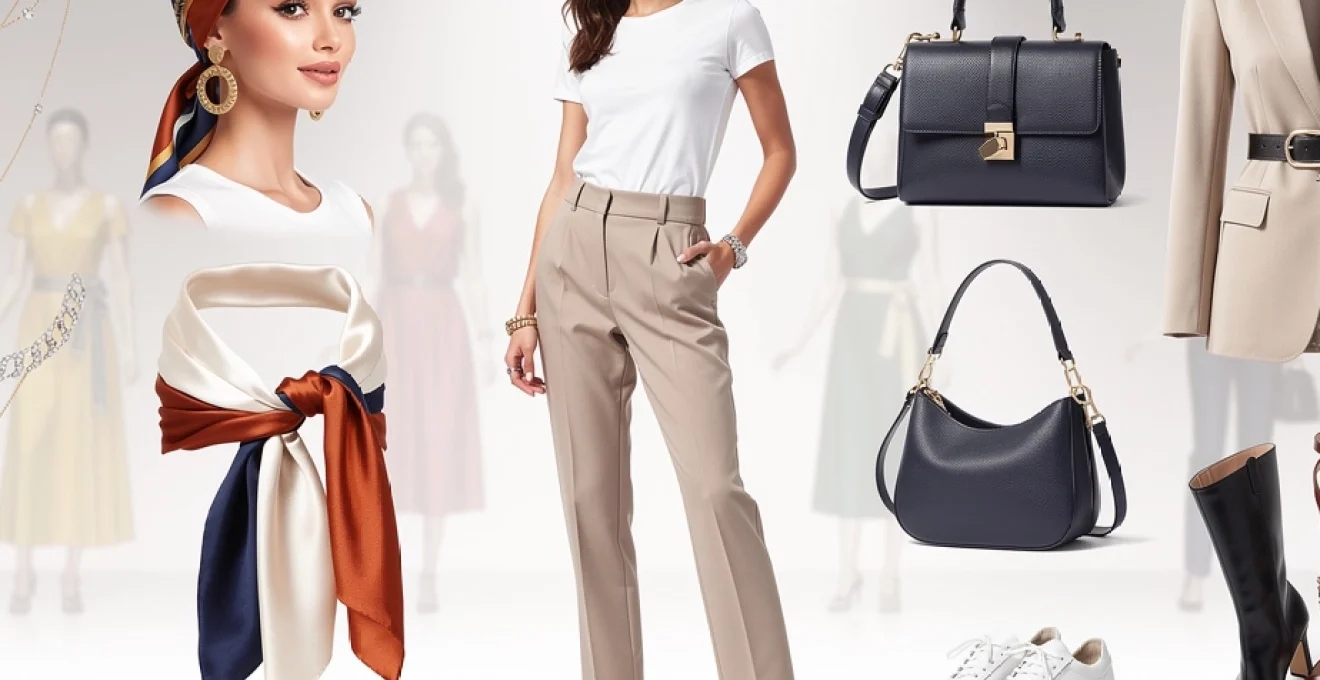
The difference between a basic ensemble and a stunning look often lies not in the garments themselves, but in the strategic deployment of carefully chosen accessories. Fashion psychology reveals that accessories serve as visual cues that can completely alter how others perceive your style, professionalism, and personality. A simple white shirt and black trousers can evolve from boardroom appropriate to evening chic, from casual weekend wear to artistic statement, all through the transformative power of thoughtful accessorising.
Understanding the art of accessory transformation requires mastering the delicate balance between restraint and impact. Each piece you add to an outfit should serve a purpose, whether that’s creating visual interest, enhancing your silhouette, or expressing your personal aesthetic. The most sophisticated dressers understand that accessories function like punctuation in written language – they provide emphasis, create pauses, and guide the observer’s eye through your entire look.
This transformative approach to styling has gained tremendous momentum in recent years, with the global fashion accessories market valued at approximately £761 billion in 2023. This growth reflects our collective understanding that strategic accessorising offers both economic and creative advantages, allowing fashion enthusiasts to maximise their wardrobe’s potential whilst expressing individual style.
Statement jewellery techniques for capsule wardrobe enhancement
The strategic deployment of statement jewellery represents one of the most powerful methods for transforming simple outfits into memorable ensembles. Modern jewellery design has evolved beyond mere ornamentation, becoming architectural elements that can completely restructure how an outfit reads visually. The key lies in understanding how different pieces interact with your clothing’s necklines, silhouettes, and overall aesthetic direction.
Bold jewellery choices should never feel accidental or overwhelming. Instead, they require careful consideration of proportion, placement, and visual weight. A single spectacular piece can anchor an entire look, whilst multiple coordinated elements can create sophisticated layering effects that demonstrate advanced styling knowledge. The contemporary approach favours intentional maximalism over minimalist restraint, provided each element serves the overall composition.
Layered necklace styling with pendant hierarchies
Creating compelling necklace layers requires understanding visual hierarchy and how different chain lengths interact with your neckline and torso proportions. The most successful layered looks establish a clear focal point whilst maintaining harmonious spacing between each element. Professional stylists typically work with odd numbers of necklaces – three or five pieces create more dynamic compositions than even numbers.
When building your layered look, start with your longest piece and work upwards, ensuring each subsequent chain sits at least two inches apart from its neighbours. This prevents tangling whilst creating distinct visual zones. Consider mixing textures and pendant sizes to add depth – a delicate chain might pair beautifully with a chunky statement piece, provided they share complementary metals or colour tones.
Oversized earring impact on facial proportion dynamics
Dramatic earrings possess unique transformative power, capable of completely altering your face’s perceived proportions whilst drawing attention upward to your features. The psychology of oversized earrings extends beyond mere fashion statement – they create a frame for your face that can enhance bone structure and add sophisticated drama to even the simplest outfits.
However, successful oversized earring styling requires careful consideration of your hairstyle, neckline, and other accessories. When wearing statement earrings, keep necklaces minimal or absent entirely, allowing the earrings to command full attention. Your hairstyle should complement rather than compete – sleek updos or side-swept styles typically showcase dramatic earrings most effectively.
Cocktail ring stacking methods for visual weight distribution
The art of ring stacking has evolved significantly beyond simple band accumulation, becoming a sophisticated method for creating visual interest and personal expression. Successful stacking requires understanding finger proportions, ring relationships, and how different metals and stones interact when grouped together. The goal is creating intentional asymmetry that appears effortlessly curated rather than accidentally accumulated.
Professional stylists recommend limiting heavy statement rings to one or two fingers per hand, using delicate bands to bridge between larger pieces. Consider varying ring heights – some sitting at finger bases, others positioned higher towards knuckles – to create dynamic compositions that move naturally with your gestures.
Balance becomes particularly important when integrating cocktail rings with other statement jewellery. If your hands feature bold, gemstone-heavy designs, keep bracelets minimal or skip them altogether to avoid overcrowding a small area of the body. Consider your lifestyle too – large stacked rings can be impractical for typing-heavy workdays but perfect for evening events where they serve as sparkling focal points. Ultimately, your ring stacks should feel comfortable, intentional, and aligned with the overall mood of your outfit.
Chunky chain integration with minimalist silhouettes
Chunky chains have emerged as modern wardrobe staples, especially for those who favour minimalist silhouettes and neutral colour palettes. Their solid, architectural presence provides an immediate style upgrade to simple outfits such as a white T-shirt and tailored trousers or a black slip dress. The contrast between a clean, pared-back base and a substantial chain creates visual tension that feels both contemporary and sophisticated.
When styling chunky chains, think in terms of single-impact pieces. One bold necklace, a substantial bracelet, or a heavy chain anklet is often enough to transform a look without tipping into excess. Pay attention to neckline placement – shorter chains work beautifully with crew necks and turtlenecks, while mid-length designs flatter V-necks and open shirts. If you enjoy layered looks, pair one chunky chain with one or two finer necklaces to maintain hierarchy and prevent the neck area from feeling overcrowded.
Metal choice also plays a crucial role in how your chunky chain reads within an outfit. High-shine gold delivers a polished, almost glamorous finish that pairs well with eveningwear and elevated day looks, whereas brushed or matte metals feel more understated and utilitarian. For capsule wardrobes, selecting one premium chunky chain in your preferred metal can offer enormous styling versatility, acting as a hero piece you return to across seasons.
Scarf styling methodologies for seasonal outfit adaptation
Scarves are among the most powerful accessories for transforming simple outfits, especially when you want to adapt the same base pieces for different seasons. A lightweight silk square can make a T-shirt and jeans feel Parisian in spring, while a chunky wool scarf can shift the same combination into cosy winter territory. The secret lies not only in fabric selection but in the specific scarf styling techniques you employ.
From French-inspired knots to creative belt-scarf hybrids, scarves can influence proportion, colour balance, and even how we perceive body lines. Because they sit close to the face and torso, small changes in placement can have a big impact on your overall look. As you explore different scarf styling methods, consider how each technique alters your silhouette and the mood of your outfit – does it feel more professional, more relaxed, or more dramatic?
French knotting techniques for neck elongation effects
The classic French knot is a refined method for styling silk and lightweight scarves that instantly elevates simple outfits like a white shirt or Breton stripe top. By controlling where the knot sits and how the fabric drapes, you can subtly influence the perceived length of your neck and torso. For elongation, the most flattering approach is to position the knot slightly off-centre and allow the scarf ends to fall vertically down the chest.
To create a traditional French knot, fold your square scarf into a long band, wrap it around your neck once, and tie a small, neat knot either just below your collarbone or to one side. The diagonal lines created by the fold help guide the eye downward, creating a lengthening effect similar to that of a pendant necklace. If you have a shorter neck or fuller bust, avoid wrapping the scarf too tightly; a little breathing room maintains elegance and comfort.
Colour and pattern placement also matter. A scarf with a border design will frame your face beautifully when the border sits close to the neckline, while central motifs become subtle focal points if positioned just below the collar. In professional environments, opt for restrained prints and refined fabrics; for weekends, experiment with bolder colours that inject personality into otherwise neutral outfits.
Belt-scarf hybrid applications in waist definition
Using a scarf as a belt is a highly effective way to define the waist and alter the silhouette of simple dresses, tunics, or oversized shirts. This belt-scarf hybrid technique introduces softness and colour where a classic leather belt might feel too rigid or formal. It can also be an elegant solution when you want to add shape without adding bulk, particularly with fluid fabrics.
To create a flattering line, choose a scarf that is long enough to wrap comfortably around your waist with some length left to drape. Tie the knot slightly off-centre and allow the ends to fall vertically – this draws the eye downward and can create the illusion of a longer torso. For petite frames, narrower scarves work best to avoid overwhelming the midsection, while taller figures can carry off wider styles and bolder prints.
This technique is particularly powerful for transforming a simple shift dress into something more intentional. A silk scarf-belt instantly adds colour, texture, and a sense of individuality, while also visually carving out a waist. In cooler months, you can layer a cardigan or blazer over the top, allowing just the tied ends to show – a subtle, sophisticated detail that signals considered styling.
Head wrap configurations for contemporary professional settings
Head wraps and scarf-based head coverings have moved firmly into the realm of contemporary professional style, offering both cultural expression and polished practicality. When integrated thoughtfully, they can transform even the simplest outfit into a distinctive, put-together look suitable for modern workplaces. The key lies in choosing refined fabrics, clean lines, and configurations that complement your facial structure.
For a streamlined, office-appropriate effect, opt for smooth, non-bulky ties that sit close to the head. Turban-style wraps with a single front twist or knot offer structure and elegance, especially when rendered in solid, neutral tones or subtle prints. This configuration frames the face and can highlight features such as cheekbones and eyes, much like a well-chosen pair of statement earrings.
Consider coordination with your other accessories to create harmony rather than competition. If your head wrap is patterned or brightly coloured, keep jewellery minimal and your handbag structured and simple. Conversely, a solid, understated wrap provides the perfect backdrop for bold earrings or a strong red lip. In all professional contexts, ensure the wrap feels secure and comfortable, allowing you to move through your day with confidence rather than constantly adjusting your styling.
Shoulder draping methods using silk square proportions
Shoulder draping with silk squares is one of the most subtle yet impactful ways to elevate a simple outfit, particularly for evening events or creative professional settings. The way a scarf falls over your shoulders can soften sharp tailoring, add colour near the face, and even alter the perceived width of your upper body. Proportion is crucial – the dimensions of your silk square directly influence the drape and final effect.
A classic 90x90cm silk square offers the most versatility. Folded into a triangle and placed over the shoulders, it can be worn with the point at the back for a traditional, cape-like effect, or rotated so the point falls forward, creating a dramatic focal line down the centre of the torso. The diagonal lines of the triangle help visually narrow the shoulders, which can be particularly flattering with broad-shouldered blazers or strapless dresses.
For a more modern, understated approach, try folding the square into a narrow band and placing it across one shoulder like a sash, then securing it with a small knot or brooch at the opposite hip. This asymmetrical draping introduces movement and sophistication, transforming a simple sheath dress or monochrome trouser suit into something gallery-opening ready. As always, ensure the scarf’s colours coordinate with your outfit’s palette to avoid visual noise.
Handbag selection algorithms for outfit elevation
Handbags are arguably the most functional of all accessories, yet from a styling perspective they also act as powerful visual anchors that can make or break a simple outfit. Choosing the right bag involves more than just matching colours; you are effectively selecting a three-dimensional shape that interacts with your body lines and clothing silhouettes. A well-chosen handbag can elongate, streamline, or add structure where needed.
When we think in terms of a “handbag selection algorithm”, we are really developing a decision-making process that considers formality level, outfit volume, body proportions, and colour strategy. Instead of owning dozens of bags, a small, curated rotation chosen with these criteria in mind will work harder for your wardrobe. This is particularly valuable for capsule dressing, where accessories do much of the heavy lifting in outfit transformation.
Structured vs. slouchy bag geometry in body line enhancement
The geometry of your bag – whether structured or slouchy – has a direct impact on how your overall silhouette is perceived. Structured bags with defined edges and firm construction introduce clarity and polish, often making casual outfits feel more intentional. They echo the lines of tailored garments, which is why you frequently see them paired with blazers, crisp shirts, and sharp trousers.
Slouchy bags, by contrast, follow the body’s natural curves and add softness to more rigid ensembles. When worn with minimalist, streamlined looks, a relaxed hobo bag or oversized tote can prevent the outfit from feeling too severe. The trick is to balance your clothing volume with your bag choice: if you are wearing wide-leg trousers and an oversized coat, a very large slouchy bag may add unnecessary bulk, whereas a medium-sized structured bag will create definition.
Pay attention to where the bag falls on your body. Shoulder bags that hit at the hip draw the eye to that point, potentially widening the appearance of the midsection. Crossbody bags that sit slightly higher can create a more flattering diagonal line across the torso, breaking up straight verticals. If you are petite, avoiding overly deep or wide bags will help maintain visual proportion and prevent the outfit from feeling weighed down.
Colour blocking strategies with contrasting leather textures
Handbags offer an excellent canvas for colour blocking, particularly when you want to transform a simple, neutral outfit into something more visually engaging. Rather than matching your bag exactly to your shoes or clothing, consider using it as a deliberate contrast point within a controlled colour story. For example, a cobalt blue bag against a camel coat and denim creates a strong, modern focal point without overwhelming the look.
Texture plays an equally important role. Contrasting leather finishes – such as pairing a smooth calfskin bag with suede boots, or a pebbled leather tote with patent loafers – adds depth and sophistication to otherwise simple outfits. The combinations function much like mixing matte and gloss finishes in interior design; the interplay of surfaces keeps the eye interested while remaining within a cohesive palette.
When experimenting with colour blocking through handbags, limit yourself to one or two accent shades alongside your core neutrals. This ensures that the bag acts as a considered style choice rather than a random pop of colour. If you are new to bold hues, start with jewel tones like emerald, burgundy, or deep teal – they tend to pair harmoniously with black, grey, navy, and beige, making them highly versatile in a capsule wardrobe.
Mini bag trend integration with maximalist accessory layering
The mini bag trend shows no sign of slowing down, and while these diminutive pieces may not carry your entire life, they offer enormous styling potential. Because mini bags occupy less visual space, they pair particularly well with maximalist accessory layering – think stacked bracelets, layered necklaces, or statement earrings. The small scale of the bag ensures that your look remains balanced rather than overloaded.
When you are working with a simple base outfit, such as a slip dress or tailored jumpsuit, a mini bag can act as a jewel-like accent. Worn crossbody or carried by the handle, it draws the eye without obscuring the clean lines of your clothing. This makes mini bags ideal for evening events, dinners, or occasions where you only need your essentials and want your outfit itself to take centre stage.
To keep the look cohesive, echo one element of the mini bag – perhaps its hardware tone, colour, or texture – in another accessory. For instance, a cherry-red mini bag can be mirrored by a red lip or a subtle stripe in a silk scarf. This repetition creates an underlying structure that allows for more adventurous layering elsewhere without losing overall harmony.
Hardware finish coordination across multiple accessories
Hardware – the metal elements on bags, belts, shoes, and jewellery – often acts as the invisible thread that ties an outfit together. While strict matching is no longer a requirement, thoughtful coordination of hardware finishes can make even the simplest outfit feel meticulously styled. The goal is to create a sense of deliberate repetition rather than rigid uniformity.
If your handbag features prominent gold hardware, for example, you might choose earrings or a watch with gold tones, even if your rings are mixed-metal. This creates a primary metal story with subtle variation, much like a well-curated gallery wall where frames share a common aesthetic. Similarly, if your shoes have silver buckles, echoing this in your belt or bracelets can produce a coherent, polished effect.
In capsule wardrobes, it is wise to decide on one dominant metal family (warm or cool) for your everyday hardware, then introduce a few mixed-metal pieces to bridge any gaps. This approach simplifies decision-making and ensures that bags, belts, and jewellery can be interchanged with minimal friction. When your accessories “speak the same language”, transforming a simple outfit becomes a quick, intuitive process.
Belt styling architecture for silhouette reconstruction
Belts are architectural tools for the body, capable of redrawing your silhouette with a single, decisive line. On simple outfits, they can create waistlines where none exist, break up long expanses of fabric, and shift the overall proportion of your look. Rather than viewing a belt as a mere practical item, consider it as a horizontal or diagonal element in your personal design blueprint.
For straight-cut dresses, shirt dresses, or oversized knits, positioning a belt at the natural waist instantly adds shape and femininity. If you prefer a more modern, elongated look, experiment with dropping the belt slightly to the high hip, which can lengthen the torso and create a relaxed, nonchalant feel. Wide belts work well over structured fabrics and tailored pieces, while slim belts are better suited to delicate materials and subtle definition.
Colour contrast is a powerful tool in belt styling. A dark belt on light fabric creates a strong, graphic statement that emphasises the waist, whereas a tone-on-tone belt blends more seamlessly, offering shape without drawing too much attention. Textured belts – braided leather, embossed patterns, or fabric ties – can add depth to monochrome outfits and serve as quiet focal points that signal advanced styling.
Footwear transformation tactics for outfit genre shifting
If accessories are the punctuation of an outfit, footwear is often the paragraph break – changing your shoes can shift the entire “genre” of your look. The same base of jeans and a blazer, for instance, can read as off-duty, office-ready, or evening-appropriate depending on whether you pair it with trainers, loafers, or heels. This makes shoes one of the most efficient tools for transforming simple outfits without changing your core garments.
To harness this power intentionally, start by identifying three or four footwear archetypes that align with your lifestyle: perhaps white trainers, sleek ankle boots, classic loafers, and a pair of heeled sandals. Each style carries a distinct mood. Trainers suggest ease and modernity, loafers signal polish and professionalism, boots introduce edge and structure, and heels add drama and formality. Asking yourself, “What story do I want this outfit to tell today?” can quickly guide your choice.
Texture and colour further refine the transformation. Patent or high-shine finishes push an outfit toward dressier territory, while suede and canvas feel more relaxed. Neutral-toned shoes blend into the overall look, elongating the leg line, whereas bold colours or metallics act as statement pieces in their own right. By rotating footwear thoughtfully, you can make a small, everyday capsule wardrobe feel surprisingly expansive and adaptable.
Seasonal accessory rotation systems for year-round versatility
Developing a seasonal accessory rotation system is one of the most effective ways to keep simple outfits feeling fresh throughout the year. Rather than completely overhauling your wardrobe each season, you strategically swap out key accessories – scarves, bags, jewellery, and shoes – to reflect changing weather, trends, and mood. This approach maximises the cost-per-wear of your core garments while satisfying the natural desire for visual variety.
In practice, this might mean favouring straw bags, woven belts, and lightweight, colourful jewellery in spring and summer, then transitioning to leather totes, structured belts, and richer metal tones in autumn and winter. Scarves move from airy cotton and silk to cashmere and wool, while footwear shifts from open-toe sandals and espadrilles to boots and loafers. Each rotation subtly re-contextualises your simple outfits, making them feel seasonally appropriate and intentionally styled.
To create a system that works for you, start by dividing your accessories into seasonal categories and storing off-season pieces neatly out of sight. At the beginning of each season, “shop” your own collection, selecting a small edit of items that will form your accessory capsule for the coming months. This deliberate limitation encourages creativity and helps you see just how transformative the right accessories can be, no matter how simple your underlying outfits may be.