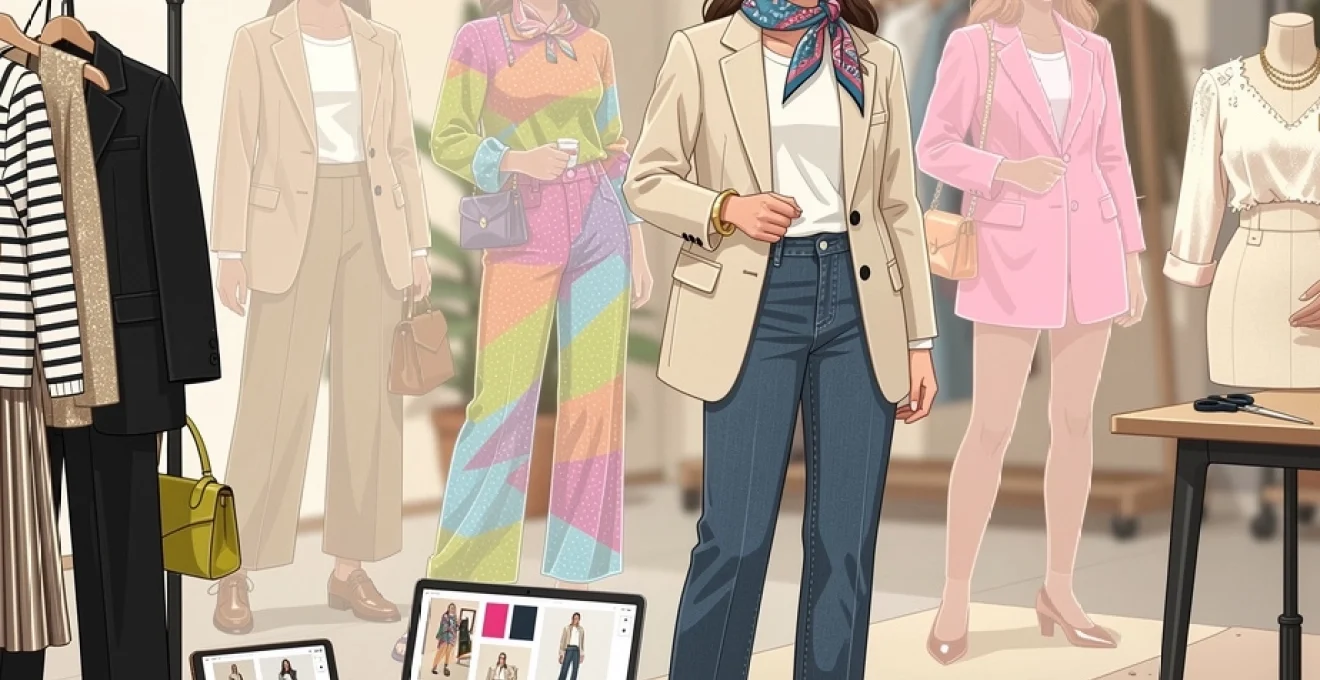
Fashion trends arrive with dizzying frequency in today’s hyperconnected world, sweeping across social media platforms and high streets before disappearing just as quickly. The modern fashion enthusiast faces an unprecedented challenge: how to remain current and stylish whilst maintaining an authentic personal identity that transcends seasonal whims. This tension between staying relevant and preserving individuality has become one of the defining struggles of contemporary dressing, particularly as digital platforms accelerate trend cycles to unprecedented speeds. The solution lies not in rejecting trends entirely nor in blindly following every passing fad, but in developing a sophisticated framework that allows you to selectively integrate trends into a coherent personal aesthetic. Understanding this balance transforms fashion from a source of anxiety into a genuine tool for self-expression.
Decoding contemporary fashion cycles: microtrends vs macrotrends
The fashion landscape has fundamentally shifted over the past decade, creating distinct categories of trends that operate on vastly different timescales. Macrotrends represent broader aesthetic movements that influence fashion for several years, such as the ongoing athleisure revolution or the return to 1990s minimalism. These substantial shifts reflect deeper cultural changes and typically offer safer entry points for personal wardrobe investment. Conversely, microtrends burn brightly but briefly, often lasting mere weeks or months before vanishing from the cultural conversation entirely. Understanding this distinction forms the foundation of intelligent trend participation.
Understanding the TikTok-Driven 20-year trend acceleration
Social media platforms, particularly TikTok, have compressed what once took decades into months. The traditional 20-year fashion cycle—whereby styles from two decades prior return to prominence—now operates at warp speed, with aesthetics from the early 2000s, 1990s, and even 1980s simultaneously competing for attention. This acceleration creates a peculiar phenomenon where multiple eras coexist in the fashion marketplace, allowing you unprecedented freedom to cherry-pick elements that genuinely resonate with your personal style. The challenge lies in discerning which revivals align with your aesthetic identity rather than simply chasing viral moments. Recent data suggests that trending hashtags on TikTok can generate demand spikes of up to 275% for specific garment types within just 48 hours, illustrating the breathtaking pace of contemporary trend propagation.
Distinguishing between seasonal runway trends and timeless silhouettes
Runway presentations serve two distinct functions: showcasing artistic vision and predicting commercial direction. Not every theatrical runway moment translates to wearable fashion, and recognising this distinction saves considerable wardrobe investment. When viewing collections from major fashion houses, look beyond the spectacle to identify recurring silhouettes, colour stories, and fabrications that appear across multiple designers. These commonalities represent the genuine directional trends worth considering. Meanwhile, certain silhouettes—the well-cut blazer, the crisp white shirt, the perfectly tailored trouser—transcend seasonal fluctuation entirely. Building your wardrobe around these timeless foundations whilst incorporating trend elements as accents creates sustainable style longevity.
Analysing fashion forecasting agencies: WGSN and peclers paris methodologies
Professional trend forecasting agencies like WGSN and Peclers Paris predict fashion directions 18 to 24 months in advance, analysing cultural movements, technological developments, and societal shifts to anticipate consumer desires. Their methodologies combine data analytics with cultural anthropology, examining everything from street style in Tokyo to emerging art movements in Copenhagen. Whilst these services primarily target industry professionals, understanding their approach helps you recognise genuine cultural shifts versus manufactured hype. Forecasters identify macro trends by tracking patterns across multiple industries—architecture, automotive design, technology—recognising that fashion rarely exists in isolation. This broader perspective allows you to distinguish between fleeting Instagram moments and substantive aesthetic movements worthy of personal investment.
Identifying your personal style archetype beyond trend categories
Before engaging with any trend, establishing your foundational style archetype proves essential. Are you drawn to romantic, flowing silhouettes or sharp, architectural tailoring? Do you gravitate towards maximalist pattern mixing or refined minimalism? Your archetype functions as a compass, guiding which trends deserve your attention and which you can confidently ignore.
Rather than boxing yourself into trend labels like “clean girl aesthetic” or “blokecore”, explore style archetypes that feel psychologically true to you: classic, romantic, edgy, bohemian, minimalist, avant-garde, sporty, and so on. You might be a “modern classic with a soft romantic twist” or “minimalist with an occasional edgy detail”. This language helps you evaluate a fashion trend not as a mandate, but as raw material. Ask yourself: how would this look filtered through my archetype? A biker boot, for instance, might be perfect in shiny patent and sharp lines for an edgy dresser, but better in soft leather and a sleeker shape for someone more romantic or minimalist. Once you understand your archetype, you stop chasing every new microtrend and instead adapt only the ones that support your long-term style identity.
Building a capsule wardrobe framework with strategic trend integration
A capsule wardrobe provides the structural backbone that allows you to follow fashion trends without losing your personal style. Think of it as the “operating system” of your closet: a cohesive set of pieces that work together in many combinations, regardless of what is currently in vogue. Trends then become like optional apps you can install or remove without destabilising the whole system. When you approach trend participation with this framework, you can enjoy the novelty of new looks while keeping your daily dressing simple, efficient, and authentic.
The 70-30 rule: balancing investment pieces with trend experiments
A practical way to structure your wardrobe is the 70-30 rule. Aim for around 70% of your clothes to be timeless, high-rotation pieces that match your personal style archetype, and reserve the remaining 30% for trend-driven experiments. This ratio ensures that your core wardrobe remains stable and wearable for years, while still allowing space for seasonal fashion trends and new aesthetics you want to explore.
In the 70% category, include items like well-fitting jeans, quality knitwear, neutral coats, tailored blazers, and shoes that suit your lifestyle. Your 30% might consist of a statement colour of the season, a currently popular silhouette like cargo trousers, or an of-the-moment accessory such as chunky loafers. If you tend to feel overwhelmed by choice, you can even apply the 70-30 principle to your budget rather than item count, dedicating most of your spend to durable investment pieces and a smaller portion to short-lived trends.
When a new trend appears, ask where it belongs: is it something you could see yourself wearing for at least three years, or is it more of a playful experiment? Positioning it inside this framework gives you permission either to invest more seriously or to seek a low-cost, low-commitment version. Over time, you will notice that some “trend” pieces migrate into your 70% core, because they continue to align with your personal style even after their mainstream moment has passed.
Applying the five-piece french wardrobe philosophy to modern trends
The Five-Piece French Wardrobe philosophy offers another helpful constraint in a world of constant fashion stimulation. Traditionally, it suggests maintaining a strong base of essentials and then adding only five new, non-basic pieces per season. In an era where dozens of microtrends surface each month, this disciplined approach forces you to be highly selective about which fashion trends you follow.
To adapt this concept today, start by defining your “non-negotiable basics”: the jeans, shirts, sweaters, and shoes you rely on weekly. Then, for each fashion season (typically spring/summer and autumn/winter), identify up to five items that meaningfully refresh your looks. These might be a trending colour bag, a new trouser shape, or a fashion-forward shoe. Because your allowance is limited, you will automatically evaluate trends more critically: is this something I will still love in a year? Does it integrate with my capsule wardrobe? Does it reflect my style archetype?
This method is particularly effective if you are easily swayed by social media hauls and “must-have” lists. Treat each of your five pieces like a serious decision, not an impulse purchase. Many people find that when they plan those five additions in advance, they avoid buying duplicates, near-duplicates, or items that only work with one specific outfit, resulting in a wardrobe that feels far more curated and luxurious.
Curating transitional accessories for trend adaptation
Accessories are one of the most efficient tools for following fashion trends without compromising your personal style or overhauling your wardrobe. A pair of shoes, a bag, or statement jewellery can signal that you are current, even when the rest of your outfit consists of classic basics. Think of accessories as the punctuation marks of your look: subtle changes in shape, colour, or scale can shift your entire style sentence.
When curating accessories, focus on pieces that can transition across seasons. For example, a structured mini bag in a trending colour can be worn with coats in winter and dresses in summer, while jewellery influenced by a particular era (such as chunky ’90s chains) works year-round. Scarves, belts, and hats are low-risk entry points into new trends, especially if you are unsure whether they will suit you long term. If a microtrend such as “balletcore” or “Western boots” appeals to you, you may find that adopting just one accessory—like ballet flats or a subtle Western-inspired belt—is enough to acknowledge the trend while staying grounded in your own aesthetic.
To keep your accessory collection from becoming cluttered, periodically review which pieces you reach for most often. If a once-beloved trend accessory now feels forced or incompatible with your outfits, consider reselling or donating it. A streamlined but intentional accessory wardrobe allows each piece to have impact, rather than getting lost in visual noise.
Implementing colour theory: seasonal palettes within your personal colour analysis
Colour is one of the most powerful—and potentially confusing—dimensions of fashion trends. Neon greens, hyper-brights, and ultra-muted earthy tones may dominate runways one season, only to be replaced by pastels or jewel tones the next. Personal colour analysis, typically divided into seasonal palettes such as Spring, Summer, Autumn, and Winter, gives you a stable reference point within this constant flux. Instead of asking “Is this colour in style?” you can ask “Is this version of the colour in harmony with my undertones?”
For instance, if you fall into a cool, bright Winter palette, icy pinks and electric blues will likely flatter you far more than dusty rose or warm camel, regardless of trend. An Autumn palette, by contrast, will shine in rich terracotta, olive, and mustard. When a new colour trend emerges—say, a wave of “Bottega green” or “Viva Magenta”—you can seek out a shade within that family that matches your season. This strategy lets you participate in colour trends in a way that enhances your appearance rather than fighting your natural colouring.
If you have never had a formal colour analysis, start by observing which colours consistently earn you compliments and which ones make you look tired or washed out. Use those observations to create a personal colour mood board and treat it as your North Star when shopping. Over time, you will find that your wardrobe feels more cohesive, and even bolder trends in colour become easier to incorporate because they interact harmoniously with what you already own.
Selective trend adoption through body proportions and personal colouring
Maintaining your personal style whilst following fashion trends also requires an honest understanding of your body proportions and individual colouring. Trends often showcase extreme silhouettes or styling tricks that look striking in editorial imagery but may not align with your physical reality or comfort levels. Rather than viewing this as a limitation, treat your body’s proportions as a design brief. Your task is not to replicate a runway look exactly, but to translate its essence into lines, lengths, and colours that support your unique frame.
Adapting oversized blazers and wide-leg trousers to your body type
Oversized blazers and wide-leg trousers are prime examples of macrotrends that can either elevate your style or overwhelm you, depending on how you adapt them. On a petite frame, an aggressively boxy blazer and extra-long puddle trousers may create the impression of drowning in fabric. If you love the tailored yet relaxed mood of this trend, consider a “soft oversized” approach instead: choose a blazer that is one size up from your usual with slightly extended shoulders, but ensure it still nips in gently at the waist and ends no lower than mid-thigh.
For wide-leg trousers, pay close attention to rise, length, and fabrication. High-waisted styles that sit at your natural waist can visually lengthen the legs, especially when paired with a tucked or cropped top. If you are tall, you may enjoy a dramatic, floor-skimming cut; if you are shorter, aim for a length that just kisses the top of your shoes to avoid visually cutting off your silhouette. Fluid fabrics create movement and elegance, while stiffer textiles feel more architectural and bold—choose based on your style archetype as well as your body type.
Regardless of height or shape, balance is key. If your blazer and trousers are both voluminous, anchor the look with a fitted top, defined waist, or sleek footwear. Alternatively, pair a wide-leg trouser with a neat, cropped jacket; or an oversized blazer with slimmer, straight-leg bottoms. When you view these trending pieces as adjustable variables rather than fixed rules, you can fine-tune proportions until they feel authentically you.
Translating dopamine dressing and barbiecore through your colour season
Dopamine dressing—the idea of wearing bright, joyful colours to boost mood—and trends like Barbiecore have pushed vivid pinks, neons, and saturated hues into the spotlight. For some, this is a natural extension of their personal style; for others, it can feel like wearing a costume. The key is to interpret these trends through the lens of your colour season and your comfort with visual intensity.
If you are a cool-toned Winter, you may thrive in hot magenta, fuchsia, or vibrant cobalt—classic dopamine dressing colours that also overlap with Barbiecore. A warm Spring might choose juicy coral, clear yellow, or bright turquoise instead of icy pink. Summers, who suit softer cool tones, could lean into dusty rose, periwinkle, or softened berry shades, capturing the spirit of the trend without overwhelming their delicate colouring. Autumns might interpret dopamine dressing through rich pumpkin, teal, or deep raspberry rather than bubblegum pink.
Not ready to commit to a head-to-toe bright ensemble? Start with accents. A vivid bag, shoe, or lipstick can deliver the same psychological lift at a fraction of the visual volume. You might also layer a bold colour under or over your trusted neutrals, such as a bright knit under a navy blazer. In this way, you participate in the mood-boosting element of the trend whilst staying aligned with the colours that genuinely flatter you.
Modifying fast fashion silhouettes: tailoring techniques for personalisation
Fast fashion often delivers trending silhouettes in generic shapes that are designed to fit “everyone” and therefore flatter almost no one. Subtle tailoring can transform these pieces from disposable to distinctive and aligned with your personal style. Think of tailoring as the final design stage rather than an afterthought: you are customising a template to suit your body and aesthetic.
Common alterations include shortening hems, taking in or letting out side seams, adjusting sleeve length, and refining shoulder fit. For example, if you like the idea of ultra-baggy jeans but find them sloppy on your frame, a tailor can taper the leg slightly below the knee or refine the waistband so they sit more securely at your natural waist. Oversized shirts can be reshaped with darts or by narrowing the sleeves, creating a look that still nods to the relaxed trend but feels intentional rather than accidental.
If you enjoy DIY projects, small modifications—such as cropping a T-shirt, removing shoulder pads, or changing buttons—can also shift an item closer to your style archetype. Swapping generic plastic buttons for metal, mother-of-pearl, or tortoiseshell, for instance, can turn a mass-market blazer into something that looks far more premium and aligned with your taste. When you personalise silhouettes in this way, you not only improve fit but also ensure that even widely popular trends feel unique on you.
Creating a personal style mood board using digital curation tools
One of the most effective ways to navigate fashion trends without losing yourself is to externalise your taste through a mood board. Seeing your preferences collected in one place makes patterns visible: recurring colours, silhouettes, textures, and styling details that might otherwise go unnoticed. In the past, this meant tearing pages from magazines; today, digital curation tools provide a far more flexible and interactive experience.
Platforms such as Pinterest, Instagram Collections, and even simple folder systems on your phone or computer allow you to save outfits, runway looks, street style images, and product photos. As you curate, focus not only on what is trending now, but also on looks that have inspired you for years. Ask yourself: what elements do I keep coming back to? Are there shapes or colour combinations that appear across eras? This process helps you distinguish between long-standing style preferences and fleeting curiosities.
Once you have assembled 50–100 images, review them with a critical eye. You might notice, for example, that you consistently favour monochrome outfits, or that almost every saved look includes a structured jacket. These insights can guide future purchases far more reliably than any single trend report. Your mood board becomes a living reference document: before adding a new piece to your wardrobe, compare it to your collection of images and ask whether it feels at home among them. Over time, this habit strengthens your style identity and makes it far easier to participate selectively in trends that truly belong in your visual universe.
Sustainable trend participation through second-hand and vintage channels
The rapid acceleration of fashion cycles has serious environmental consequences, from textile waste to overproduction. Fortunately, you do not have to choose between sustainability and staying current. Second-hand, vintage, and rental channels allow you to experiment with trends at a lower environmental cost—and often with higher quality garments. In many cases, you can even find earlier versions of the very styles currently being revived, such as original 1990s slip dresses or 1980s blazers.
Sourcing archive pieces from vestiaire collective and the RealReal
Online resale platforms specialising in designer and premium brands, such as Vestiaire Collective and The RealReal, are invaluable resources for curated archive fashion. These sites aggregate pieces from past seasons, offering access to silhouettes and fabrics that may no longer be widely available in stores. If a current trend is rooted in a specific era or designer reference—like Y2K denim, ’90s minimalism, or 1970s boho—you can often find authentic versions that were made with superior materials and construction.
When browsing these platforms, search by category, decade, or key term rather than solely by brand. For instance, instead of looking for a particular label, try “vintage wide-leg trousers wool” or “90s slip dress bias cut”. Read descriptions carefully to understand condition and measurements, and take advantage of any authentication or return policies offered. Because many archive items are one-of-a-kind, this approach also helps ensure your take on a trend remains distinctive rather than identical to what everyone else is wearing.
By investing in pre-loved pieces, you are effectively extending the life cycle of garments that already exist, reducing demand for new production. This aligns with a more mindful approach to style: you can indulge in designer influences and explore fashion trends while contributing less to the churn of fast fashion.
Renting trend pieces via by rotation and HURR collective
Clothing rental platforms, including services like By Rotation and HURR Collective in the UK, offer another sustainable way to engage with trends. Renting is particularly useful for standout pieces you know you will not wear frequently: event dresses, statement outerwear, or highly recognisable items that may feel dated after a single season. Instead of purchasing a dress you will wear once for a wedding or holiday party, you can borrow a current, fashion-forward piece and then return it.
From a personal style perspective, rental also functions as a testing ground. Curious about a bold silhouette or colour but hesitant to commit? Renting lets you live with the trend briefly, notice how confident you feel wearing it, and assess how it photographs and fits into your lifestyle. If you adore the experience, you may decide to invest in a similar piece for your permanent wardrobe; if not, you have satisfied your curiosity without adding clutter or waste.
To make renting work seamlessly, plan ahead for special occasions and browse platforms with your mood board in mind. Look for items that echo your style archetype rather than choosing something radically outside your usual preferences just because it is available. This ensures that even your most experimental outfits still feel like an extension of you.
Upcycling fast fashion items: DIY techniques for personalised modifications
Upcycling turns existing garments—especially those from fast fashion—into unique pieces more closely aligned with your personal style. Instead of discarding items that feel slightly off, you can rework them with simple DIY techniques. This might involve cropping a top, dyeing a faded dress, adding panels of contrasting fabric, or transforming a dress into a skirt. The result is a garment that both participates in a trend and carries your individual signature.
If you are new to upcycling, start small. Changing buttons, shortening sleeves, or adding a fabric belt can dramatically shift a piece’s personality with minimal sewing skills. For more advanced projects, you might combine elements from multiple items—using the sleeves from one shirt on another, or turning an oversized men’s blazer into a tailored, waist-defining jacket. Online tutorials and sewing communities provide step-by-step guidance, making the learning curve more accessible than ever.
Beyond the environmental benefits, upcycling can deepen your connection to your wardrobe. When you have invested time and creativity into modifying a piece, it becomes less disposable and more meaningful. You are no longer a passive consumer of trends but an active co-creator, shaping fashion to fit your body, taste, and values.
Developing style confidence through fashion psychology and self-expression techniques
Ultimately, following fashion trends without losing your personal style is as much a psychological process as it is a practical one. Confidence grows when your outer presentation feels aligned with your inner sense of self. Fashion psychology research suggests that what we wear can influence not only how others perceive us, but also how we think and behave—a phenomenon sometimes referred to as “enclothed cognition”. When your clothes support your identity rather than contradict it, you are more likely to feel grounded and self-assured, even in experimental outfits.
One useful technique is to develop a set of “style affirmations”—not in the sense of vague positive statements, but as clear descriptors of how you want to feel in your clothes. For example: “I feel sharp and composed”, “I feel playful yet polished”, or “I feel quietly powerful”. When considering a new trend piece, ask whether it helps you access these states. If an item looks exciting on the hanger but makes you feel self-conscious or unlike yourself, it may not be the right trend for you, regardless of how popular it is.
Another psychological strategy is gradual exposure. If a trend pushes you slightly outside your comfort zone in a way that intrigues you, introduce it in small doses rather than all at once. You might start by wearing a bold shoe with an otherwise familiar outfit, or by trying a new silhouette at home before taking it into public spaces. This step-by-step approach allows your self-image to adjust, reducing the risk that you will abandon a piece after one wear because it feels “too much”.
Most importantly, give yourself permission to opt out. True style confidence includes the ability to say, “This is a beautiful trend, but it is not for me,” without guilt or fear of missing out. When you build a wardrobe that respects your body, colouring, lifestyle, and psychological comfort, trends become optional tools rather than tyrannical rules. You can then enjoy fashion as a dynamic, evolving language for self-expression—one in which your personal voice always remains at the centre.