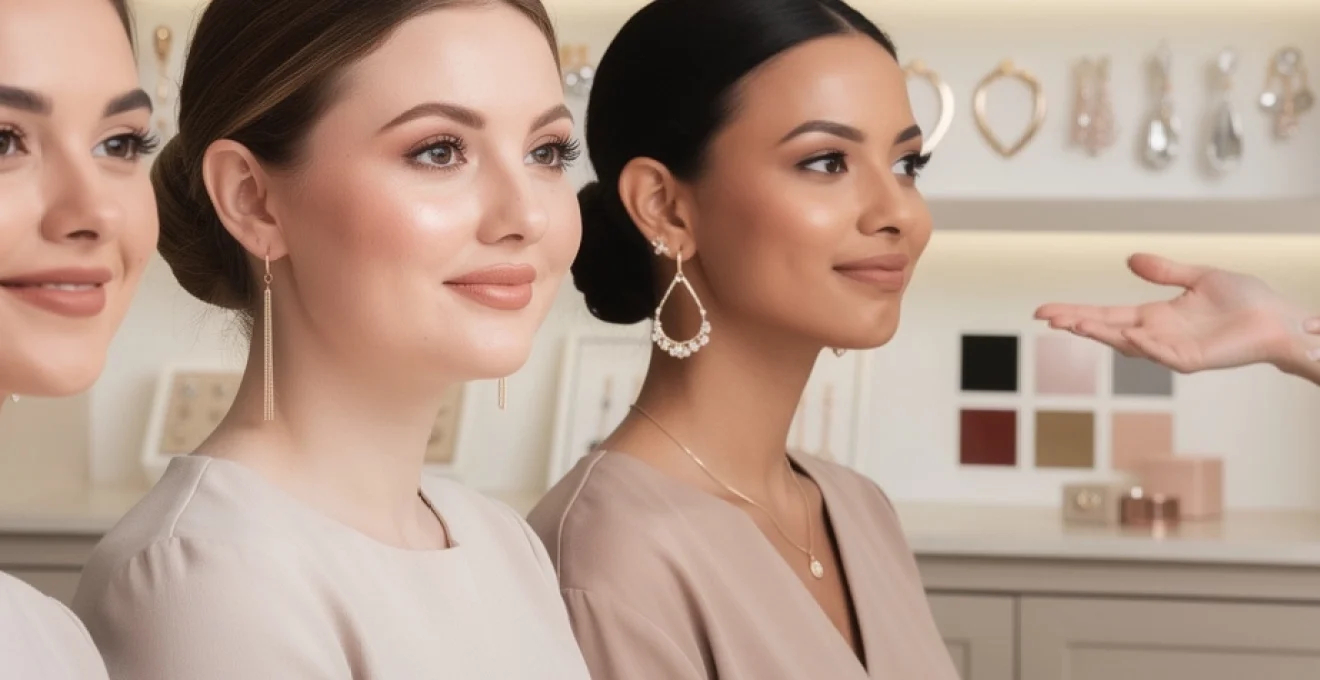
The relationship between facial geometry and jewellery selection represents one of the most sophisticated aspects of personal styling. When you understand how different earring designs interact with your unique facial proportions, you unlock the ability to enhance your natural features whilst creating visual harmony. This knowledge transcends simple fashion trends, establishing a foundation for making confident accessory choices that consistently flatter your appearance.
Professional stylists have long recognised that the science behind earring selection involves careful consideration of facial measurements, angular relationships, and proportional balance. Your face shape serves as the blueprint for determining which earring silhouettes will create the most aesthetically pleasing results. This approach ensures that your jewellery choices work in harmony with your natural bone structure rather than competing against it.
Face shape analysis and geometric classification systems
Understanding facial geometry requires a systematic approach to measurement and analysis. The classification of face shapes follows established principles used by professional makeup artists and stylists worldwide. These geometric categories provide the foundation for making informed earring selections based on mathematical proportions rather than guesswork.
Modern face shape analysis considers multiple factors including forehead width, cheekbone prominence, jawline definition, and overall facial length. These measurements work together to create distinct geometric patterns that respond differently to various earring styles. The key lies in recognising how different shapes can either complement or contrast with your natural facial architecture.
Oval face shape measurements and proportional ratios
The oval face shape represents the mathematical ideal in facial geometry, characterised by a length-to-width ratio of approximately 1.5:1. This proportion creates natural balance that allows for the greatest versatility in earring selection. Oval faces typically feature gently curved jawlines, balanced cheekbones, and a forehead that measures slightly wider than the chin area.
When measuring an oval face, the widest point occurs at the cheekbones, with gradual tapering towards both the hairline and jawline. This creates a harmonious silhouette that can accommodate various earring styles without overwhelming the natural proportions. The key advantage of oval face shapes lies in their inherent balance, which means most earring designs will enhance rather than detract from the overall appearance.
Round face shape characteristics and angular deficiency assessment
Round faces demonstrate a width-to-length ratio approaching 1:1, creating a circular or softly curved appearance. The cheeks typically represent the widest facial area, with minimal definition between the forehead, cheekbone, and jawline measurements. This creates a youthful, approachable appearance that benefits from earring styles that introduce angular elements or vertical lines.
The primary consideration for round faces involves creating the illusion of length and definition. Since round faces naturally lack sharp angles, earring choices should focus on introducing structure and elongating the overall silhouette. This doesn’t mean avoiding all curved designs, but rather selecting pieces that add dimension and visual interest without emphasising the face’s existing roundness.
Square face shape jawline definition and temporal width analysis
Square faces exhibit strong, defined jawlines with forehead, cheekbone, and jaw measurements that remain relatively consistent. The angular nature of this face shape creates a powerful, confident appearance characterised by straight lines and sharp transitions. The temporal region often appears broad, contributing to the overall geometric structure that defines this facial category.
Professional analysis of square faces focuses on the relationship between jaw width and forehead breadth. These faces benefit from earring styles that introduce curved elements to soften the natural angularity. The goal involves creating visual balance rather than competing with the face’s inherent strength and definition.
Heart-shaped face structure and Forehead-to-Chin ratio calculations
Heart-shaped faces demonstrate a distinctive tapering from a broader forehead to a narrower chin, creating an inverted triangle effect. The forehead typically measures as the widest facial area, with prominent cheekbones that gradually narrow towards a pointed or delicate chin. This creates an elegant, refined appearance that requires specific earring considerations to maintain proportional balance.
The mathematical relationship in heart-shaped faces shows a significant differential between upper and lower facial measurements. This proportional variance means earring selection should focus on adding visual weight to the lower facial area whilst avoiding styles that emphasise the already prominent forehead region
This is why heart-shaped faces respond especially well to earring silhouettes that widen toward the bottom of the design, visually rebalancing the relationship between forehead width and chin delicacy. When selected with precision, the right earrings can almost act as a subtle architectural counterweight, drawing the gaze downwards and creating a smoother transition along the vertical axis of the face.
Diamond face shape cheekbone prominence and temple narrowness evaluation
Diamond face shapes are defined by high, prominent cheekbones combined with a narrower forehead and chin. When measured, the cheekbone width exceeds both the temporal (temple) width and jaw width, creating a distinctive faceted appearance. The face length often exceeds its width, but the key diagnostic element remains the concentration of width at the mid-face region.
From a geometric perspective, this creates strong diagonal lines from the temples to the jaw, which can appear particularly striking in profile. Professional analysis focuses on how earrings can soften these diagonals and distribute visual weight more evenly. Designs that introduce gentle curves or subtle horizontal emphasis help to moderate temple narrowness and reduce the impression of excess width at the cheekbones, resulting in a more cohesive overall silhouette.
Earring silhouette mechanics and visual weight distribution
The way an earring hangs, moves, and occupies space relative to your face is just as important as the face shape itself. Stylists often think in terms of visual weight distribution – how the mass, length, and width of an earring affect the perceived proportions of your facial structure. Much like an interior designer balances furniture in a room, we use earring silhouettes to balance height, width, and angles around the face.
Different earring categories – drops, chandeliers, studs, and hoops – each interact with facial geometry in specific ways. Their length, width, and placement along the earlobe can either reinforce existing proportions or strategically counterbalance them. When you understand these mechanics, you can choose earrings not just because they are beautiful, but because they perform a precise visual function for your unique face.
Drop earring length calculations for facial elongation effects
Drop earrings are one of the most effective tools for modifying perceived facial length. As a general guideline, stylists often work with a simple ratio: for subtle elongation, drop length should be around one-third of your visible face length (measured from hairline to chin); for more dramatic elongation, up to one-half can be used. On an average face length of 18–20 cm, this typically translates to a drop length of 5–9 cm.
For round faces or faces with softer contours, long, slender drop earrings create a vertical visual line that draws the eye downward, making the face appear more elongated and refined. On already long or rectangular faces, however, excessive drop length can overemphasise verticality and make the face appear even narrower. In these cases, shorter drops that end around the midpoint of the neck or just below the jawline tend to deliver a more harmonious effect.
Chandelier earring width-to-face ratio optimisation
Chandelier earrings combine length with significant lateral spread, which means their width-to-face ratio must be considered carefully. A useful working rule is to keep the widest part of the chandelier at or below 40–50% of your cheekbone width. This ensures the earrings add presence without visually overwhelming your facial proportions. For most adults, this translates to a maximum chandelier width of approximately 2–3.5 cm.
On heart-shaped or inverted triangle faces, chandeliers that flare towards the bottom can be especially effective, as they place visual weight near the jawline where the face is narrower. Conversely, for very round or short faces, overly wide chandeliers risk compressing the vertical space and making the face appear shorter and broader. In that scenario, more streamlined chandeliers – with graceful vertical lines and moderate lateral expansion – maintain elegance without compromising proportional balance.
Stud earring diameter selection based on earlobe proportions
Because studs sit close to the face, their relative size to the earlobe is crucial. As a guideline, many stylists recommend that the visible diameter of a round stud should not exceed 60–70% of the width of the earlobe at its widest point for everyday wear. If your earlobe measures around 8 mm across, that places the ideal stud size in the 4–6 mm range for balanced, proportional styling.
Larger studs can certainly be worn for statement looks, but they tend to project forward rather than elongating or reshaping the facial outline. On smaller or more delicate features, an oversized stud can dominate the upper part of the face and shorten the perceived distance between cheekbone and jaw. If your goal is subtle enhancement rather than bold emphasis, staying within the recommended diameter range will ensure your stud earrings appear intentional and refined rather than disproportionate.
Hoop earring circumference and jawline interaction dynamics
Hoop earrings create a circular or oval frame that interacts directly with your jawline and cheekbones. Their impact is determined by three main factors: overall diameter, thickness of the hoop, and whether the hoop shape is circular or elongated. As a rule of thumb, small hoops (up to 20 mm) act similarly to studs, while medium hoops (20–40 mm) interact strongly with the jawline, and large hoops (40 mm and above) begin to influence the entire lower half of the face.
On square or angular faces, medium to large round hoops can introduce much-needed curvature, visually softening a pronounced jaw. For round faces, slightly elongated oval hoops tend to be more flattering than perfectly circular ones, as the vertical axis helps counteract width. You can think of hoop selection as choosing the right “halo” around your lower face: the more your hoop shape contrasts with your natural outline, the more it can correct or refine your perceived facial geometry.
Metal tones and skin undertone compatibility matrix
Once you understand which earring shapes complement your face, the next refinement involves pairing metal tones with your skin undertone. This step is often overlooked, yet it can significantly influence how luminous and rested your complexion appears. The goal is to create a subtle colour harmony between skin and metal, much like choosing the right lighting temperature in a room to flatter its interior.
Professionals broadly classify skin undertones into three categories: warm (yellow, golden, or peach), cool (pink, red, or blue), and neutral (a balanced mix of both). As a general guideline, yellow gold, rose gold, and bronze harmonise beautifully with warm undertones, while white gold, platinum, and sterling silver typically flatter cool undertones. Neutral undertones enjoy the broadest flexibility and can alternate between warm and cool metals depending on outfit and desired effect.
If you are unsure of your undertone, observe how your skin reacts to different metals you already own. Do you look more awake in silver or in gold? Another practical test involves vein colour at the wrist: greener veins often indicate warm undertones, bluer veins point to cool, and a mix suggests neutrality. Once you identify your undertone, combining the right metal tone with the most flattering earring shape creates a compound effect: your face shape appears balanced while your complexion gains radiance.
Professional earring styling techniques for angular correction
Professional stylists rarely think in terms of “perfect” or “imperfect” faces; instead, we focus on angular correction – the art of subtly adjusting perceived lines and proportions through accessories. Earrings are especially powerful here because they sit close to key structural points: the jawline, cheekbones, and neck. When used strategically, they can soften strong lines, add definition where it is lacking, or shift visual emphasis to your favourite features.
For faces with very pronounced angles – such as square or diamond shapes – curved earrings like round hoops, fluid drops, or organic, irregular silhouettes help diffuse hardness. If your features are softer and you feel your face lacks structure, geometric earrings with clear lines and defined edges can introduce welcome architectural interest. Ask yourself: do you want your earrings to echo your natural structure, or to counterbalance it? Often, using contrast rather than imitation yields the most sophisticated, face-flattering results.
Celebrity case studies and face shape earring exemplars
Observing how celebrities and their stylists use earrings to complement face shapes can be a practical masterclass in real time. Red carpet events, press tours, and editorial shoots provide countless examples of how different silhouettes and metal tones interact with a variety of facial geometries. While you may not share their wardrobe, you can certainly apply the same principles to your own jewellery box.
In the following case studies, we will examine how well-known personalities with distinct face shapes use earrings as precision tools. Pay attention not only to the designs themselves, but also to their length, width, and interaction with hairstyles and necklines. This analytical approach will help you translate high-profile styling strategies into everyday, wearable choices that work for you.
Angelina jolie’s square face shape and statement earring strategies
Angelina Jolie is a classic example of a square face shape, with a defined jawline and balanced width across the forehead, cheeks, and jaw. Her stylists frequently leverage earrings to soften this architecture rather than compete with it. You will often see her in elongated drop earrings with fluid lines or gentle tapers that create vertical emphasis while introducing curvature around the jaw area.
When she wears statement earrings on the red carpet, they typically feature rounded or teardrop elements rather than sharp geometric angles. This choice prevents her strong bone structure from appearing overly severe under harsh lighting and high-definition cameras. For readers with similar square face geometry, Jolie’s approach illustrates how powerful long, curved drops and substantial but rounded designs can be in balancing a pronounced jaw and broad forehead.
Scarlett johansson’s round face oval drop earring applications
Scarlett Johansson often displays characteristics of a round face: full cheeks, a softly curved jawline, and a width-to-length ratio approaching 1:1. To create a more elongated, sculpted effect, her stylists regularly select earrings that draw the eye downward and introduce subtle angularity. Oval drop earrings, slim linear designs, and geometric dangles are frequent choices in her red carpet appearances.
These elongated silhouettes counteract facial width by establishing a strong vertical line alongside the cheeks. Additionally, she often avoids very wide hoops or large circular studs for major events, as these would echo the natural roundness of her face. If you share similar proportions, studying Johansson’s preference for oval drops and refined lines can help you identify which “earring for round face shape” strategies might work best in your own collection.
Keira knightley’s angular features and geometric earring balancing
Keira Knightley’s facial structure is notably angular, with sharp cheekbones and a jawline that can read as square or rectangular depending on hairstyle and makeup. One might assume that she should always opt for soft, curved earrings to compensate, yet her styling is more nuanced. She frequently wears geometric earrings – squares, bars, and faceted shapes – but ensures that they remain delicate in scale and often pairs them with softer hairstyles.
This combination demonstrates an advanced principle: angular faces can indeed wear angular earrings, provided the designs are proportionally light and do not mirror the exact scale of the jawline. By choosing fine, minimalist geometric pieces, Knightley maintains her modern, architectural aesthetic while avoiding visual heaviness. For those with similarly strong features who enjoy contemporary jewellery, her approach shows that you do not need to abandon geometrics; you simply need to moderate size and thickness.
Blake lively’s oval face shape and versatile earring adaptability
Blake Lively exemplifies the oval face shape, with balanced proportions and a gently tapered jawline. This geometry allows her an exceptional degree of freedom in earring selection, and her red carpet history showcases nearly every silhouette: dramatic chandeliers, oversized hoops, classic studs, and sculptural drops. Because her face shape is naturally harmonious, her stylists focus more on matching earrings to outfit, neckline, and overall mood than on strict corrective strategies.
That said, you may notice that ultra-long, extremely heavy earrings are used selectively, often balanced with voluminous hair or higher necklines to avoid over-elongating the face. For readers with oval faces, Lively’s styling is an encouraging reminder that you can experiment widely – from minimalist gold hoops to bold gemstone chandeliers – while using nuances like drop length and metal tone to fine-tune your look for each occasion.
Common earring selection pitfalls and corrective methodologies
Even with a solid understanding of face shapes and earring mechanics, certain recurring mistakes can prevent your jewellery from reaching its full flattering potential. One frequent pitfall is choosing earrings solely based on trend, without considering how their silhouette interacts with your unique facial geometry. Another is ignoring scale: earrings that are too small can vanish on a strong bone structure, while overly large designs may overpower more delicate features.
So how do you correct these issues in practice? A useful method is to perform a quick three-step check whenever you try on a new pair: first, assess balance (do the earrings complement or distort your natural proportions?); second, evaluate focus (do they draw attention to features you love, such as eyes or cheekbones?); third, check comfort and practicality (can you wear them for several hours without distraction?). If any of these steps raise a concern, a slight adjustment in length, width, or design can typically resolve it.
Another common misconception is that you must follow “earring rules for face shapes” rigidly. In reality, these guidelines are better understood as a toolkit rather than a rulebook. If you adore a style that is technically not optimal for your face shape, you can often adapt your overall styling to compensate – for example, by adjusting your hairstyle, neckline, or makeup emphasis. Ultimately, the most successful earring choices are those that combine geometric awareness with personal expression, allowing you to feel both proportionally balanced and authentically yourself.