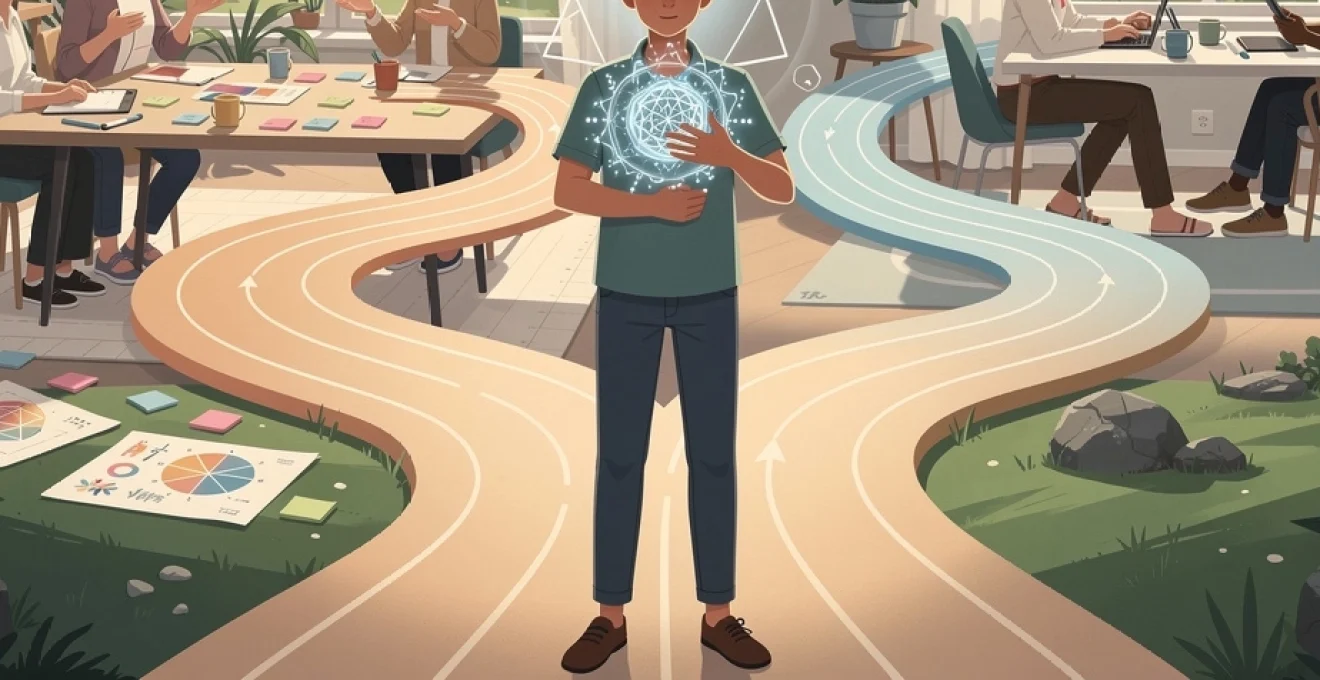
Living authentically has become increasingly challenging in today’s hyper-connected world, where external expectations and social media pressures often overshadow our genuine desires and values. Yet, the pursuit of an authentic lifestyle remains one of the most rewarding journeys you can embark upon. When your daily choices align with your core identity, you experience a profound sense of fulfilment that transcends material success or social approval.
The process of building an authentic lifestyle requires deliberate introspection, strategic planning, and consistent action across multiple dimensions of your existence. From the spaces you inhabit to the career paths you pursue, every element of your life can either support or undermine your authentic self-expression. Understanding the methodologies and frameworks available to guide this transformation is essential for creating lasting, meaningful change.
Authentic Self-Discovery through Values-Based assessment methodologies
The foundation of authentic living begins with comprehensive self-awareness, achieved through scientifically-validated assessment tools that reveal your core values, strengths, and behavioural patterns. These methodologies provide objective insights that cut through the noise of external influences and societal expectations, offering a clear roadmap for aligning your lifestyle with your authentic identity.
Implementing the schwartz values survey for personal alignment
The Schwartz Values Survey represents one of the most robust frameworks for identifying your fundamental motivations and priorities. Developed through extensive cross-cultural research, this assessment reveals ten universal values that drive human behaviour: power, achievement, hedonism, stimulation, self-direction, universalism, benevolence, tradition, conformity, and security. Understanding where you fall on these dimensions provides crucial insights into lifestyle choices that will feel genuinely satisfying.
When you complete this assessment, pay particular attention to values conflicts that may be creating internal tension in your current lifestyle. For instance, if you score highly on both achievement and benevolence, you might find fulfilment in careers that combine personal success with positive social impact. These insights become invaluable when making major life decisions about career changes, relationship choices, or living situations.
Utilising the VIA character strengths survey for core identity mapping
Complementing values assessment, the VIA Character Strengths Survey identifies your top character strengths from a scientifically-validated list of 24 qualities such as creativity, perseverance, gratitude, and leadership. These strengths represent the essence of who you are at your best, providing a psychological foundation for building an authentic lifestyle. Research indicates that people who regularly use their top strengths report higher levels of life satisfaction and engagement.
Your signature strengths should inform not only career choices but also how you structure your daily routines and recreational activities. If creativity ranks among your top strengths, incorporating regular creative pursuits into your lifestyle becomes essential for authentic living. Similarly, if social intelligence is a core strength, prioritising meaningful relationships and collaborative activities will enhance your sense of authenticity and fulfilment.
Applying enneagram personality typing for behavioural pattern recognition
The Enneagram system offers profound insights into unconscious behavioural patterns and motivations that drive your actions. Unlike other personality frameworks, the Enneagram focuses on the why behind behaviour rather than just observable traits. This depth makes it particularly valuable for identifying areas where your current lifestyle might be driven by fear, habit, or external expectations rather than authentic choice.
Each Enneagram type has specific growth paths and blind spots that affect lifestyle design. Type Three personalities, for example, may need to resist the temptation to build lifestyles focused purely on external image and achievement, instead cultivating space for genuine self-reflection and authentic relationships. Understanding your type’s patterns enables you to make conscious choices that support growth rather than reinforcing limiting behaviours.
Conducting life design thinking workshops using stanford’s framework
Stanford’s Life Design methodology applies design thinking principles to personal lifestyle creation, emphasising experimentation, iteration, and prototype thinking. This approach recognises that building an authentic lifestyle is an ongoing process rather than a single decision. The framework encourages you to approach life changes with curiosity and experimentation rather than pressure to make perfect choices immediately.
The process involves five key phases: empathising with yourself to understand your genuine needs and desires, defining the problems or gaps in your current lifestyle,
ideating multiple possible lifestyle prototypes, building and testing small experiments, and then iterating based on what you learn. Instead of asking, “What should I do with my life?” you generate several versions of a life that could fit you and then run low-risk tests: a short course, a side project, a temporary schedule change, or a trial move. This reduces the fear of getting it wrong, because you treat your lifestyle like a series of prototypes rather than a fixed, irreversible decision.
To apply this framework, schedule your own mini life design workshop. Start by mapping your current week and highlighting activities that energise or drain you. Then create three alternate “life dashboards” that change variables such as location, working hours, or main professional focus. For each prototype, define one simple experiment you can run in the next 30 days. Over time, these structured experiments help you build a lifestyle that reflects who you really are, grounded in data from your own lived experience rather than abstract fantasies.
Environmental architecture for authentic living expression
Your physical environment subtly shapes your behaviour, mood, and self-perception every single day. If your home and workspace are misaligned with your values and identity, living authentically becomes an uphill battle. By contrast, when your surroundings are intentionally designed to support your true priorities, you are nudged toward choices that feel natural and congruent. Environmental architecture for authentic living is about translating inner clarity into outer form.
The goal is not to create a magazine-perfect space, but a values-aligned environment that supports the lifestyle you actually want to live. This means considering how light, colour, materials, and spatial organisation influence your habits and emotional state. By integrating principles from biophilic design, colour psychology, minimalism, and sustainable design, you construct a living environment that acts like a silent partner in your personal growth. Every room becomes a reminder of who you are and what matters most.
Biophilic design principles in personal space curation
Biophilic design is the practice of incorporating elements of nature into built environments to support wellbeing, focus, and emotional balance. Research published in 2023 suggests that even small increases in natural elements, such as plants or natural light, can boost mood and productivity by up to 15–20%. When you design a lifestyle that reflects who you really are, embracing biophilic principles helps you stay grounded and connected, especially if you spend many hours indoors or on screens.
To curate biophilic personal spaces, prioritise natural light, indoor plants, and organic textures like wood, stone, and natural fibres. Ask yourself: if your living space were a landscape that expressed your inner self, what would it look and feel like? Consider views from your main work or rest areas—can you see something alive, like a plant, a tree, or even a sky view? Think of biophilic design as giving your nervous system a “home base” in nature, even when you are physically inside.
Colour psychology implementation through benjamin moore’s wellbeing collection
Colour is one of the most immediate ways to influence how a space feels and how you feel within it. Studies in colour psychology show that certain hues can calm the nervous system, while others subtly cue alertness or creativity. This is where curated palettes like Benjamin Moore’s Wellbeing Collection become practical tools for authentic living, allowing you to match colour choices with your emotional and lifestyle intentions.
When implementing colour psychology, begin by mapping zones in your home to specific functions and emotional states. For restful, introspective spaces—like bedrooms or meditation corners—soft blues, muted greens, and warm neutrals typically support relaxation and reflection. For creative work or collaborative areas, more saturated but still soothing tones can stimulate engagement without overwhelming your senses. Treat each wall and surface as an opportunity to reinforce the kind of person you are becoming: calm, focused, expressive, or grounded.
Minimalist spatial planning using marie kondo’s KonMari methodology
Minimalism is not about owning as little as possible; it is about ensuring that what you own actively supports the life you want. Marie Kondo’s KonMari methodology offers a structured, emotionally intelligent approach to minimalist spatial planning. By evaluating each item through the lens of “Does this spark joy?” you move beyond pure utility and connect with deeper values like meaning, identity, and intentionality. This is a powerful filter for building a lifestyle that reflects who you really are rather than who you used to be.
When applied to spatial planning, KonMari encourages you to organise by category rather than by room—clothes, books, papers, miscellaneous, and sentimental items. As you work through each category, pay attention to patterns: which objects feel like current expressions of your authentic self, and which belong to older versions of you or external expectations? The result is not just a tidier space, but a living environment where every visible item reinforces your chosen identity and frees up mental bandwidth for what truly matters.
Sustainable material selection for Values-Aligned home design
If sustainability and ethical responsibility are among your core values, your choice of materials becomes a direct extension of your authentic lifestyle. Sustainable material selection involves considering the lifecycle of products, their environmental impact, and the social conditions under which they were produced. Global surveys indicate that more than 60% of consumers now prefer brands with visible sustainability commitments, reflecting a broader shift toward values-driven consumption.
In practice, this can mean choosing furniture made from certified sustainable wood, opting for low-VOC paints, selecting textiles made from organic or recycled fibres, and supporting local artisans over mass-produced imports when possible. Think of each purchase as a micro-vote for the kind of world you want to help create. When your home is filled with materials that align with your ethics, you experience less cognitive dissonance and more coherence between what you say you value and how you actually live.
Career trajectory realignment with ikigai framework integration
Your work is one of the most visible and time-consuming expressions of your lifestyle. If your career trajectory contradicts your core values and identity, no amount of weekend optimisation can fully compensate. The Japanese concept of Ikigai—often visualised as the intersecting space between what you love, what you are good at, what the world needs, and what you can be paid for—offers a sophisticated lens for career realignment. Integrating the Ikigai framework helps you move beyond simplistic “follow your passion” advice toward a more holistic, sustainable vision of work.
Aligning your career with Ikigai is not necessarily about a dramatic, overnight pivot. Instead, it often involves incremental adjustments: developing skills, testing new roles, reshaping job responsibilities, or building side ventures that better fit your authentic self. By systematically exploring each quadrant of the Ikigai model, you can identify where current misalignments lie and design a career trajectory that feels both meaningful and economically viable. This becomes a core pillar in building a lifestyle that reflects who you really are, not just what your CV says.
Skills-based competency mapping using LinkedIn learning analytics
To understand how your current abilities support—or limit—your Ikigai-aligned career options, a skills-based competency map is invaluable. Platforms like LinkedIn Learning and LinkedIn’s Skills Insights provide data-driven overviews of in-demand skills across industries, as well as personalised analytics on what you have already mastered. Think of this as creating an honest inventory of your professional toolkit, measured against the roles and projects that genuinely excite you.
Begin by listing roles or career paths that intersect with your values and interests, then examine the skills most commonly associated with those paths using LinkedIn’s job and learning analytics. Next, compare this list with your existing skills profile to identify gaps and overlaps. Where are you already strong? Where will targeted learning give you the highest leverage for an authentic career shift? With this clarity, you can design a focused learning plan—through online courses, mentorships, or stretch projects—that moves you steadily closer to work that feels like a natural extension of who you are.
Purpose-driven career pivoting through design thinking protocols
Career change can feel risky, especially if you have invested years in a particular field or identity. Applying design thinking protocols—empathise, define, ideate, prototype, and test—turns a daunting pivot into a series of manageable experiments. Instead of betting everything on a single big move, you run small, purpose-driven tests that reveal whether a new direction genuinely aligns with your values, strengths, and desired lifestyle.
For example, if you feel called toward social impact work but come from a corporate background, you might start by volunteering, freelancing for a nonprofit, or joining a cross-functional project related to sustainability or social responsibility. These are your “career prototypes.” You gather feedback from each experiment: Do you feel energised or drained? Do your strengths find natural outlets? This iterative, evidence-based process allows you to refine your direction and build confidence before committing to larger structural changes such as retraining or relocation.
Portfolio career development using tim ferriss’s 4-hour framework
The traditional model of a single, linear career is increasingly being replaced by portfolio careers—combinations of roles, income streams, and projects that together form a coherent professional identity. Tim Ferriss’s 4-Hour framework popularised ideas such as lifestyle design, automation, and mini-retirements, which can be adapted to construct a diversified, values-driven work life. A portfolio career can be especially aligned with authenticity if you have multiple interests or resist being defined by a single professional label.
To build such a portfolio, start by identifying one primary income source that provides stability, then explore 1–2 secondary projects that express other facets of your identity: teaching, consulting, creative production, or impact-driven initiatives. Apply Ferriss’s principles by asking where you can automate, delegate, or streamline tasks to free time for higher-value, more authentic work. Over time, you can rebalance the portfolio, increasing the share of work that feels most aligned and reducing or reshaping elements that feel purely transactional.
Remote work infrastructure for Location-Independent lifestyle design
The rise of remote and hybrid work models has dramatically expanded what is possible in terms of lifestyle design. A location-independent or semi-location-independent setup allows you to align your daily rhythms with your natural energy cycles, preferred environments, and personal commitments. However, this freedom only supports authenticity if it is backed by robust infrastructure: reliable technology, clear boundaries, and intentional routines.
When designing a remote work lifestyle, consider three layers: technical, spatial, and temporal. Technically, invest in dependable equipment and connectivity so your professional identity is not compromised by avoidable friction. Spatially, create distinct zones for focused work, rest, and recreation, even if you are working from a small apartment or shared space. Temporally, experiment with time-blocking, asynchronous collaboration, and energy-based scheduling so that your workday genuinely fits how you function best. The more deliberately you architect these elements, the more your work life will feel like an authentic extension of who you are rather than a digital replica of an outdated office model.
Social circle curation through relationship audit techniques
The people you surround yourself with influence your beliefs, habits, and sense of possibility, often more than you realise. If your social circle consistently rewards conformity or inauthentic behaviour, you will find it difficult to sustain a lifestyle that reflects your true self. Social circle curation is not about coldly “networking up” or cutting people out for convenience; it is about conducting an honest relationship audit to understand which connections support your growth and which pull you away from it.
Begin by quietly mapping key relationships in your life—friends, colleagues, mentors, and communities. For each, reflect on questions such as: Do I feel more myself or less myself after spending time with this person? Do they respect my boundaries and values? Do we share a mutual commitment to growth, or are we bonded mainly by shared complaints or old habits? This form of relational inventory can be confronting, but it offers clarity about where to invest more energy, where to renegotiate boundaries, and where to gently create distance.
Once you have this clarity, you can intentionally seek out environments and communities more aligned with your authentic identity: professional groups, interest-based clubs, learning cohorts, or value-driven online communities. Think of this as redesigning your “social architecture” so that encouragement, honest feedback, and inspiration are the norm rather than the exception. Over time, a curated social circle becomes both a mirror and a scaffold, reflecting who you really are and supporting who you are becoming.
Financial architecture for Value-Driven resource allocation
Money is one of the most concrete expressions of your priorities. You can articulate values like freedom, generosity, or creativity, but your bank statements often reveal what you truly prioritise in daily life. Financial architecture for value-driven living involves designing budgeting, saving, and investing systems that channel resources toward what matters most, while reducing spending that props up inauthentic identities or social comparisons.
A practical starting point is to categorise your expenses into three broad buckets: essential needs, authentic joy, and autopilot consumption. Essential needs cover the basics of safety and stability. Authentic joy expenses directly support your core values—education, meaningful travel, creative tools, or experiences with loved ones. Autopilot consumption includes purchases made from habit, stress, or status-seeking rather than genuine desire. As you review your spending through this lens, patterns quickly emerge: where are you underfunding what truly nourishes you, and where are you overspending on things that leave you feeling empty?
From here, you can construct a values-based budget that deliberately reallocates resources. This might mean downsizing housing to fund a sabbatical, reducing impulse shopping to pay for coaching or therapy, or prioritising savings for location flexibility over luxury items. Consider setting up automatic transfers aligned with these priorities so that your financial system quietly enforces your authentic choices. Over time, this architecture reduces money-related stress and builds a sense of integrity between your stated values and your actual financial behaviour.
Habit formation systems using james clear’s atomic habits methodology
Authentic living is not a single decision; it is the cumulative effect of countless small actions repeated over time. James Clear’s Atomic Habits methodology is especially useful here because it focuses on identity-based habits—starting with who you want to be rather than what you want to achieve. Instead of saying, “I want to get fit,” you say, “I am the kind of person who takes care of my body.” This shift aligns perfectly with the goal of building a lifestyle that reflects who you really are.
Clear’s four-step model—cue, craving, response, reward—provides a practical blueprint for designing or dismantling habits. To build authentic habits, you make desired behaviours obvious, attractive, easy, and satisfying. For instance, if you see yourself as a reflective, growth-oriented person, you might place a journal on your pillow each morning so it cues evening reflection, pair journaling with a favourite tea, limit the practice to just five minutes to reduce friction, and track your streak to create a sense of progress. These small design choices turn abstract identity into concrete daily action.
Equally important is using the environment and systems to break habits that conflict with your authentic self. If you value presence and deep work but find yourself compulsively scrolling social media, you can remove apps from your phone, use website blockers, or create phone-free time blocks to disrupt the cue-response loop. Think of each habit as a vote for the person you wish to become. Over months and years, these votes accumulate, reshaping not only your routines but your self-concept. In this way, habit systems become the engine that sustains the authentic lifestyle you have carefully designed across every area of your life.